Anergy networks, sized and compared on cost and carbon.
Anergy networks, cold district heating and 5th-generation (5GDHC) loops live or die on the source choice, the network temperature and how heating and cooling share the same pipes. Sympheny puts all three in one optimisation, so the concept you take to a funder is the one the numbers support.
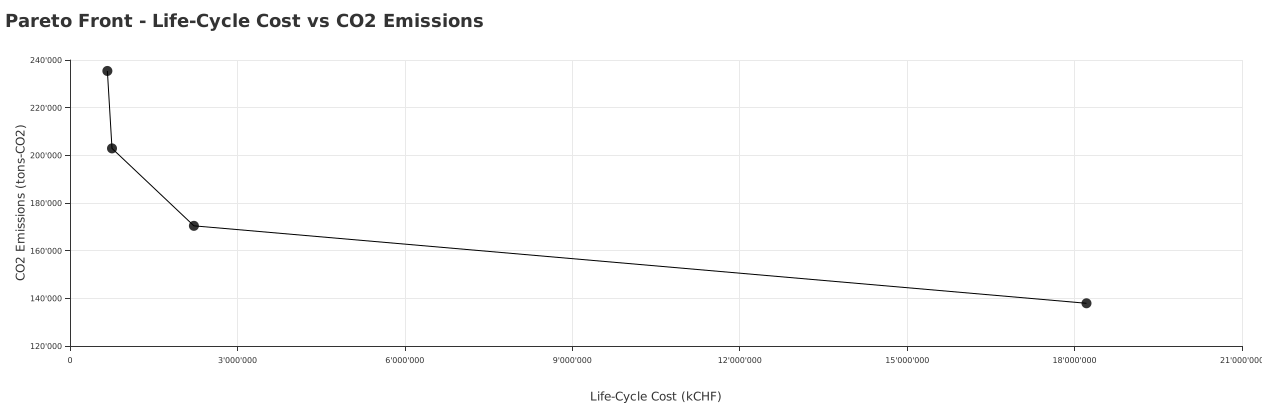
Every optimised anergy-network combination plotted on cost against carbon, from a single project.
Why ambient-source networks are hard to plan well.
The source decides everything, and it is local
Groundwater, river or lake water, wastewater, waste heat, boreholes. The available sources, their seasonal limits and their temperatures are site-specific, and they set the ceiling on what an anergy network can deliver. Get the source assessment wrong and the rest of the concept rests on sand.
Heating and cooling have to be planned together
A 5GDHC loop runs near ground temperature, so the same network can heat and cool at once and recover heat between buildings. That is the whole point, and it is also what makes the balance hard to size by hand: demand profiles, simultaneity and storage all interact across a full year.
Spreadsheets cannot hold the trade-offs
Network temperature, source mix, decentralised heat pumps and seasonal storage trade against each other on both cost and carbon. Testing a handful of combinations by hand misses the design that wins, and funders increasingly want to see the comparison, not just the conclusion.
Proven on ambient and low-temperature networks.
A low-temperature thermal network supplied by river and groundwater, sized across six energy hubs and stress-tested against more than 30 future price and demand scenarios for the Insel-Holligen district.
Read case study26 buildings modelled as one multi-temperature system, with low-temperature sources feeding heat pumps and seasonal borehole storage validated for the campus's 2030 climate-neutral concept.
Read case studyA city-wide supply strategy showing a CO₂-free system is reachable at similar life-cycle cost to the existing fossil-based one, with renewable sources in the mix.
Read case study“In the Uster city centre I compared three networking options: no network, an anergy network, and one with additional electricity trading. The result was clear — maximum thermal and electrical networking is the best solution, economically and ecologically. I couldn't have run a variant comparison at this depth without Sympheny.”
Sources, network and architecture in one optimisation.
Sympheny models the ambient loop, the heat sources and the building-level technologies as one multi-energy system, then optimises the whole thing at hourly resolution. The comparison is consistent because it comes out of a single model, not three separate studies stitched together.
The network is part of the model, not an assumption.
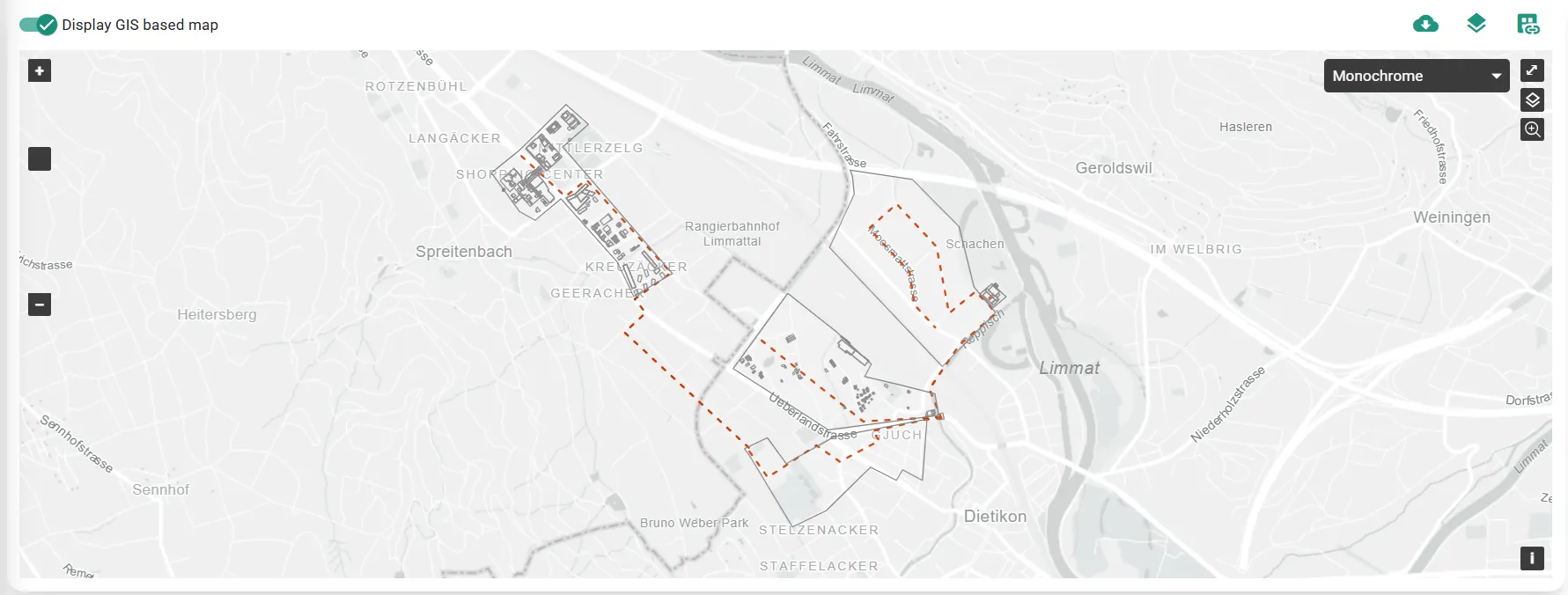
Define hubs (buildings, zones or substations) and draw the ambient loop between them on a real GIS map, with heat loss and cost per metre. Because the loop runs near ground temperature, the model captures the low losses that make 5GDHC attractive, and the routing cost feeds straight into the technology comparison.
- Ambient, low-temperature and conventional network types modelled between the same hubs
- Network length and routing cost measured directly from the GIS map
- Bidirectional heat exchange between buildings represented in the energy balance
Every ambient source, evaluated as a candidate.
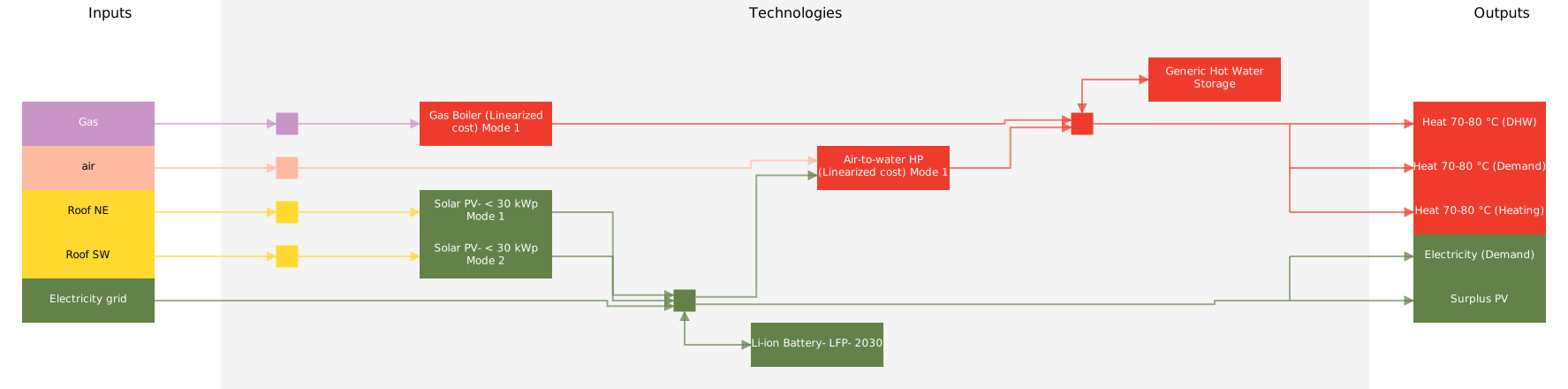
Groundwater, river and lake water, wastewater, data-centre and industrial waste heat, and borehole fields all enter the same optimisation as candidate sources, each with its seasonal availability and temperature. Decentralised heat pumps lift the loop to delivery temperature, modelled with seasonal COP profiles so winter performance is real, not a single annual figure.
- Groundwater, surface water, wastewater, waste heat and boreholes as candidate sources
- Seasonal resource limits respected, so the optimisation stays physically honest
- Decentralised heat-pump COP profiles, month by month
Ambient loop, low-temp or conventional. Let the optimisation decide.
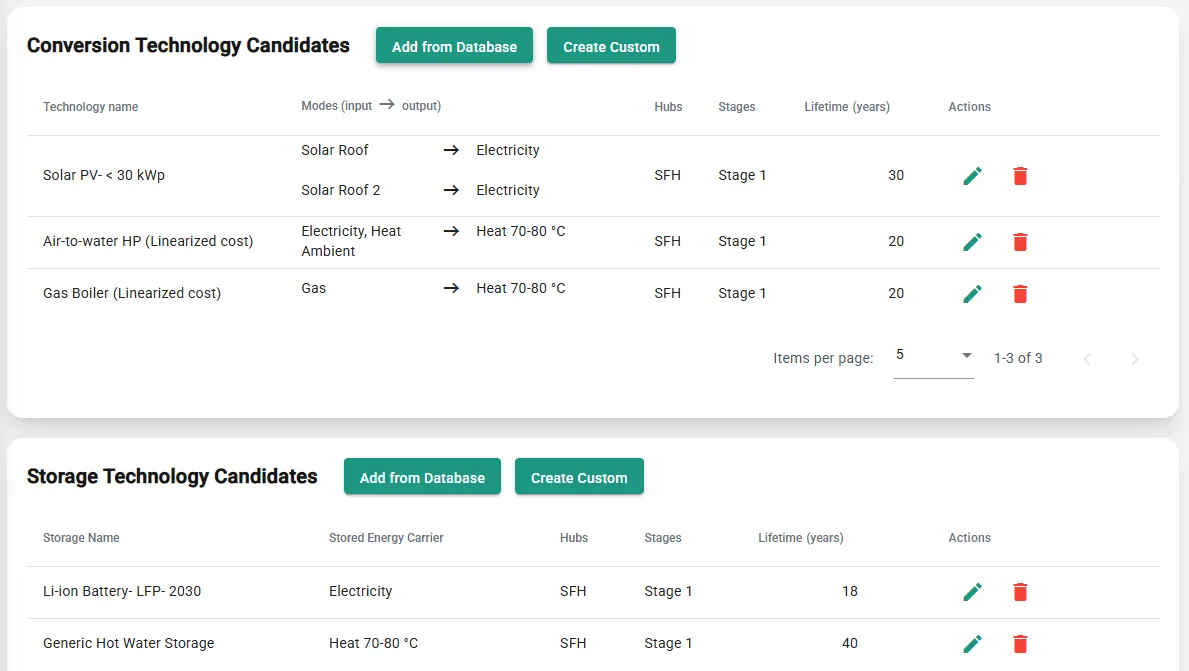
Instead of fixing the network temperature before modelling starts, define the options as candidates between the same hubs. The optimiser weighs an ambient 5GDHC loop against a low-temperature or conventional network on cost and carbon together with the source mix and storage. You get the answer, with the trade-off shown, rather than another assumption to defend.
- Ambient (5GDHC), low-temperature and conventional architectures in the same project
- Seasonal and short-term storage, including boreholes, sized by the optimiser
- Heating and cooling resolved together across a full reference year
Pareto cost and carbon comparisons stakeholders can read.
Every combination the optimiser evaluates lands on a Pareto front: life-cycle cost against CO₂. The cheapest scheme, the lowest-carbon scheme and the trade-offs between them, all from one project. Load-duration curves, Sankey flows and hourly profiles sit alongside it, and the underlying data exports to Excel for the business case.
- Pareto front across every optimised anergy-network scenario
- Hourly resolution across a full reference year, heating and cooling
- Stakeholder-ready charts and an Excel export of the underlying numbers
For the budget holder, that means a defensible concept earlier: the cost-versus-carbon trade-off is quantified before commitments are made, and engineers spend their time on judgement instead of rebuilding spreadsheets. In the Insel-Holligen concept, ewb and Eicher+Pauli converged on a sized low-temperature supply concept and a robustness check across 30+ futures in one workflow.
Sympheny covers feasibility and concept design: the stage where the source mix, network temperature, storage and business case get settled. Once the concept is fixed, hydraulic detailed design (pipe sizing, pressure and flow modelling) is a separate step in tools built for it. Most of what decides whether an anergy network gets funded happens before that stage.
Why an optimisation model, not another spreadsheet.
Anergy networks are a multi-energy, multi-temperature problem. The tools most teams reach for were built for something narrower.
Versus spreadsheets
A spreadsheet can size one configuration. It cannot search the source mix, network temperature, storage and building technologies together, and it cannot show a funder the cost-versus-carbon trade-off across the whole option space.
Versus single-energy desktop tools
Tools that size a heat network or a heat pump in isolation miss the point of 5GDHC, where heating, cooling and inter-building heat recovery are one balance. Sympheny optimises electricity, heat and cooling together.
Versus building it from research code
The optimisation comes from a decade of Empa and ETH Domain research, already packaged as a cloud platform with GIS, scenario comparison and client-ready outputs. You get the method without maintaining a solver yourself.
Anergy networks and 5GDHC, answered.
What is an anergy network?
An anergy network is a thermal network that distributes heat at very low, near-ground temperature, so each connected building uses its own heat pump to lift the supply to the temperature it needs. Because the loop runs close to ambient, distribution losses are minimal and the same network can move heat from buildings that are cooling to buildings that are heating. Anergy network is the term common in Switzerland; the same idea is called cold district heating, an ambient loop, or a 5th-generation district heating and cooling (5GDHC) network elsewhere.
How is 5GDHC different from conventional district heating?
Conventional (1st to 4th generation) district heating delivers heat at a fixed, higher temperature from a central plant, so it can only heat. A 5GDHC or anergy network runs near ground temperature and is bidirectional: buildings draw heat or reject it through local heat pumps, and waste heat from cooling one building can supply heat to another. That makes 5GDHC well suited to mixed districts with both heating and cooling demand, and to low-temperature renewable and waste-heat sources.
Which heat sources suit an anergy or ambient network?
Low-temperature, locally available sources: groundwater, river and lake water, treated wastewater, waste heat from data centres or industry, and the ground itself through borehole fields. The right mix depends on what the site offers and on each source's seasonal availability and temperature. Sympheny models these as candidate sources in the optimisation, so the source assessment and the network design are decided together rather than in sequence.
Can the same network provide heating and cooling?
Yes, and that is one of the main reasons to choose an ambient network. Because the loop sits near ground temperature, a building that needs cooling rejects heat into the loop while a building that needs heating draws from it, so the network recovers heat between buildings instead of wasting it. Sizing this well means modelling heating and cooling demand together across a full year, which Sympheny does at hourly resolution.
How do you size an anergy network and check the business case?
Sizing means resolving the source mix, network temperature, decentralised heat pumps and storage against hourly heating and cooling demand across a reference year, then checking the result holds up under different price and demand futures. Sympheny returns a Pareto front of cost-versus-carbon designs, each fully sized, and supports a sensitivity check across many scenarios. In the Insel-Holligen concept this was more than 30 future scenarios in one workflow.
Where does Sympheny fit in the planning process?
Sympheny is for feasibility and concept design: comparing sources, network temperatures, storage and the business case before capital is committed. It is not a hydraulic detailed-design tool; pipe sizing, pressure and flow modelling come afterwards in software built for that. Most of the decisions that determine whether an anergy network gets funded are made at the concept stage Sympheny supports.
How much does an anergy network cost?
There is no single price. Cost is driven by the source mix, the loop temperature, how much seasonal storage the design needs and how dense the connected demand is. A groundwater or waste-heat source can improve the economics, while borehole fields and large heat pumps raise the up-front capital. The reliable way to price a scheme is to size the whole system and read life-cycle cost against CO₂, rather than start from a cost-per-metre rule of thumb. For IBC Chur, Sympheny showed a CO₂-free city-wide supply was reachable by 2035 at life-cycle costs similar to the existing fossil-based system.
Related planning topics and proof.
See your anergy network options compared before you commit.
Bring a site to a demo and watch the sources, network temperatures and costs get compared in one model.