Get the site energy concept right before the capital is committed.
Energy infrastructure decisions made in the concept phase lock in cost, carbon, and grid risk for the next 30 years. Sympheny lets developer, asset, and industrial-site teams compare whole-site concepts (PV, heat pumps, storage, district-heating tie-in, grid constraints, phasing) side by side, fast enough to inform a bid and defensible enough for the permit file.
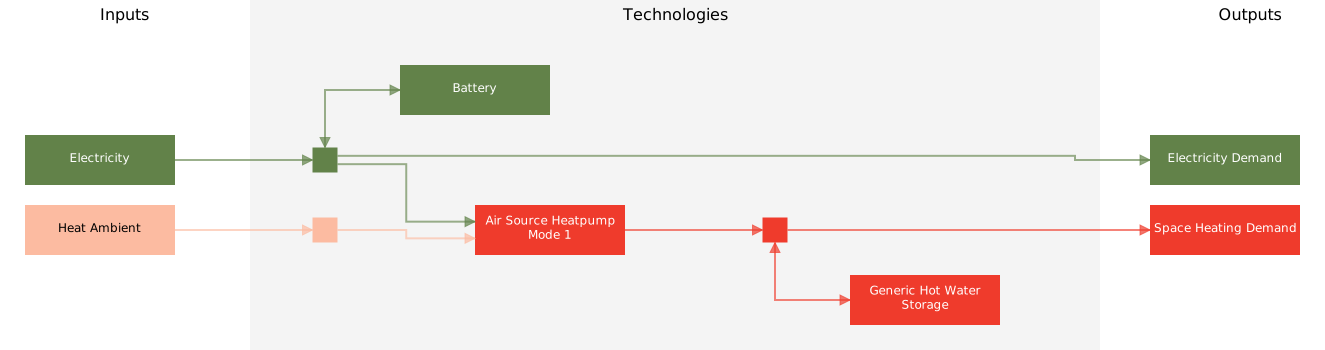
Site energy system: inputs, technologies, and outputs laid out in a single connected model.
Trusted by developers and industrial site teams
Used by developers, asset owners, campus, and industrial site teams to test MoPEC-compliant site energy concepts, fast enough to inform a bid, defensible enough to take to investors and authorities.




When site energy planning gets complex
Grid connection limits or long upgrade timelines
Rising electricity and heat demand from electrification
Need to replace gas boilers, CHP, or steam systems
Waste heat recovery opportunities across buildings or processes
Solar, storage, heat pumps, and thermal networks competing for space and budget
Multiple stakeholders: owner, tenants, utility, engineering firm, municipality
For developers
- Mixed-use districts and neighbourhoods
- New developments and phased build-outs
- Feasibility studies and permitting support
- Owner, investor, and municipality presentations
For industrial sites
- Factories, campuses, logistics parks, and business parks
- Electrification and heat supply transition planning
- PV, battery, heat pump, and grid-capacity trade-offs
- Site-wide decarbonisation and resilience scenarios
How Sympheny helps
Decisions before the capital is committed
Compare whole-site energy concepts during acquisition and concept design, while the choices still cost a presentation slide rather than a redesign.
Every trade-off in one view
CAPEX, OPEX, CO₂, grid constraints, space, resilience, phasing. All of it side by side, instead of split across separate studies you have to reconcile yourself.
One connected system, not isolated components
Model buildings, processes, hubs, and phased build-outs together, as one system. Sector coupling and shared infrastructure show up at the concept stage, not as a surprise in detailed design.
What changes for developers and industrial site teams
| Process | Before Sympheny | With Sympheny |
|---|---|---|
| Acquisition and concept phase | Energy infrastructure is a late-stage line item, assumed rather than analysed while the bid is being built | Whole-site energy scenarios compared from acquisition onwards, so the deal price reflects the real concept |
| Infrastructure trade-offs | PV, heat, storage, grid capacity, and phasing studied in separate disciplines and stitched together at the end | Electricity, heat, cooling, storage, grid constraints and phasing modelled together from the start |
| Permit and authority engagement | Energy concept for the permit is a last-minute deliverable, and a project risk | MoPEC-compliant concept generated from the same model that informed the deal |
| Investor and board reviews | CAPEX, OPEX, CO₂, space, and resilience trade-offs are hard to explain in a single slide | Decision-ready scenario outputs for owners, investors, engineers, and authorities: same evidence base, every audience |
Site energy concepts, proven in the field.
See how developers and site owners have used Sympheny to pressure-test the energy concept while it was still cheap to change, before the capital went in.
A self-sufficient campus energy concept
Technical proof: Agri-PV, storage, and biodigester options compared
Business outcome: A viable path to 100% energy self-sufficiency without giving up agricultural land use.
Residential energy concept for a new housing quarter
Technical proof: 16 buildings, 3 supply variants on the same Pareto front
Business outcome: Groundwater heat pumps win once cost, CO2 and autarky are weighed together.
Solar development strategy for the Port of Switzerland
Technical proof: 16 variants across four strategies optimised
Business outcome: Up to 20-25% cost reduction identified; lowest-risk path confirmed.
Need to replace a gas boiler before 2030?
In 4-6 weeks, Sympheny can compare gas boiler replacement pathways across heat pumps, electrode boilers, biomass, district heat, PV and storage, and hybrid configurations, with cost, CO2, subsidy, and phasing trade-offs in one model.
Compare fossil heat, electrified heat, renewables, storage, and hybrid concepts side by side
Make Scope 1 reduction, NPV, lifecycle cost, and CO2 trade-offs visible before capital is committed
Include policy, subsidy, tariff, and carbon-cost assumptions in the same scenario model
Daniel Büchi, General Manager, Neuhof“With the help of Sympheny, we have found a concept that gives us a viable path to energy self-sufficiency.”