Energie Wasser Bern · Eicher+Pauli
Strategic energy concept for the Insel-Holligen district
A low-temperature thermal network for 90,000 MWh, modelled across 6 hubs and 30+ scenarios.
A low-temperature thermal network supplied by river and groundwater, stress-tested against more than 30 future price and demand scenarios.
- Customer
- Energie Wasser Bern · Eicher+Pauli
- Sector
- Engineering Consultant
- Location
- Bern, Switzerland
- Project type
- District concept
- Scenarios
- 30+ price & demand scenarios
- Tools
- Sympheny · MILP optimisation · Hourly demand profiles · Sensitivity analysis
Develop a robust district energy concept for a complex hospital, residential, and commercial area in Bern.
Optimised five local energy sources across six hubs, then stress-tested the concept against 30+ future price and demand scenarios.
The recommended infrastructure concept could be defended before investment decisions were locked in.
The challenge
In mid-2020, Energie Wasser Bern (ewb), the Bern utility formed in 2002 from the city’s electricity, gas, water and district heating supply, partnered with engineering and sustainability firm Eicher+Pauli to develop a new energy concept for the Insel-Holligen area of Bern. The site sits close to the river Aare, which made a low-temperature thermal network supplied by groundwater and/or river water the central design question.
The complication was that groundwater and river water can’t be used freely. Their seasonal availability has to be respected to keep the resource sustainable, which folds straight into the network sizing and the choice of supplementary technologies in each hub. Spreadsheet methods could capture pieces of the problem but not the whole picture at the resolution required, and the team wanted a faster, more reliable way to find the optimal trade-off between cost and emissions.
How Sympheny was used
Insel-Holligen was divided into six areas, each modelled as a separate energy hub. The hubs were linked through the existing infrastructure and the candidate low-temperature thermal network. For every hub, the energy planners supplied heating and cooling demand profiles at different temperature levels and a set of candidate energy supply technologies. Sympheny’s algorithms then optimised the system at hourly resolution, returning a Pareto front from cost-minimising to CO₂-minimising solutions.
- Six linked energy hubs. Each area modelled as a separate hub with its own demand profiles and candidate technologies, connected through the candidate low-temperature thermal network.
- River and groundwater constraints. Captured the seasonal limits on Aare river water and groundwater extraction, so the optimisation respected the sustainable use of both resources.
- Sensitivity over 30+ scenarios. Stress-tested the optimal system against more than 30 future energy-price and demand scenarios to check the economics of the recommended solution.
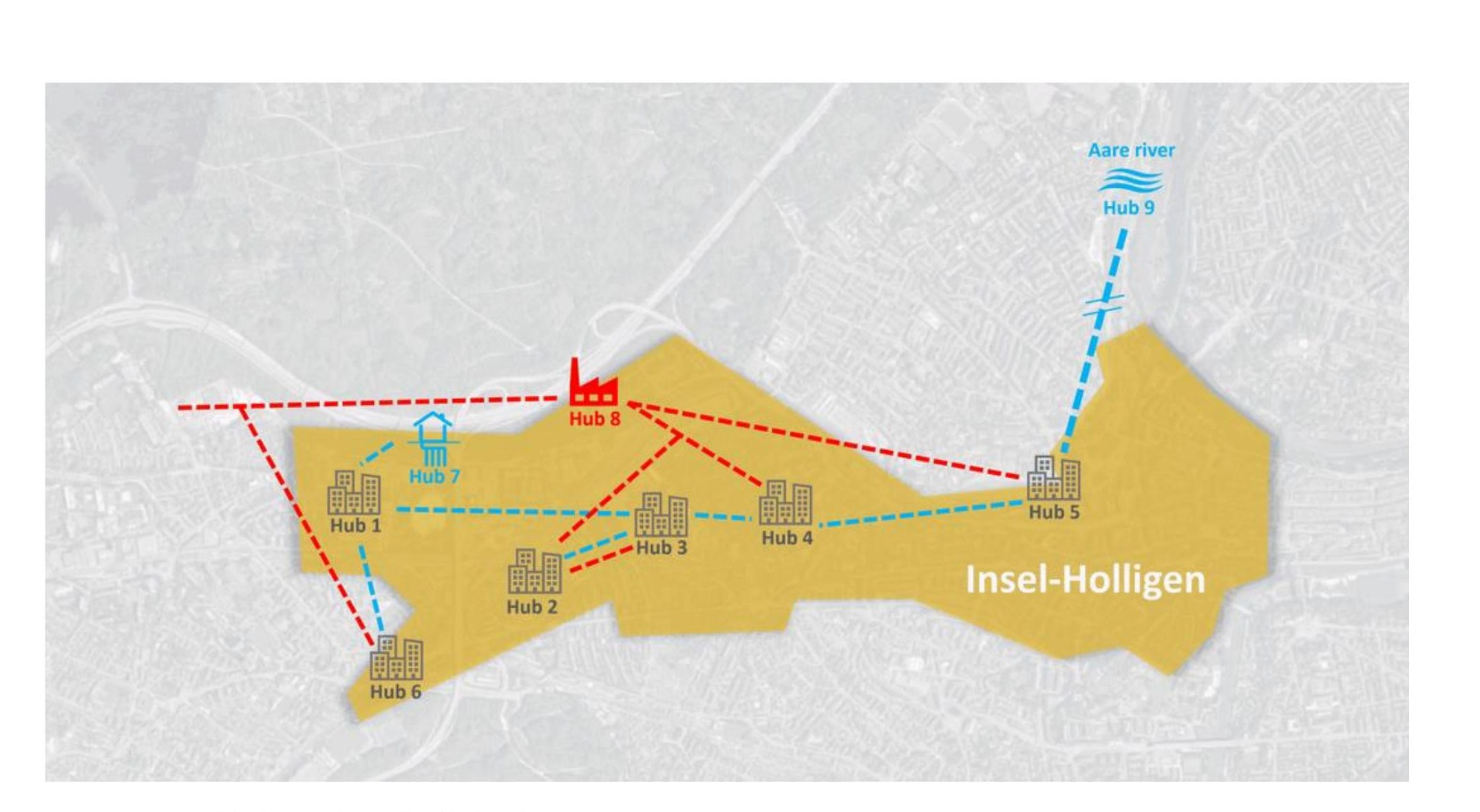
The Insel-Holligen site as modelled in Sympheny: six demand hubs (1–6) on the site, with Hub 9 marking the connection to the river Aare for low-temperature heat.
Result
Sympheny returned a menu of optimal supply solutions ranging from a cost-minimising design to a CO₂-minimising design, all on the Pareto front, each one a fully sized combination of supply-technology candidates plus thermal-network connections. Beyond the technology mix, the algorithm’s hourly energy balance gave the planners the optimal sizing and physical locations for each conversion component and network link.
Layered on top of that, a sensitivity analysis tested the economic performance of the optimal system against more than 30 future energy-price and demand scenarios. The combined output, a fully sized technology menu plus a robustness check across plausible futures, let ewb and Eicher+Pauli converge on an optimised energy supply concept for Insel-Holligen quickly and with confidence.
A sized technology menu plus a robustness check across more than 30 plausible futures let ewb and Eicher+Pauli converge on an optimised low-temperature thermal supply concept for Insel-Holligen quickly and with confidence.
Sympheny supports our strategic energy planning in an ideal way. The flexibility is extremely convincing and the sensitivity analysis provides security in finding solutions.