IBC Energie Wasser Chur
City-wide energy supply strategy toward 2050
Net-zero energy supply for an entire city, at 2018 life-cycle costs.
Three city-wide scenarios confirmed a CO₂-free supply by 2035 is achievable at similar life-cycle costs to today's fossil-based system.
- Customer
- IBC Energie Wasser Chur
- Sector
- Utility
- Location
- Chur, Switzerland
- Project type
- Utility strategy
- Net-zero
- by 2035
- Tools
- Sympheny · MILP optimisation · Multi-objective Pareto · Hourly demand profiles
Test long-term energy supply pathways for Chur and understand whether a CO2-free system could be achieved by 2035.
Built one city-wide model and compared three scenarios across cost, emissions, local resource limits, and tariff assumptions.
Confirmed a CO2-free 2035 supply pathway at similar life cycle cost to today's fossil-based baseline.
The challenge
IBC Energie Wasser Chur has been Graubünden’s multi-utility since 1896, supplying electricity, gas, heat, cooling and drinking water to the city of Chur and the surrounding region. With Switzerland’s energy and climate trajectory, IBC needed to assess what it would take to transition the city’s energy system toward net-zero, and at what cost.
The analysis had to do two things at once. First, directly compare cost against CO₂ emissions across alternative system designs, including all the synergies between energy carriers. Second, quantify the scale and type of investment required to reach net-zero across an energy reference area of 3,168,360 m². On top of that, the available regional resource was bounded (only a certain amount of wood could be used per year, a constraint provided by ELIMES) and three different time horizons each came with their own price structure.
How Sympheny was used
IBC and the energy planners modelled a full Energy Hub for Chur in Sympheny, with every candidate conversion and storage technology defined by its energy carrier, inputs and outputs, conversion efficiency, investment costs and maintenance costs, and production surpluses allowed to be exported. Three scenarios were optimised (2018, 2035 and 2050), each with its own demand assumptions (rising building efficiency for 2035 and 2050) and tariff structure (per-kWh in 2018, capacity-based in 2035 and 2050). Solar was modelled against an assumed 700,000 m² of available roof area (50% of the city total) using Chur’s 2016 station-square irradiation.
- City-scale energy hub. Modelled the entire Chur energy reference area (3.2 million m²) as one optimisable hub, with imports, exports and on-site resources tied together at the system level.
- Resource constraints from ELIMES. Capped regional wood availability and other framework conditions so the optimisation respected what the region can actually supply on a sustainable basis.
- Three time horizons, one baseline. Optimised 2018, 2035 and 2050 in parallel, with different demand levels and tariff structures, five Pareto-optimal designs each.
Result
The most important finding from the Pareto fronts is that a CO₂-free energy supply by 2035 is possible with similar life-cycle costs as 2018. The three drivers that make that possible are concrete: increased energy efficiency through building renovation and equipment replacement; lower technology costs from economies of scale; and a tariff structure that weights power purchases more heavily than energy purchases.
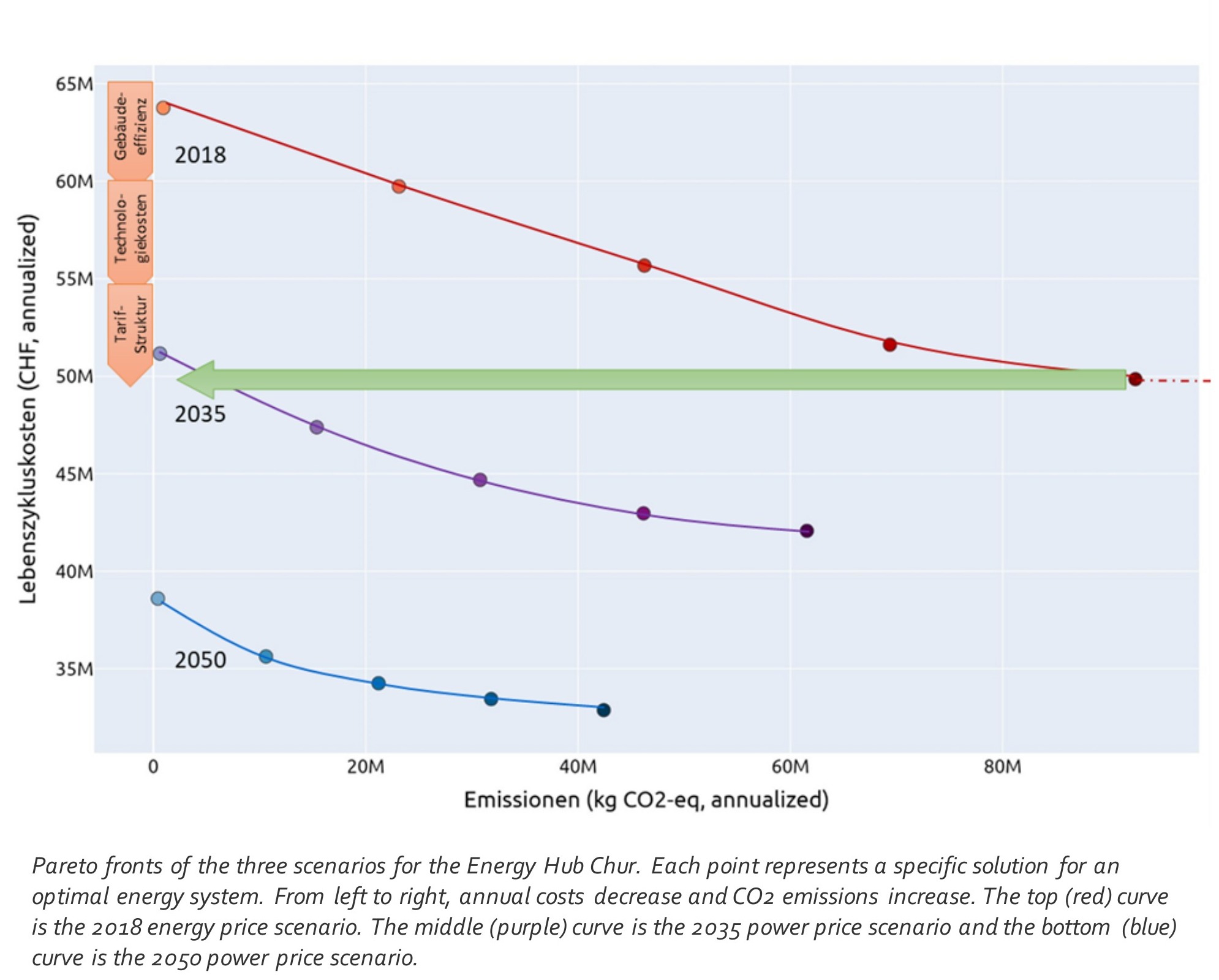
Reaching this end-state is not free of investment. The system has to be restructured to use only renewable-based technologies, which in some cases means substantial up-front capital. But once those investments are made, the new system operates at life-cycle costs comparable to today’s. The simulations also pointed to a procurement implication: IBC should secure future renewable gas (bio or synthetic) and renewable electricity through long-term supply contracts to lock in attractive prices for the converted system.
IBC Chur now has a long-term supply strategy grounded in numbers rather than narrative, and a model they can re-run as fuel prices, regulations and demand assumptions evolve. Each new investment decision can be tested against the same city-wide baseline rather than starting from a blank page.
Three time-horizon scenarios confirmed a CO₂-free supply by 2035 is achievable at similar life-cycle costs to today's fossil-based system, with three concrete drivers: building-renovation efficiency, lower technology costs from scale, and a tariff structure weighting power above energy.