Empa
Climate-neutral research campus by 2030
26 buildings across 12 hubs, toward Empa's 2030 climate-neutral target.
A 10% CO₂ reduction already achieved in the current state, with a further 25% modelled in the planned state toward 2030 climate neutrality.
- Customer
- Empa
- Sector
- Campus
- Location
- Dübendorf, Switzerland
- Project type
- Campus decarbonisation
- CO₂
- −35% toward 2030 target
- Tools
- Sympheny · MILP optimisation · Multi-temperature network modelling · Three-state comparison
Plan Empa's Dubendorf campus toward climate neutrality by 2030 while keeping the model useful as the site evolves.
Created a living campus model covering up to 26 buildings across 12 energy hubs and compared initial, current, and planned states.
Showed a 35% CO2 reduction pathway and delivered a model Empa can re-run as buildings and assumptions change.
The challenge
Empa, the Swiss Federal Laboratories for Materials Science and Technology, has set a climate-neutral target for its main Dübendorf campus by 2030. The campus is also growing: new buildings, an extension of the medium-temperature network, and added research capacity from in-house Empa and Eawag innovations in energy generation, storage and wastewater treatment.
The energy system was already complex before the extension. High heating, cooling and electricity demand co-exist with on-site production, multiple thermal networks, and storage components. That complexity rises as the site develops. Empa needed a holistic view of the current system before it could plan the next stage. Two questions had to be answered together: is the current operation already optimal for the site, and how should the planned extension be configured to actually reach the 2030 target without losing the institutional knowledge already embedded in the team’s data.
How Sympheny was used
Sympheny and Empa kicked off with a joint workshop to scope boundary conditions and review existing data, then built a single hub-and-network model covering three defined states: initial, current and planned. The campus was decomposed into 12 hubs at one-hour time resolution, with electricity, heat at multiple temperature levels and cooling all represented. Each state had its own technology and network set: initial and current were tightly constrained to reflect what’s actually installed, while the planned state opened up the technology choice for the optimisation algorithm.
- Multi-temperature network model. Captured the high-temperature, medium-temperature and cooling networks together at hourly resolution so the bidirectional MT exchanges could be analysed properly.
- Three-state comparison. Modelled initial, current and planned states side by side, so the climate-neutral roadmap was anchored against verified historical operation.
- Living energy plan. Delivered the model directly into Empa’s Sympheny account so the team can re-run scenarios as boundary conditions like prices and demand evolve.
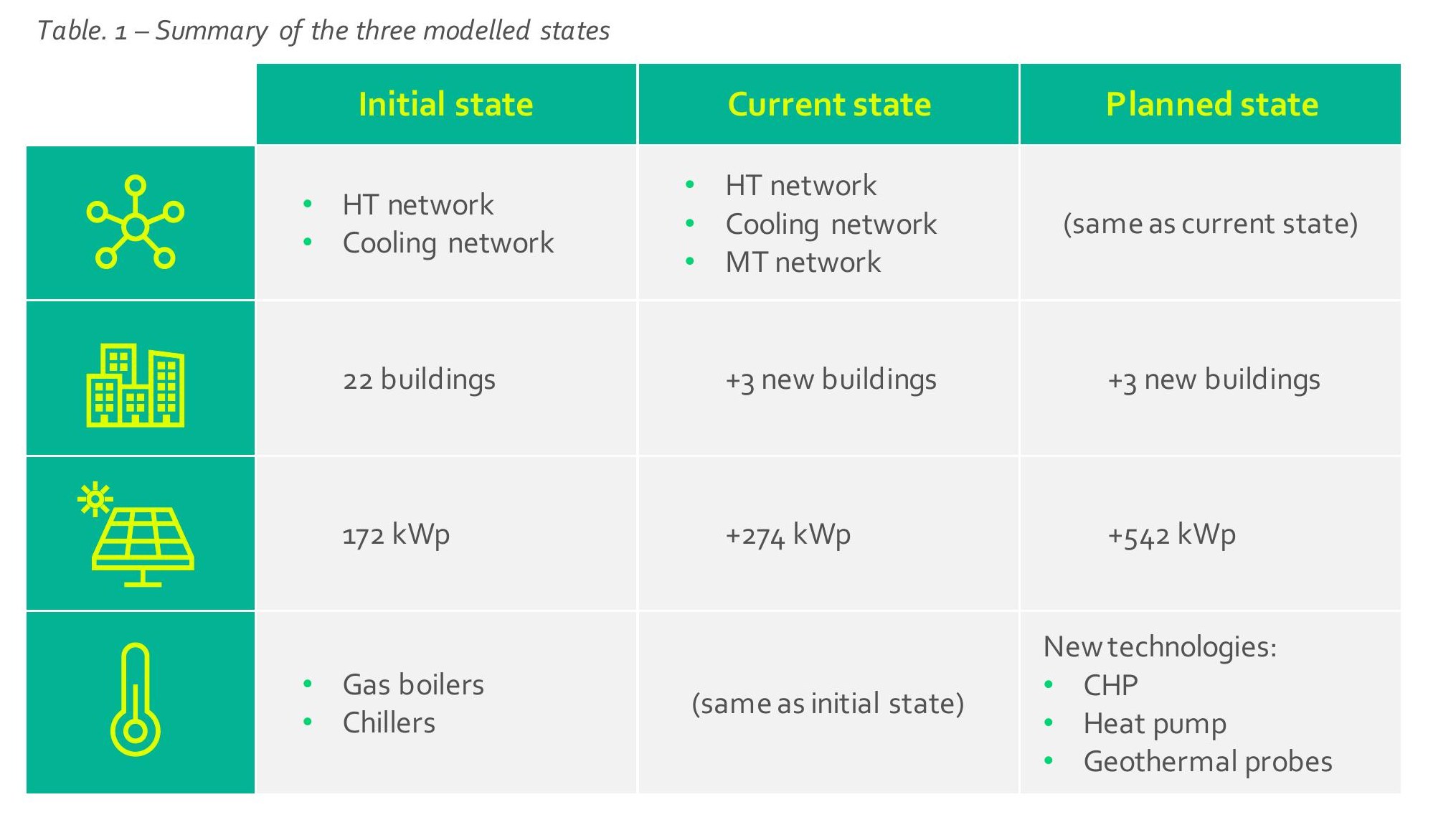
The three states modelled in Sympheny: initial (22 buildings, 172 kWp PV, gas boilers and chillers), current (plus 3 buildings, plus 274 kWp, plus CHP, heat pump and geothermal probes), and planned (plus 3 more buildings, plus 542 kWp).
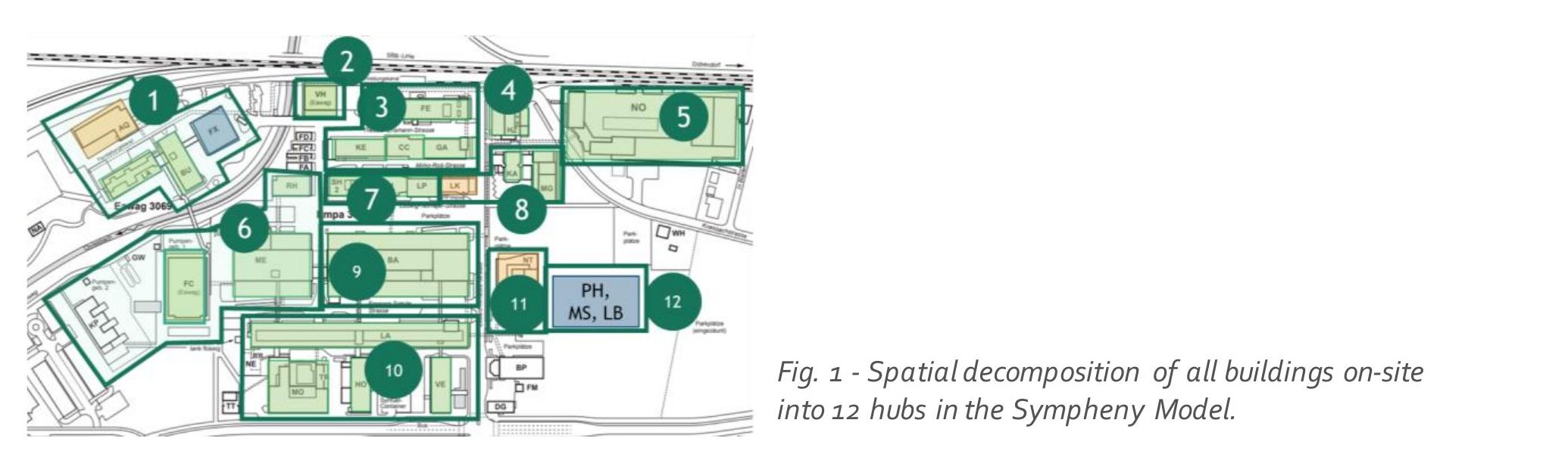
Empa’s Dübendorf campus decomposed into 12 hubs in the Sympheny model, with each hub treated as a separate sub-system in the optimisation.
Result
Hourly comparison of the three modelled states shows a 10% CO₂ reduction is achievable in the current state relative to the initial state, and a further 25% reduction in the planned state, a directional roadmap consistent with the 2030 climate-neutral target. Presenting the initial and current models also surfaced monitoring inaccuracies in the existing data, which Empa was then able to correct in the model with a second pass.
The medium-temperature network analysis (heat-recovery chillers, process waste heat from high-temperature cooling, low-temperature sources for the heat pump, and seasonal storage through boreholes) validated the integration of borehole technology into the future concept. It also surfaced energy mutualisation potentials between buildings that the team had not previously been able to see. Empa’s model now lives in their Sympheny account as a ‘living energy plan’ the team can re-run as boundary conditions change.
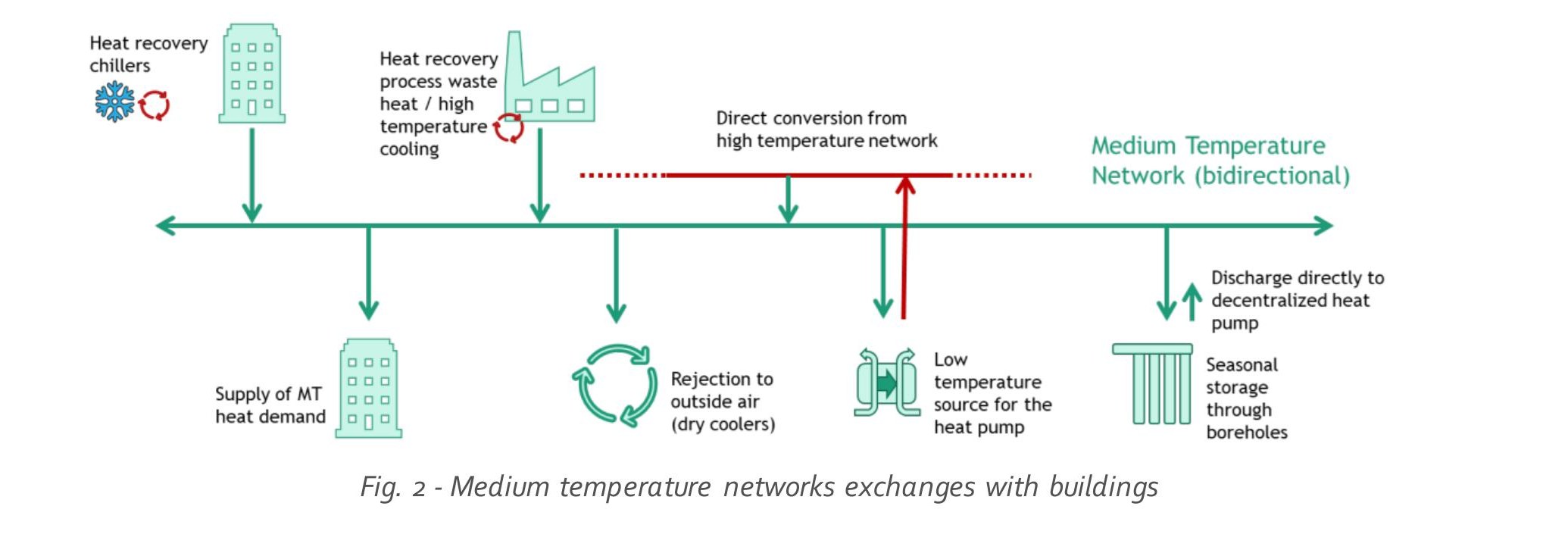
The bidirectional medium-temperature network as analysed in Sympheny, surfacing energy mutualisation potentials and validating the integration of borehole technology in the future concept.
A three-state hourly comparison (initial, current, planned) confirmed a directional roadmap consistent with Empa's 2030 climate-neutral target: 10% CO₂ already achievable, 25% more reachable in the planned state. The model lives in Empa's account as a living energy plan.