Plan the whole campus as one energy system.
A campus is a small city: many buildings, several thermal networks, on-site generation and storage, all interacting. Sympheny optimises them together at hourly resolution, so the decarbonisation roadmap is costed and defensible rather than assembled building by building.
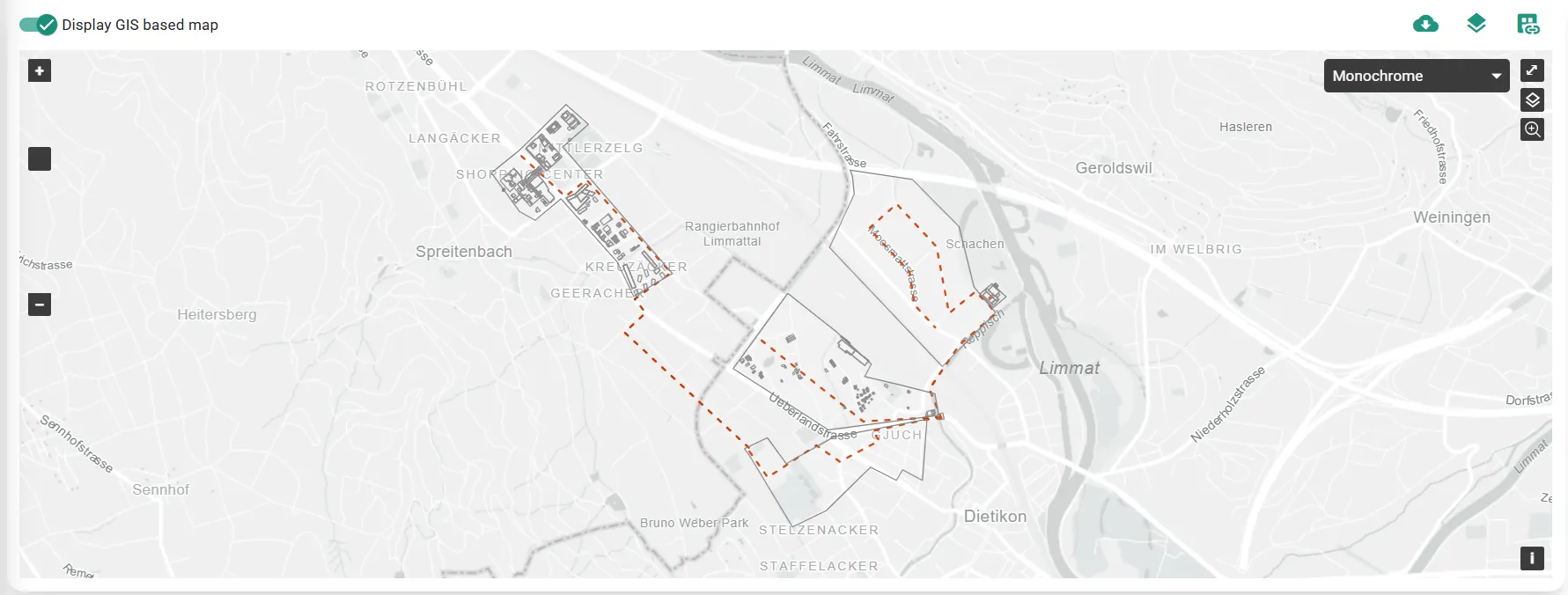
A campus decomposed into energy hubs on a real map, with networks and on-site supply modelled as one system.
Why campus concepts are hard to get right.
Building-by-building misses the system
Plan each building on its own and you lose the very thing that makes a campus efficient: shared networks, surplus heat moving between buildings, storage that serves the whole site. The savings live in the connections, and those only appear when the buildings are modelled together.
The phasing is as hard as the technology
Campuses grow and renovate in stages. A concept that ignores the order of works, which network extends when, which plant comes online first, is hard to fund and harder to deliver. The build sequence has to be part of the answer, not an afterthought.
A 2030 or 2050 target needs evidence
Estates committees and funders want to see that a climate-neutral target is reachable, at what cost, and against what baseline. A roadmap nobody outside the team can interrogate does not unlock the budget.
Proven on real campuses.
26 buildings decomposed into 12 hubs across three states, confirming a roadmap toward the campus's 2030 climate-neutral target: about 10% CO₂ already achievable and a further 25% in the planned state.
Read case studyA self-sufficient concept for nine campus facilities, with Agri-PV, a biodigester, methane and hydrogen storage, sized together for full energy autarky at low life-cycle cost.
Read case studyEvery building, network and source in one optimisation.
The buildings, the thermal networks between them, the on-site generation and the storage all sit inside the same mixed-integer optimisation, solved hourly across a reference year. The site is modelled as it behaves: one connected system, not a stack of separate studies.
Buildings become hubs, the campus becomes a system.
Group the buildings into energy hubs on a real GIS map and draw the thermal networks between them. Surplus heat from one part of the campus can serve another; the optimiser decides which connections are worth building from measured length and cost.
- Dozens of buildings grouped into hubs on a GIS basemap
- Multi-temperature and ambient networks between hubs modelled explicitly
- Heat shared between buildings rather than each running its own plant
Generation, storage and sector coupling, sized together.
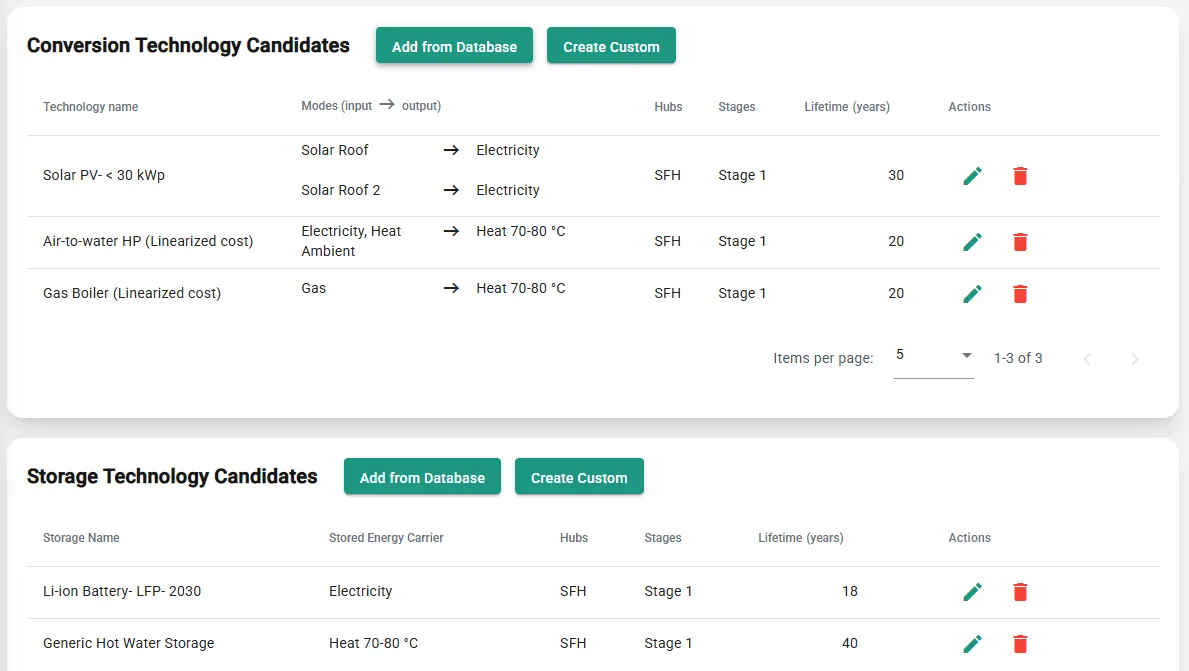
PV, heat pumps, CHP, boreholes, batteries and seasonal storage all enter as candidates, with seasonal performance and hourly resource limits built in. Where a campus runs vehicles or processes, those vectors are coupled in so the whole demand is met from the optimal mix.
- PV, heat pumps, CHP, boreholes, batteries and seasonal storage as candidates
- Seasonal COP and hourly resource limits respected, not annual averages
- Heat, electricity and fuels coupled where the campus needs them
A staged, stress-tested path to the target.
Compare the current state, an optimised current state and the planned future state in one model, then test the recommended roadmap against price and demand futures. The result is a phased concept anchored against verified operation, not a single optimistic line.
- Initial, current and planned states compared side by side
- Build order and phasing returned by the optimiser
- Sensitivity across many price and demand scenarios
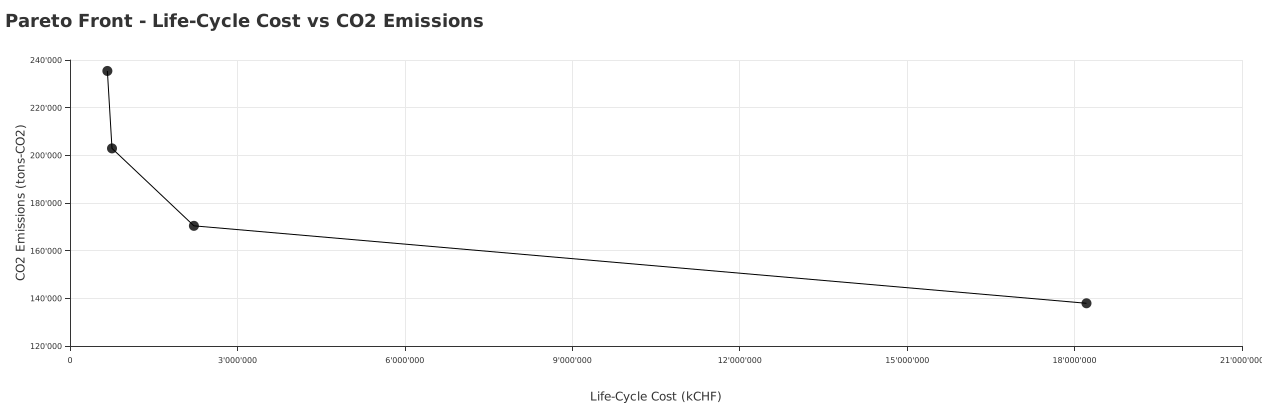
For the economic buyer, that means a costed, staged roadmap to the campus target: what it takes over its life against the baseline, and in what order to build it.
Sympheny covers feasibility and concept design: the stage where the technology mix, network architecture and phasing get settled. Detailed hydraulic and building-level engineering is a separate step in tools built for it. Most of what determines whether a campus roadmap gets funded is decided before that stage.
Built for the campus-scale decision.
Plenty of tools touch parts of a campus concept. Sympheny is built for the decision an estates team has to defend: which system to build across the whole site, and in what order.
Not a single-building tool
Building energy models answer one building well. Sympheny optimises the buildings, the networks between them and the shared supply together, so the campus-level savings actually surface.
Not a spreadsheet roadmap
A spreadsheet can list measures but cannot resolve how they interact at hourly resolution. Sympheny co-optimises supply, networks and phasing, then stress-tests the result.
Built around the optimisation, run in the browser
A MILP engine sits at the core, run in a cloud platform an engineer uses directly, with client-ready outputs. The rigour is there without a bespoke modelling project.
Questions campus teams ask.
What is a campus energy concept?
A campus energy concept is a plan for supplying heat, cooling and electricity to a group of buildings on one site as a connected system, rather than building by building. It sets out which on-site generation, storage and networks to build, what they cost over their life and how much carbon they save. Sympheny models the buildings, networks and supply together so the concept can be optimised as one.
How do you decarbonise a campus?
Campus decarbonisation usually combines shared thermal networks, on-site renewable generation, storage and staged building renovation. The hard part is that these interact, so deciding them one at a time tends to lock in a sub-optimal system. Sympheny co-optimises the supply mix, the networks and the build order in one model at hourly resolution, then tests the roadmap against price and demand futures.
Can a campus reach a climate-neutral target by 2030 or 2050?
Whether a target is reachable, and at what cost, depends on the specific site: its demand, available resources and space for plant. Sympheny tests it directly: it compares the current state against an optimised planned state and returns the CO₂ reduction achievable and its life-cycle cost. On the Empa campus, the model confirmed about 10% CO₂ reduction already achievable and a further 25% toward the 2030 climate-neutral target.
How does Sympheny help plan a campus?
Sympheny is a cloud-based multi-energy optimisation platform. It models a campus as energy hubs connected by thermal networks, sizes on-site generation and storage, and returns a Pareto front of cost against CO₂ with a staged build order and exportable data. Engineering teams and estates use it to move from a brief to a defensible, fundable concept in days rather than weeks.
Related pages and proof.
See your campus modelled as one system.
Bring the site to a demo and watch the buildings, networks and supply optimised together, or start a free trial and build the first concept yourself.