Turn a designated heat network zone into a system you can defend
Heat network zoning identifies the areas where a heat network is the lowest-cost low-carbon option, and within them connection can become mandatory. The designation is the start. The hard part is the energy system inside the zone: which sources, which network, what it costs and what it saves. Sympheny is built to model and optimise exactly that.
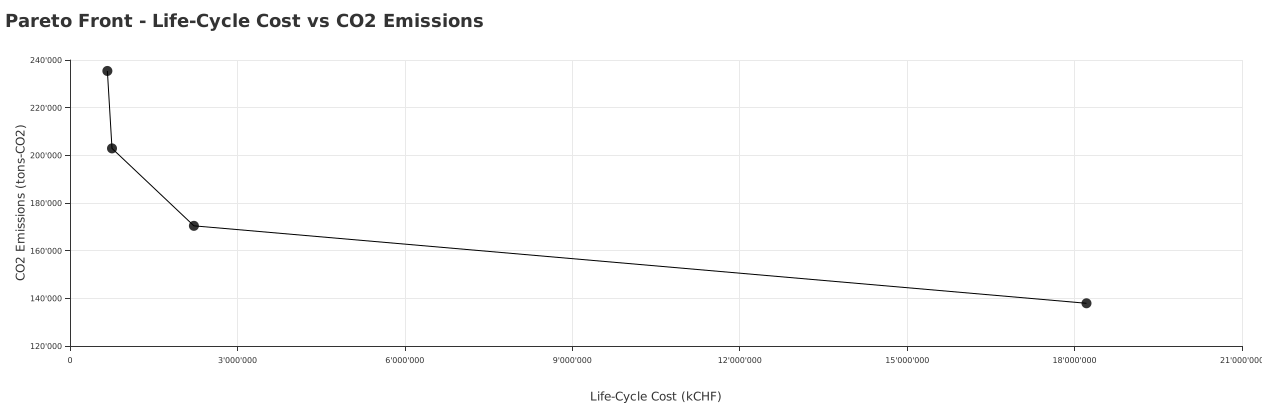
Cost against CO₂ for a municipal energy plan: every point is a fully sized system the team can take to council.
Zoning sets where. It does not settle which sources, network or cost.
Zoning designates the area, on a timetable
Under the Energy Act 2023, heat network zoning is being rolled out across England, with zoning coordinators identifying and designating areas where a heat network is the lowest-cost route to low-carbon heat. Designation names the zone and the duty. It leaves open the question the delivery team then has to answer: which sources, which network, and at what cost.
The zone is only as good as the system inside it
A designated zone is a strategic decision that a heat network is the right answer, not a costed scheme. The moment that has to be justified to a council, a funder or the Green Heat Network Fund, it needs the calculated energy concept underneath: sized technologies, network segments, a Pareto of cost against CO₂.
Spreadsheets buckle under deadline pressure
When several zones have to be assessed at once, the analysis is often kept by hand in spreadsheets: a few options each, hard to audit, slow to rerun. Under time pressure the breadth of options is the first thing to go, and decisions that commit capital for decades end up resting on two or three calculated cases.
Proven from an eco-quartier to a whole city.
An eco-quartier decarbonisation roadmap with three fully costed pathways. The CO₂-optimal path reaches an 83% emission cut by 2040; the mid-way path delivers substantial reductions at only about 6% higher life-cycle cost.
Read case studyA city-wide supply strategy over a 3.2 million m² reference area, confirming a CO₂-free supply by 2035 at life-cycle costs comparable to the 2018 fossil-based system.
Read case studyA district heating expansion across 74 buildings, five candidate network segments and three plants, with the build order staged and the source mix compared in one model.
Read case study“In the Uster city centre I compared three networking options: no network, an anergy network, and one with additional electricity trading. The result was clear — maximum thermal and electrical networking is the best solution, economically and ecologically. I couldn't have run a variant comparison at this depth without Sympheny.”
The rigorous, auditable energy-system layer of the zone
Sympheny models each zone, area or whole town as a multi-energy system and optimises it, so the scheme is built on calculated concepts rather than assumptions. Every candidate technology, network and source is compared on the same basis: cost against CO₂, in the form a funder can interrogate.
Model the area as it actually is
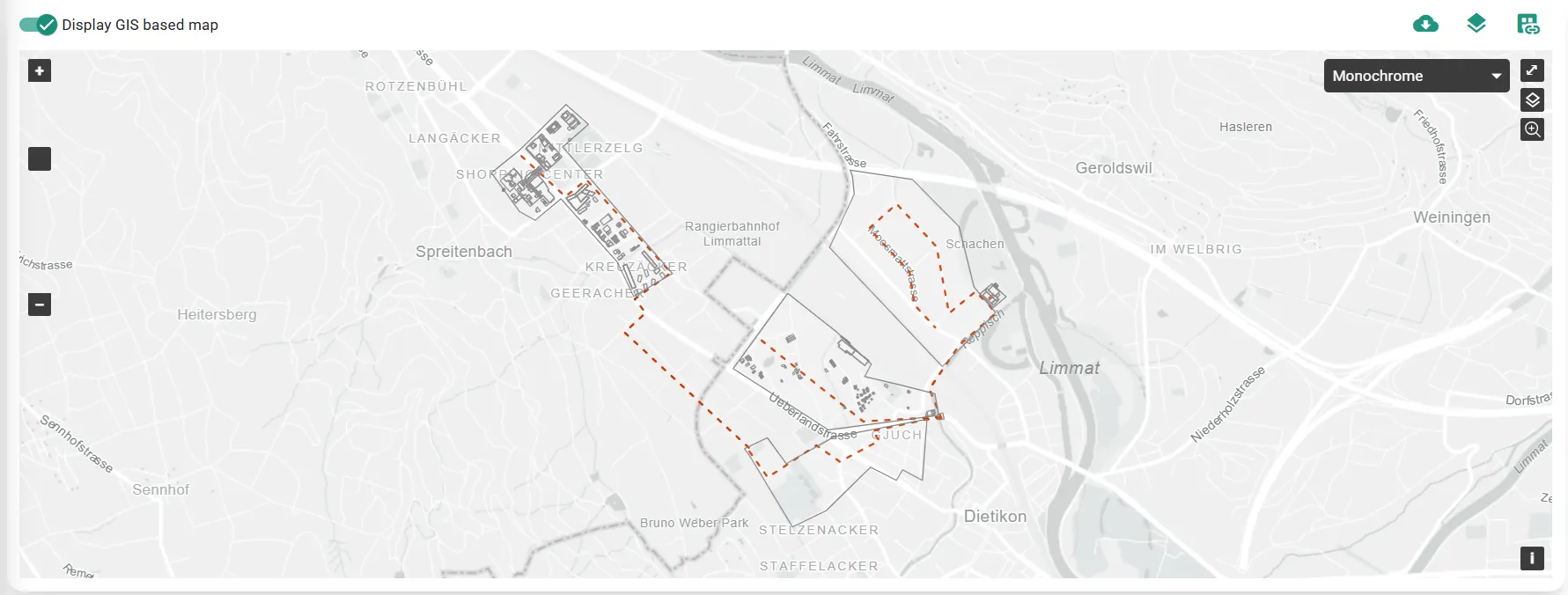
Start from the territory, not a blank sheet. Sympheny's GIS-enabled view holds the buildings, demand and local resources of an area, so the plan reflects the real heat density and the sources that area can actually draw on.
- GIS site view with buildings, demand and network routes
- Local sources mapped in: waste heat, water, geothermal, biomass
- From a single district up to a whole city or region
Network or decentralised, and on what
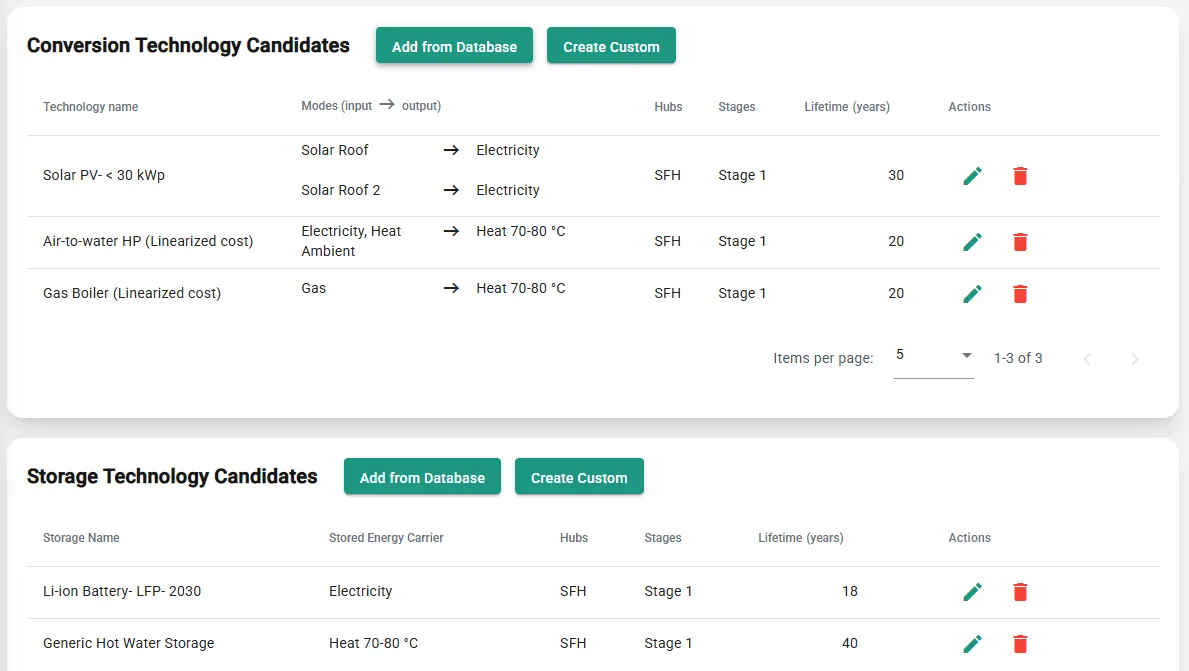
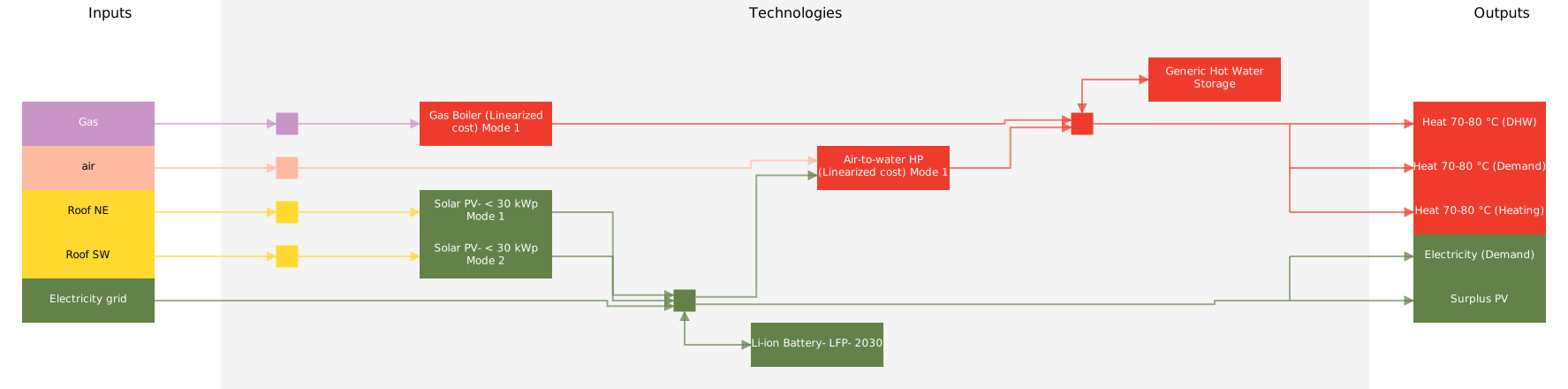
Answer the core question of every supply area directly. Sympheny co-optimises the supply mix and the network together, so a central heat network is compared against decentralised options on cost and CO₂ inside one model, not stitched together from separate studies.
- Central network against decentralised supply, like for like
- Every source for an area inside the same optimisation
- Staged build-out: what gets built first, what follows
Scenarios and sensitivity, built to be interrogated
A plan gets challenged. Sympheny runs multiple decarbonisation pathways and stress-tests each against shifting energy prices, interest rates and connection rates, so a recommendation holds up when the assumptions move and when a council asks why.
- Multiple pathways from cost-optimal to CO₂-optimal
- Automated sensitivity analysis on the key assumptions
- Underlying data exportable to Excel for the deliverable
Show what each level of ambition costs
Instead of a single answer, Sympheny returns the trade-off between life-cycle cost and emissions as a Pareto front. Decision-makers can see what the cost-optimal, the climate-optimal and the politically viable middle path each cost, before committing.
- Pareto front of life-cycle cost against CO₂
- A politically viable middle path made visible
- Investment and capacity overviews straight from the platform
For the economic buyer: a fundable scheme delivered to the zoning timetable, with the cost of each level of ambition made explicit, and the evidence base a Green Heat Network Fund application needs.
Sympheny models and optimises the energy system inside a zone: the technology mix, the network architecture and the business case. It is not the zoning assessment tool that designates the zone, and it is not detailed hydraulic design. It fills the gap between them, turning a designated zone into a fully calculated, fundable concept in hours rather than weeks.
Built for the concept decision, not the plan document or the data lake.
Plenty of tools touch parts of municipal energy planning. Sympheny is built for the specific decision a planning team has to defend: which system to build per area, and why.
Not a heat-cadastre or GIS plan tool
Stock-analysis and heat-cadastre tools map demand and produce the plan document. Sympheny picks up where they stop, turning a zoned area into a costed, optimised energy concept.
Not a long-run market model
Market and dispatch platforms model national systems over decades. Sympheny works at the district and city scale a plan is actually built at, with the network segments and sources as explicit decisions.
Built around the optimisation, run in the browser
A MILP engine sits at the core, but it runs in a cloud platform an engineer uses directly, with client-ready outputs. The rigour is there without a bespoke modelling project to set it up.
Questions local authorities and delivery teams ask.
What is heat network zoning?
Heat network zoning is the process, under the Energy Act 2023, of identifying and designating areas in England where a heat network is the lowest-cost way to decarbonise heat. Within a designated zone, certain buildings can be required to connect. Zoning decides where a heat network is the answer; Sympheny models and optimises the energy system that then has to be built inside it.
Who does heat network zoning apply to?
Zoning is led by zoning coordinators working with local authorities, and within designated zones it can place connection requirements on larger non-domestic buildings, public-sector buildings and communal residential schemes. The delivery work, comparing sources, network routes and costs, usually falls to the authority's engineering consultancy or energy team. That is where Sympheny is used.
What is the Green Heat Network Fund?
The Green Heat Network Fund (GHNF) is the capital grant scheme supporting the construction and expansion of low-carbon heat networks in England. Funding decisions turn on a credible, evidenced case for the chosen low-carbon sources and the network design. Sympheny produces that evidence base: sources and network compared on cost against CO₂, with the underlying data exportable for the application.
How do you actually build the scheme inside a zone?
You model the zone as a multi-energy system, then optimise it: every candidate source and network compared on life-cycle cost against CO₂, stress-tested across price and demand scenarios, with a staged build order. Sympheny does this in one model and returns a Pareto front rather than a single recommendation, so the chosen option can be justified against the alternatives.
Who is Sympheny for in heat network zoning?
Two roles. The consulting engineer or energy team delivering the scheme uses Sympheny for model rigour, multi-energy scope and the auditability needed to defend the numbers to a council and a funder. The local authority lead uses the outputs to meet the zoning timetable with a fundable scheme and to see what each level of ambition costs.
How quickly does Sympheny deliver results?
A first zone model stands in hours, not weeks. How fast a robust concept follows depends on data availability, but the optimisation itself compares more than 50,000 technology combinations per run, and the model is built to be rerun as data, prices and assumptions change rather than rebuilt from scratch.
Related planning topics and proof.
Build the zone scheme on numbers a funder will back.
Bring a designated zone to a demo and watch the sources, the network and the costs resolved in one model, or start a free trial and build the first concept yourself.