Primeo Energie
Optimal expansion strategy for a district heating network
Profitable district heating expansion to 74 buildings, at over 80% renewable supply.
Five candidate network segments, three plants, four scenarios, and three of four scenarios profitable with the 80% renewable threshold exceeded.
- Customer
- Primeo Energie
- Sector
- Utility
- Location
- Muttenz, Switzerland
- Project type
- District heating expansion
- Renewable
- 80%+ renewable heat supply
- Tools
- Sympheny · MILP optimisation · Hourly hub-and-segment model · Renovation as decision variable
Determine which district heating network expansion scenarios in Muttenz were profitable while exceeding an 80% renewable heat target.
Optimised all candidate network segments, plant operation, renovation assumptions, and four connection scenarios together.
Confirmed three of four scenarios as profitable and showed all five network segments belonged in the optimal design.
The challenge
Primeo Energie is one of Switzerland’s largest heat-network operators, running over 220 heating plants for thermal contracting, custom industrial heat, and area development across Switzerland and neighbouring countries. In the municipality of Muttenz near Basel, Primeo wanted to extend its existing district heating network to connect more customers, but the system was already complex: five new building hubs, five candidate network segments, and three existing plants (one wood-waste central and two oil boilers).
Three things made the planning hard. The free capacity on the existing network varies monthly and is insufficient in critical winter months, so any expansion has to be sized against a moving constraint. The added load depends on whether new buildings are connected as-is or after renovation, which changes both demand and revenue. And the cost of each new pipe segment depends directly on its length and utilisation, which loops back into how the three plants should be operated. Primeo needed reliable answers on profit potential and economic risk before committing to the build-out.
How Sympheny was used
Primeo’s team and Sympheny built a single holistic model of the Muttenz district: five hubs, five candidate segments, three plants, the connection back to the existing network, and an aggregated CO₂-equivalent constraint to enforce ≥80% renewable supply. Four scenario variants were defined for 2027 and 2031 with lower (A) and higher (B) connection rates, with and without building-envelope renovation as part of the optimisation. The model worked at hourly time resolution to track when the existing wood-waste plant’s free capacity could supply the new load and when the oil boilers had to step in.
- Hourly hub-and-segment model. Captured the monthly variation in spare capacity on the existing network and the seasonal mismatch with new winter demand.
- Renovation as a decision variable. Treated building-envelope refurbishment as part of the optimisation, not a fixed input, surfacing where it improved profit despite lower heat sales.
- Renewable-share constraint. Used hourly production tracking to enforce a minimum 80% renewable heat share across the whole network, including peak winter operation.
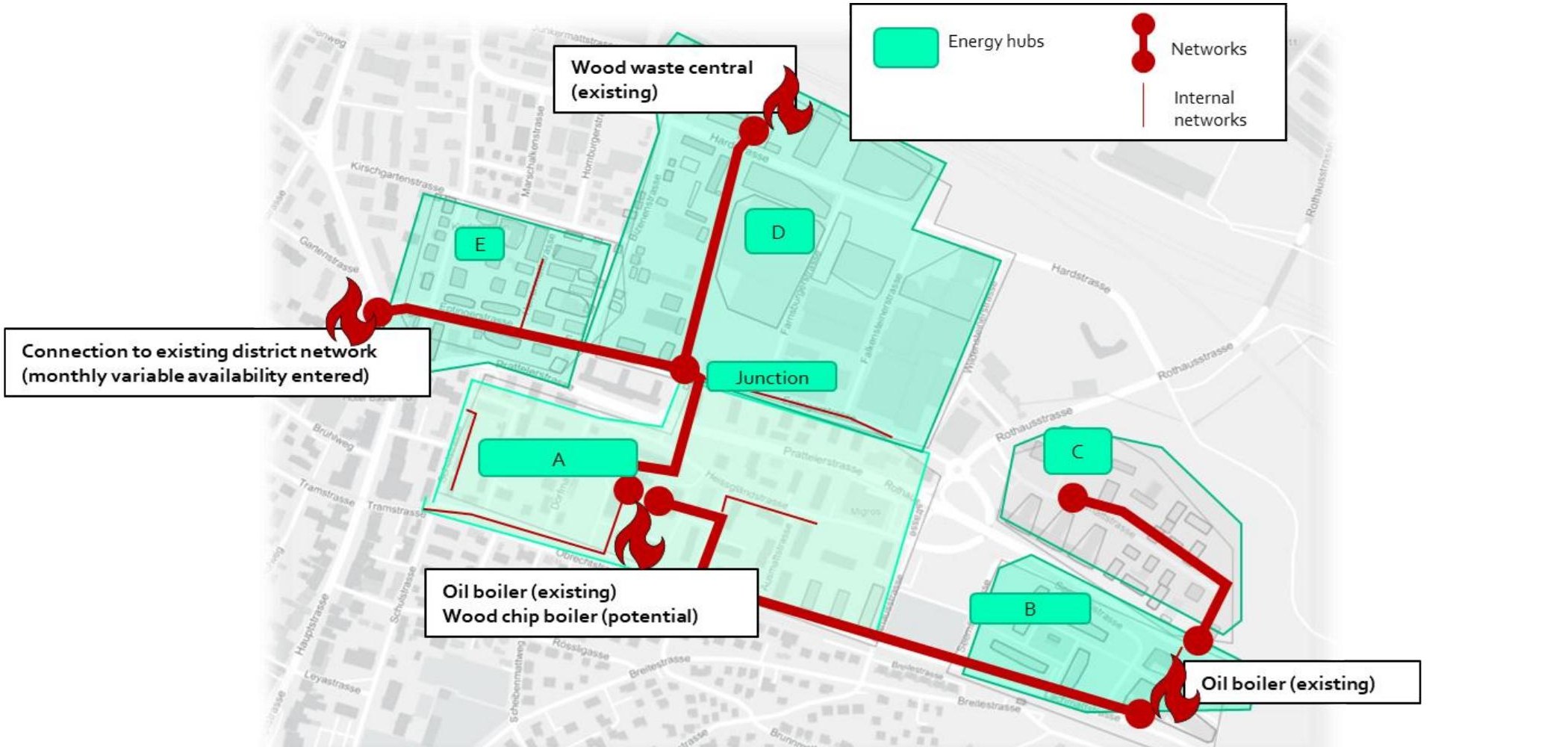
The Muttenz site as modelled in Sympheny: five building hubs, three existing plants, and five candidate network segments to the existing district heating network.
Result
Three of the four scenario variants modelled returned profitable expansion plans, with all five candidate network segments built in the optimal solutions and two of them operated bidirectionally. The 2031-B(R) scenario, with a higher connection rate plus optimised renovation, was the most profitable: the simulation showed that even though renovation reduces heat demand and direct revenue, the savings on network sizing more than offset that loss.
On the supply side, the existing wood-waste plant’s spare capacity covers the new base load most of the year; in winter, additional heat is purchased from the wood-waste central via a bidirectional segment. The two existing oil boilers are kept as capacity reserves and only run on the highest demand peaks, enough to clear the 80% renewable threshold. Replacing the oil boiler at hub A with a wood-chip boiler did not pay off; only in the highest-demand variant (no renovation) is an additional wood boiler required to cover peaks the existing oil units can’t reach. Primeo now knows which segments to build, in what order, and which scenario pays back: the basis for the staged Muttenz build-out.
Three of four scenarios returned profitable expansion plans, with all five candidate network segments built and two operated bidirectionally. The 2031-B(R) scenario, with a higher connection rate plus optimised renovation, was the most profitable.