Yverdon-les-Bains
Eco-quartier energy concepts and decarbonisation roadmap
An 83% emission reduction by 2040, across cost-optimal, mid-way and CO₂-optimal roadmaps.
An 83% CO₂ reduction by 2040 mapped across three fully costed pathways, from cost-optimal to climate-optimal, with a politically viable route in between.
- Customer
- Yverdon-les-Bains
- Sector
- Municipality
- Location
- Yverdon-les-Bains, Switzerland
- Project type
- Eco-quartier planning
- CO₂
- −83% by 2040
- Tools
- Sympheny · Gurobi solver · MILP optimisation · Anergy network analysis · Multi-roadmap Pareto
Align the Gare-Lac eco-quartier concept with Yverdon-les-Bains' wider city decarbonisation roadmap.
Compared three scenarios on the same underlying model so district-level choices and city-level targets stayed connected.
Mapped an 83% CO2 reduction pathway by 2040 with practical trade-offs visible for public-sector planning.
The challenge
The municipality of Yverdon-les-Bains is redeveloping its strategic Gare-Lac site into a new mixed-use eco-quartier: 3,800 inhabitants and 1,200 workspaces in one development. Yverdon-les-Bains energies, the local utility for electricity, gas, water and public lighting, mandated engineering and planning office Eicher and Pauli to develop the future energy concepts for the site, with consulting firm Enersys coordinating and maintaining a visualisation dashboard via their GRIDS energyCity software.
The localised master plan covers a long list of decisions that all interact: building standards and how they shift life-cycle costs and CO₂ emissions; integrating geothermal and wastewater low-temperature heat potentials; pre-sizing and routing of high- and low-temperature thermal networks; PV sizing and how it threads into the rest of the concept; and waste heat from on-site equipment that has implications for urban climate and air quality. Across all of that, the municipality needed several decarbonisation roadmaps to 2040 with explicit cost–emissions trade-offs.
How Sympheny was used
Eicher and Pauli used Sympheny as the analytical backbone of the project, pulling data from each project partner into one model everyone could trust and work from. Sympheny’s optimisation engine runs on Gurobi, the industry-standard MILP solver, which handles the combinatorial complexity of multi-technology, multi-period energy system design. Three scenarios were optimised at each time step (2025, 2030 and 2040): a cost-optimal path, a CO₂-optimal path, and a mid-way solution that targets the best compromise between cost and emissions. Each system solution corresponds to a fully dimensioned energy system design: pre-sized networks, sized technologies, hourly operation.
- Three roadmaps to 2040. Cost-optimal, mid-way, and CO₂-optimal pathways modelled across 2025, 2030 and 2040, so policy-makers can see what each level of ambition actually costs.
- Anergy network analysis. Tested whether the wastewater treatment plant could supply enough low-temperature heat to anchor an anergy network for the eco-quartier, a critical lever for the CO₂-optimal solution.
- Living model across project phases. Built so it can evolve from planning through construction and operation, with updated data integrating directly into the existing model rather than replacing it.
Result
The CO₂-optimal scenario delivers an 83% emission reduction by 2040 versus the status quo, achieved through building refurbishment, heat pumps, heat recovery, and an anergy network supplied by the wastewater treatment plant, with the wastewater connection identified as the key lever for lowering emissions. That ambition comes at a cost: the CO₂-optimal solution is roughly 90% more expensive on life-cycle cost terms than the cost-optimal solution.
The mid-way solution is the politically interesting result. Compared to the cost-optimal path, the mid-way path delivers further CO₂ reductions for only a roughly 6% increase in life-cycle costs, a much more attractive trade-off. Each scenario corresponds to a fully dimensioned design that answers concrete planning questions: whether the wastewater volume is enough for low-temperature heat supply, what other sources are worth deeper analysis, and what role PV should play in the integrated system. The model lives on as a digital twin in Sympheny, ready to be refined as local data improves and the project moves from planning into construction and operation.
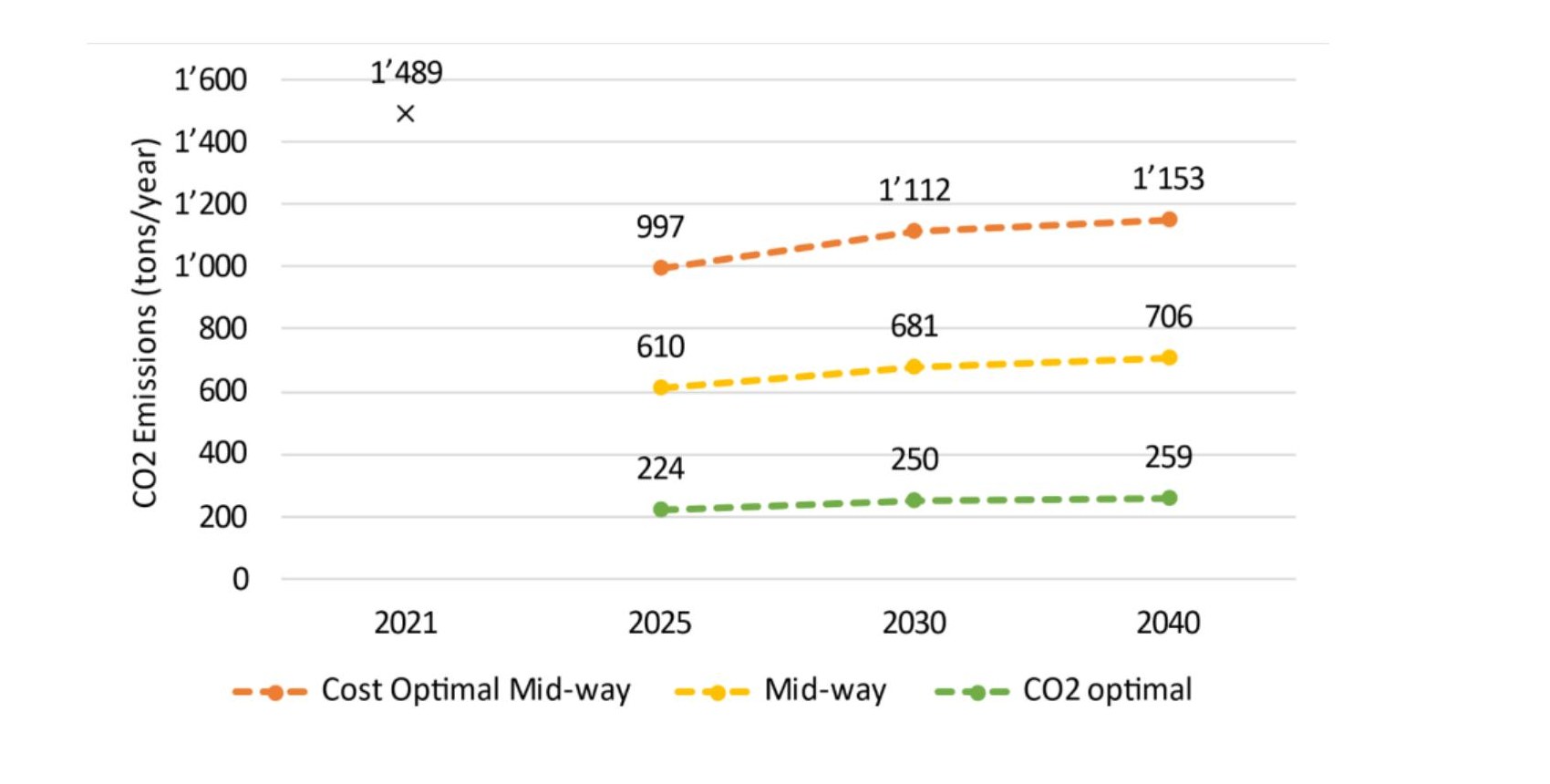
Emission timeline for the three scenarios. The CO₂-optimal path drops from 1,489 tCO₂/year in 2021 to 259 tCO₂/year in 2040, an 83% reduction.
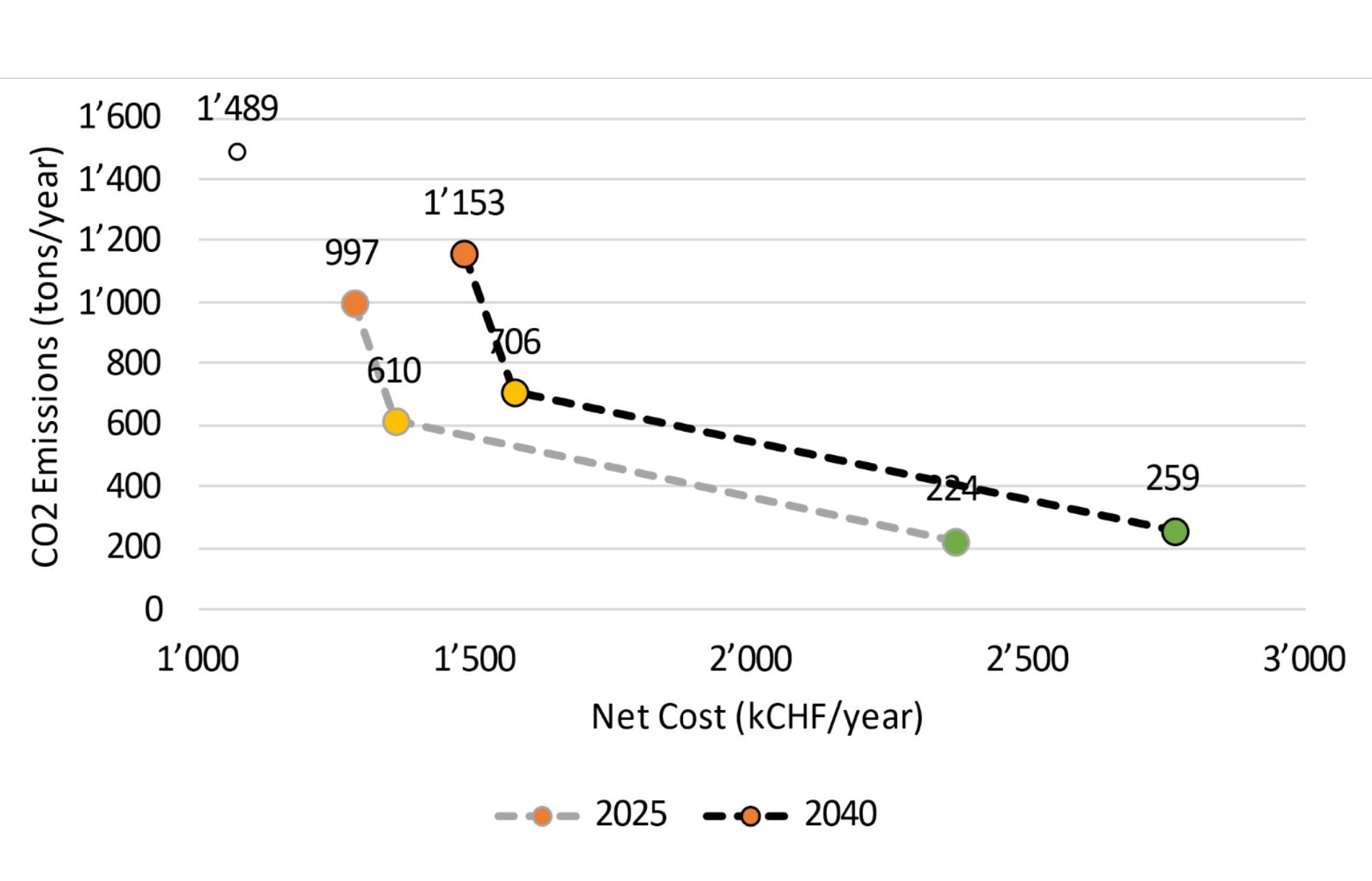
Pareto front for the 2025 and 2040 system variations. The mid-way solution sits between cost-optimal and CO₂-optimal, adding modest cost for substantial emission reductions.
An 83% CO₂ reduction by 2040 for the CO₂-optimal pathway. The mid-way solution delivers further CO₂ cuts versus cost-optimal at only ~6% higher life-cycle cost, a politically attractive trade-off. The model lives on as a digital twin for ongoing project phases.