IWB · Port of Switzerland
Solar development strategy for the Port of Switzerland
Four strategies, 16 variants, and a 20–25% cost reduction at the Port of Switzerland.
Up to 20–25% cost reduction at the port, with regulatory change identified as the dominant risk and interlinking the buildings as the lowest-risk strategy.
- Customer
- IWB · Port of Switzerland
- Sector
- Utility
- Location
- Basel, Switzerland
- Project type
- Solar development strategy
- Solar
- 6,000 kWp PV potential exploited
- Cost
- −20 to −25% vs status quo
- Tools
- Sympheny · MILP optimisation · Scenario matrix · Tariff sensitivity
Find the best solar expansion and energy-sharing strategy for a complex multi-stakeholder port site in Basel.
Compared four strategies and 16 optimised variants across PV expansion, internal electricity sharing, storage, and tariff risk.
All strategies showed savings versus the status quo; the best reached 20-25% lower energy costs with a sequenced investment plan.
The challenge
The Port of Switzerland in Basel, Switzerland’s only commercial port, is committed to a sustainable infrastructure for the region. Together with utility IWB, logistics operators Rhenus Alpina and Ultra-Brag, the port launched the Port Innovation Laboratory to help Basel reach its net-zero target by 2037 in a real industrial test bed. As part of the development plan, Rhenus Alpina was considering installing a third PV plant on the port site, a move that would create more than 6 GWh of potential overproduction, and the consortium wanted to know whether that surplus could be turned into additional revenue or whether something else made more sense.
The site is hard to plan because three things move at once. Spatial complexity: high-impact options like creating an electricity-sharing community require modelling the location of every building that would be connected. Resource availability: intermittent solar generation has to be matched against very different on-site loads, including cranes and buildings. And volatility: the energy market shifts often enough that the analysis had to span several scenarios with different power costs and renewable-export prices. Spreadsheet methods are too coarse for an integrated plan; full simulation tools would have demanded technology decisions the consortium hadn’t yet made.
How Sympheny was used
IWB and the Sympheny team ran the project as four sequential steps: status-quo analysis, goal-setting, scenario modelling, and presentation of the optimal strategies. Four strategies were defined, each building on the previous one: status quo, max on-site production, interlinking of buildings, and max self-consumption with batteries. Each strategy was optimised against four scenarios (stabilisation of energy markets, sustained high prices, excess energy, and unstable supply) for a total of 16 variants.
- Strategy-and-scenario matrix. Sixteen variants (four strategies stress-tested against four energy-market scenarios) produced a single decision matrix showing the cost, investment and risk profile of each option.
- Risk and opportunity dashboard. Variable operating costs, additional total investment, total costs and delta-vs-status-quo per variant, lined up so chances and risks could be compared at a glance.
- Sensitivity to feed-in tariff. Tested how the economics of every strategy shift if the feed-in tariff is replaced by spot-market revenue alone, surfacing regulatory change as the dominant risk.
Result
All four strategies (other than the status quo) deliver cost savings versus today’s operation, up to roughly 20–25%. The full 6,000 kWp PV potential is largely exploited in every strategy except the status quo. Without interlinking the buildings, only 10% of generated electricity is consumed directly on site; in the strategies that include batteries (max self-consumption), the batteries are sized to cover roughly 2–4% of total electricity demand.
The most important finding is that regulatory change is the dominant risk, not market price volatility. The feed-in tariff assumption has the biggest single impact on PV economics. If only the spot electricity price counted as revenue, PV expansion would be capped at 1,900 kWp, and pure max-self-consumption would be more expensive than the status quo. Interlinking the buildings is the strategy that protects the port against a negative tariff change, and the analysis identifies the buildings that should be connected first versus those that only join in some scenarios. The port now has a staged build-out plan it can stand behind, plus one open question for future studies to answer: whether to extend the electricity community to neighbouring port operators.
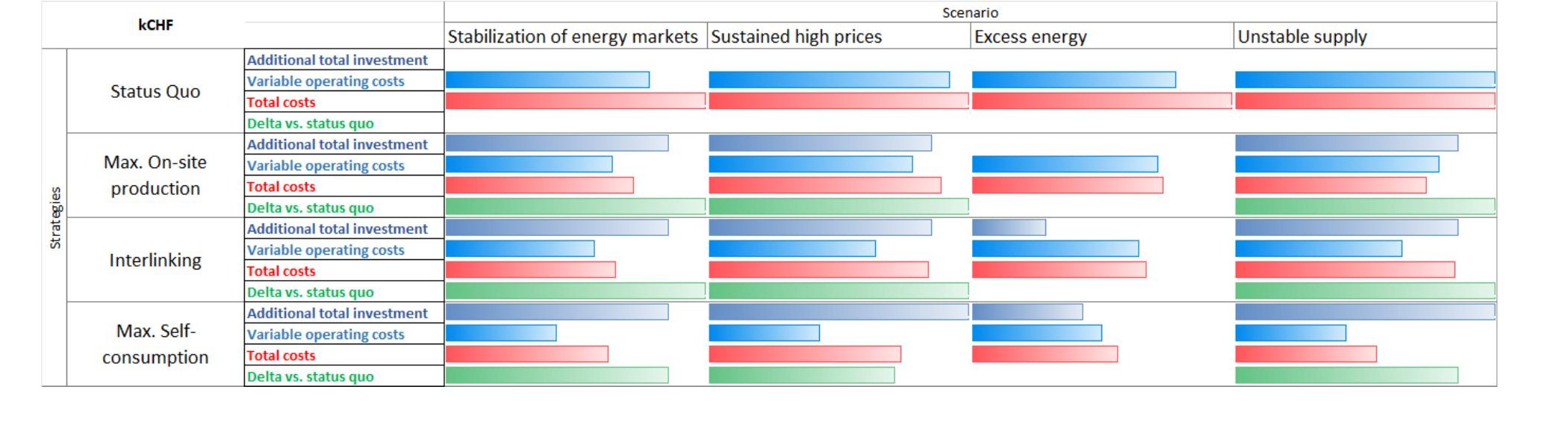
The 4 × 4 strategy-and-scenario matrix calculated in Sympheny. Every strategy beyond the status quo cuts total cost, with savings up to 20–25%.
Published research
The integrated energy planning work at the Port of Switzerland has been published in the proceedings of the 4th International Sustainable Energy Conference (ISEC 2026). Co-authored with the Port of Switzerland, the paper models the port as a multi-hub integrated energy system in Sympheny and identifies 2035 concepts that cut greenhouse-gas emissions by 82–97% and energy imports by 39–44% at comparable annual cost.
Read the paper: Integrated Energy Solutions for Sustainable Port Development (ISEC 2026) →
All four strategies (other than the status quo) deliver cost savings up to 20–25%. Regulatory change is the dominant risk, not market price volatility. Interlinking the buildings is the strategy that protects the port against a negative tariff change.
With Sympheny we've delivered client projects we otherwise wouldn't have taken on at all. From simple analyses to demanding calculations, everything runs in one tool. That simplifies our workflows and saves valuable time.