Neuhof
A self-sufficient campus energy concept
Full energy autarky for a 9-facility educational campus, with Agri-PV tied to seasonal methane storage.
100% renewable, self-sufficient design across nine facilities: Agri-PV with a biodigester, methane and hydrogen storage.
- Customer
- Neuhof
- Sector
- Campus
- Location
- Birr, Switzerland
- Project type
- Self-sufficient campus
- Renewable
- 100% renewable supply
- Tools
- Sympheny · MILP optimisation · Agri-PV modelling · Seasonal storage sizing
Find a technically credible path to 100% energy self-sufficiency without giving up agricultural land use.
Compared Agri-PV, biodigester, methane storage, heat, electricity, and vehicle-fuel options as one connected campus system.
Identified a viable self-sufficient campus concept built around Agri-PV, organic waste, and seasonal methane storage.
The challenge
Neuhof is an educational institution in Birr, Switzerland, supporting young people through facilities for horticulture, gardening, gastronomy, agriculture, painting, metalwork and carpentry, alongside residential and training spaces. Across nine education facilities, offices, housing and farm land (18,000 m² of built area on 172,000 m² of land) the campus has the variety of a small village. Today its energy comes from grid electricity and grid gas. Neuhof set itself the goal of becoming a lighthouse for others: a 100% renewable, fully self-sufficient energy system.
That goal forces sector coupling. Full self-sufficiency means every vector of demand (space heating, electricity and fuels for vehicles including agricultural tractors) has to be met from on-site or immediately surrounding renewable resources. A new training facility and renovations of existing buildings change the demand profile. And a self-sufficient system needs physical space for decentralised production and storage on-site, so any concept has to be spatially feasible, not just energetically optimal.
How Sympheny was used
The Sympheny team first quantified hourly-resolution space-heating, hot-water and electricity demand profiles for every building on site, plus energy demand profiles for vehicles and tractors, using a combination of measurements and energy simulations. On the supply side, on-site renewable resources were assessed and quantified from prior assessments of geothermal potential, wind speeds and water flows, covering solar, geothermal, wind, hydro, agricultural waste, manure and organic waste from the surrounding area. A wide candidate set of conversion and storage technologies was specified (Agri-PV, geothermal probes, a biodigester, batteries, ice storage, pit hot-water storage, hydrogen and methane storage, an electrolyser, a fuel cell, a methaniser, a gas CHP) and Sympheny’s algorithm iterated through possible system configurations to find a minimal-cost, technically feasible path to full autarky.
- Whole-vector self-sufficiency. Optimised heat, electricity and vehicle fuels together, so the algorithm could exploit sector coupling rather than handle each vector in isolation.
- Agricultural resource integration. Treated agricultural surfaces, manure and organic waste as first-class energy resources, alongside solar, geothermal, wind and hydro.
- Seasonal storage logic. Sized methane and hydrogen storage so summer surpluses carry the site through winter without any grid withdrawal.
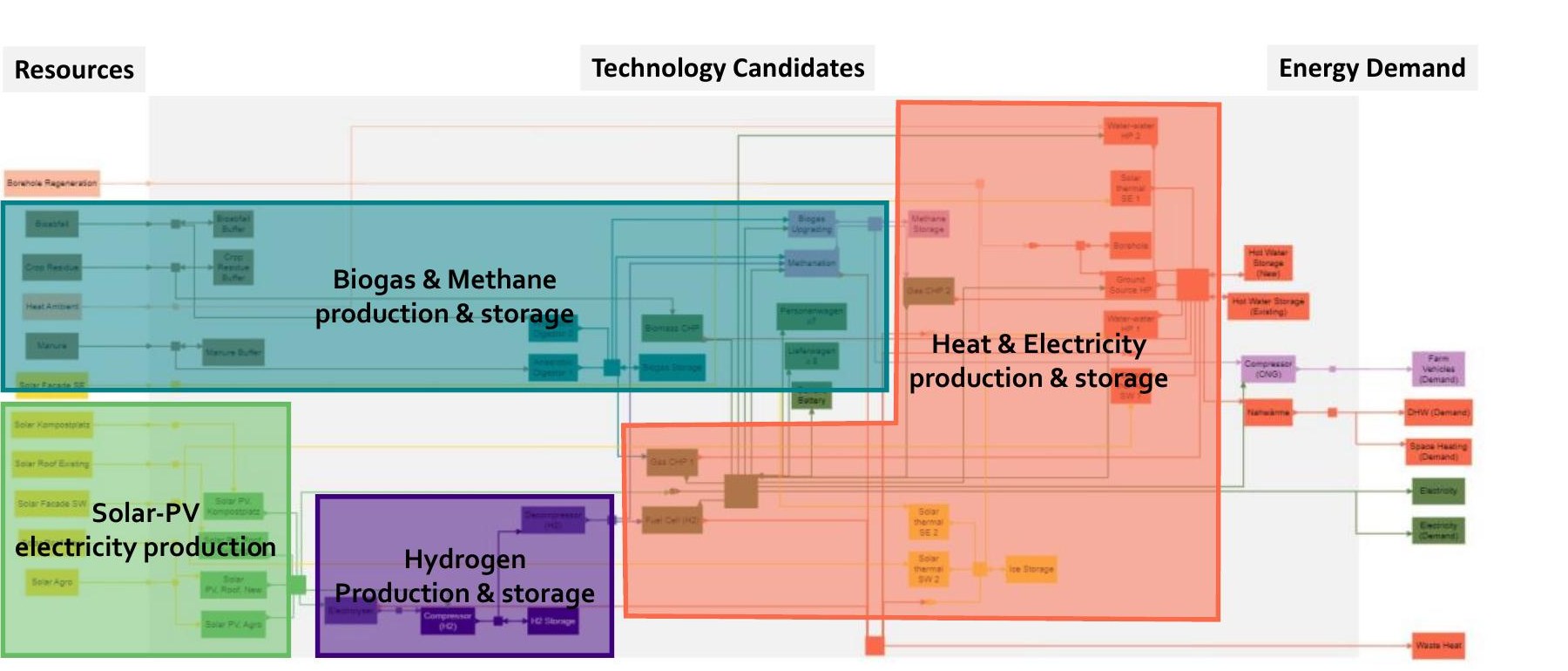
The Neuhof energy system as configured in Sympheny: solar-PV, biogas-and-methane, hydrogen, and heat-and-electricity sub-systems linked into one self-sufficient model.
Result
After multiple optimisation iterations, Neuhof and Sympheny identified one concept with a particularly attractive balance of low system complexity and low life-cycle costs: a large Agri-PV system, a large methane tank for seasonal energy storage, a gas CHP, an air-source heat pump, and several smaller storage systems for shorter-term energy storage. Heat, electricity and methane for the farm vehicles are supplied primarily by the combination of solar from the Agri-PV system and organic waste from on-site and surrounding agricultural operations. The organic waste is run through a biodigester and upgraded to methane, with seasonal storage of methane ensuring sufficient supply through the winter months without any withdrawals from the electricity or gas grid.
The Agri-PV system also produces a significant summer surplus, which in this concept is converted to hydrogen, temporarily stored on-site, and sold to third parties, turning the seasonal mismatch into outside revenue. The concept exploits exactly what makes Neuhof distinctive: ample agricultural surfaces and a steady stream of organic waste. That makes it directly replicable on other agricultural sites and rural areas.
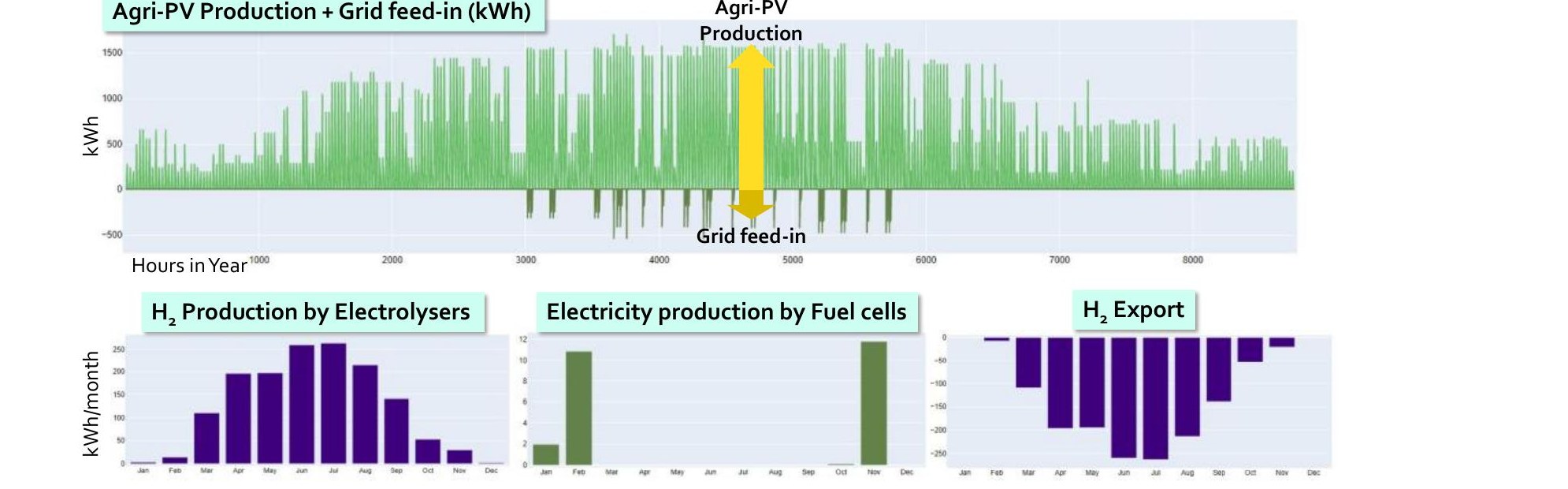
Annual operation of the optimal concept: Agri-PV production through the year, monthly H₂ production from summer surplus, fuel-cell electricity at winter peaks, and the resulting H₂ export profile.
A concept with low system complexity and low life-cycle costs: large Agri-PV, methane tank for seasonal storage, gas CHP, air-source heat pump and smaller short-term storage. Heat, electricity and farm-vehicle methane all supplied from on-site solar and organic waste.