Lauber IWISA
Residential energy concept for a new housing quarter
Three supply variants for a 12,000 m² residential quartier. The groundwater heat pump wins on autarky.
Air-source HPs, groundwater HPs and biomass compared on cost, CO₂ and autarky for a new 16-building Swiss residential quartier.
- Customer
- Lauber IWISA
- Sector
- Engineering Consultant
- Location
- Upper Valais, Switzerland
- Project type
- Residential quarter
- Variants
- 3 variants compared on cost, CO₂ and autarky
- Tools
- Sympheny · MILP optimisation · Three-variant comparison · Autarky analysis
Recommend an energy supply concept for a new 16-home residential quarter using clear cost, CO2, and self-sufficiency evidence.
Compared three supply concepts on the same demand and site model, including cost-optimal and CO2-optimal options.
Groundwater heat pumps emerged as the strongest overall option, with trade-offs clear enough to defend to the client.
The challenge
Lauber IWISA, a building-services firm in the Upper Valais, partnered with Sympheny, the Leipzig University of Applied Sciences and author Simon Bach to plan the energy supply for a new Swiss residential quartier: ten multi-family and six single-family houses, roughly 12,000 m² of heated area. Against the backdrop of supply concerns, rising energy prices, and the 2050 net-zero target, the project had to determine annual costs, annual CO₂-equivalent emissions, and degree of autarky for several supply options.
The hard part was matching parameters to model structure. Many input variables shape the outcome, and the quartier had a wide menu of plausible supply concepts: central versus decentralised, electric versus combustion, single-source versus sector-coupled. Selecting parameters for sources, storage and conversion technologies in a way that produced credible, comparable results was a non-trivial modelling task.
How Sympheny was used
The team used Sympheny to model the entire quartier and let the system optimisation surface the lowest-cost and lowest-CO₂ options across three explicit variants: Variant 1, decentralised air-source heat pumps in every building; Variant 2, central groundwater extraction with a distribution network and decentralised groundwater heat pumps; Variant 3, a central biomass combustion plant feeding a district heating network with house transfer stations. Less common technologies (hydrogen, electrolysers, wastewater as a heat-pump source) were also screened, with hydrogen ruled out on cost grounds.
- Whole-quartier optimisation. Modelled all 16 buildings as a single system rather than a series of standalone calculations, so central infrastructure costs were sized against shared demand.
- Technology-open candidate set. Evaluated air, groundwater and biomass alongside less common options like hydrogen and wastewater heat, letting the algorithm rather than convention pick what survives.
- Three-way trade-off view. Reported each variant on cost, CO₂-equivalent and autarky together, so the engineering choice could be made on all three criteria, not cost alone.
Result
On annual costs and CO₂-equivalent, the two heat-pump variants differ only slightly: the higher capex of groundwater heat pumps is offset over time by lower electricity costs versus air-source. The biomass variant (wood-chip combustion, which beats pellet combustion on both cost and CO₂) has the lowest annual costs of the three.
Autarky is what changes the recommendation. Variant 3 (biomass) has clearly lower autarky than the heat-pump options, which means its annual costs depend heavily on future wood-chip prices. Once cost, CO₂-equivalent and autarky are weighed together, the central groundwater heat pump comes out ahead: slightly higher annual costs, but the highest autarky of the three and the least exposure to imported energy-carrier prices. The Sympheny model is what made the three-way comparison practical, returning the lowest-cost and lowest-CO₂ solutions for each variant directly.
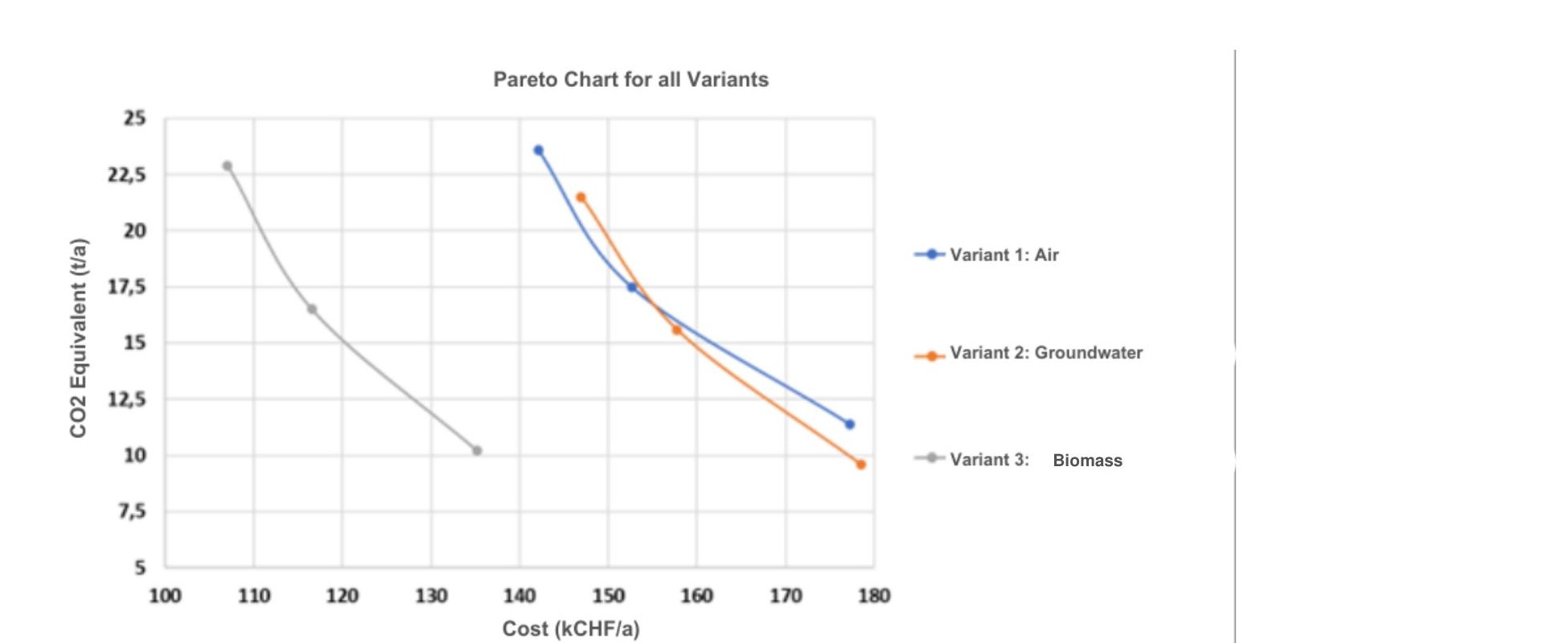
Pareto-optimal solutions for the three supply variants. Biomass (grey) is the cheapest on annual costs, but lower on autarky; the groundwater variant wins once autarky is factored in.
Once cost, CO₂-equivalent and autarky are weighed together, the central groundwater heat pump variant wins: slightly higher annual costs than biomass, but the highest autarky of the three and the least exposure to imported energy-carrier prices.