District cooling, sized and costed before you commit to a plant.
On campuses, in downtown mixed-use districts and around data centers, cooling is now the load that drives the energy bill and the peak demand charge. Sympheny weighs a shared chilled-water system — a central cooling plant, a chilled-water network and thermal storage — against decentralized unit cooling, sized on the real cooling load, so the central-versus-distributed decision is a costed trade-off instead of a default.
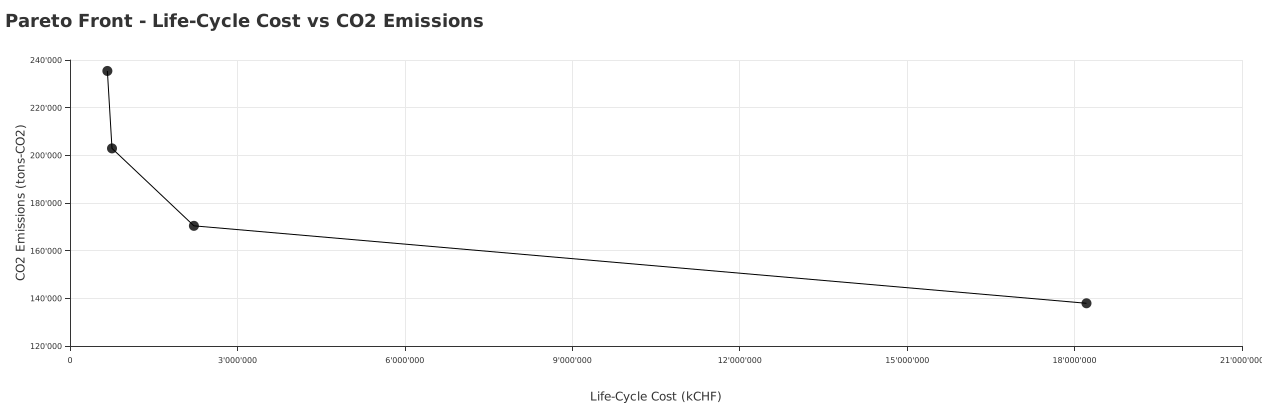
Every district cooling option on one chart: life-cycle cost against carbon, sized on the real cooling load.
What teams planning shared cooling are up against.
Cooling now dominates the load and the budget
On a modern campus, mixed-use district or data-center site, cooling has overtaken heating as the load that sets the electricity bill and the equipment plan. Yet it is often sized building by building, with no view of how a shared plant could pool the demand, recover the diversity between buildings and cut the installed tonnage. The result is more chiller capacity than the district actually needs.
Central versus decentralized gets decided too late
Whether to build one central cooling plant with a chilled-water loop, or leave each building with its own chillers, is the decision that shapes the whole project. But it is usually settled by habit or by the first concept on the table, long before anyone has compared the two on cost, carbon and resilience against the real load. By the time the question gets asked properly, the layout is already fixed.
Peak cooling drives the capacity charges
Cooling is peaky, and the few hottest hours of the year set the demand charges and the chiller sizing for the whole system. Thermal storage — chilled water or ice — can shave that peak and shrink the plant, but only if it is sized against the real hourly cooling profile and valued against the tariff, not bolted on as an afterthought.
Sizing shared heating and cooling networks against real demand is what we do.
A low-temperature network moving 90,000 MWh a year of heating and cooling across six hubs and 30+ scenarios. The same shared-network, peak-pooling modeling a district cooling scheme relies on.
Read case studyA district roadmap testing whether shared heating and cooling could anchor a network, reaching an 83% CO2 cut by 2040 across three fully costed pathways, the same district-scale trade-off.
Read case studySixteen shared-supply and local-sharing scenarios compared in one project. Pooling and sharing energy locally was the lowest-risk strategy, the same logic a central cooling plant runs on.
Read case studySize the plant, the network and the storage in one optimization.
Sympheny models the buildings, the central cooling plant, the chilled-water network and thermal storage as one multi-energy system and optimizes it with mixed-integer programming. It sizes the plant against the pooled, diversified cooling load, places thermal storage to shave the peak, and compares the shared system against decentralized unit cooling on life-cycle cost and carbon, on real hourly demand, rather than building by building.
Model the district and its cooling load as it actually is.
Start from the site, not a blank sheet. Sympheny's GIS-enabled view holds the buildings, their hourly cooling (and heating) demand and the on-site resources, so the system reflects the real cooling density and the diversity between buildings. Pooling load across a campus or downtown block is where a shared plant earns its keep, and that only shows up when the buildings are modeled together.
- GIS site view with buildings, hourly cooling loads and network routes
- Load diversity across buildings captured, not assumed away
- From a single building up to a campus, downtown block or data-center district
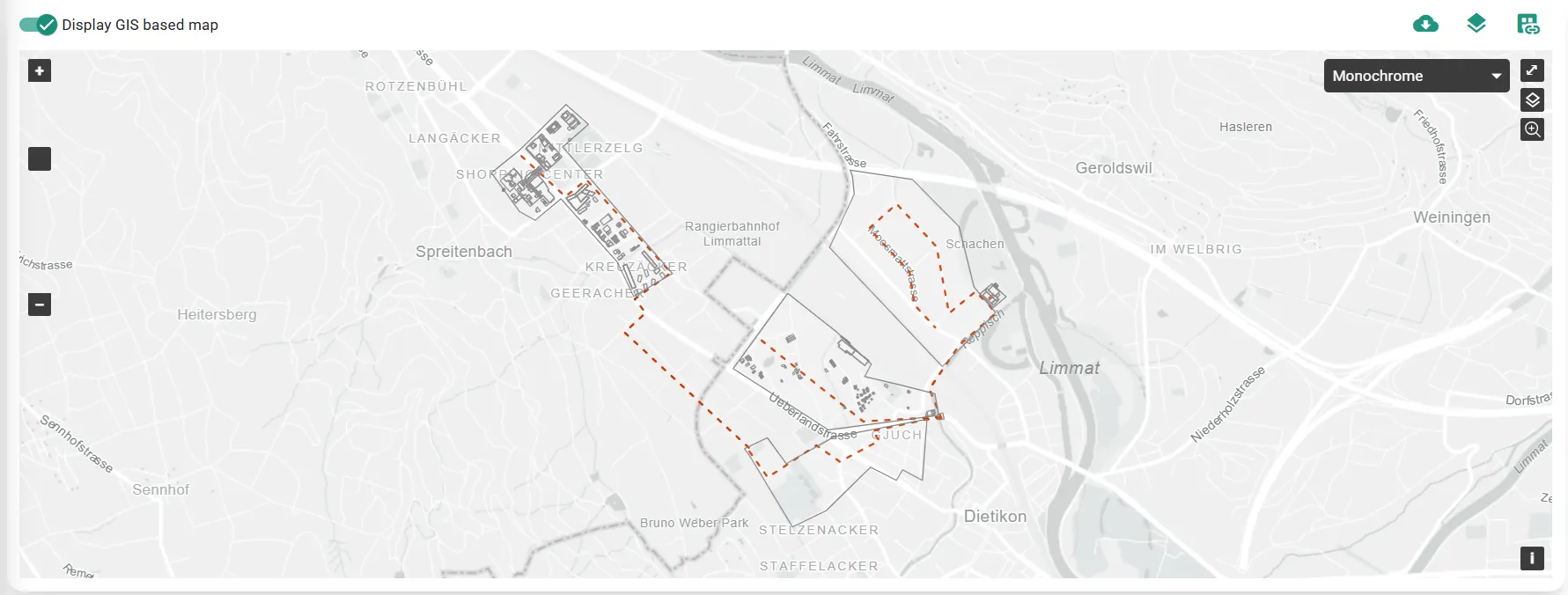
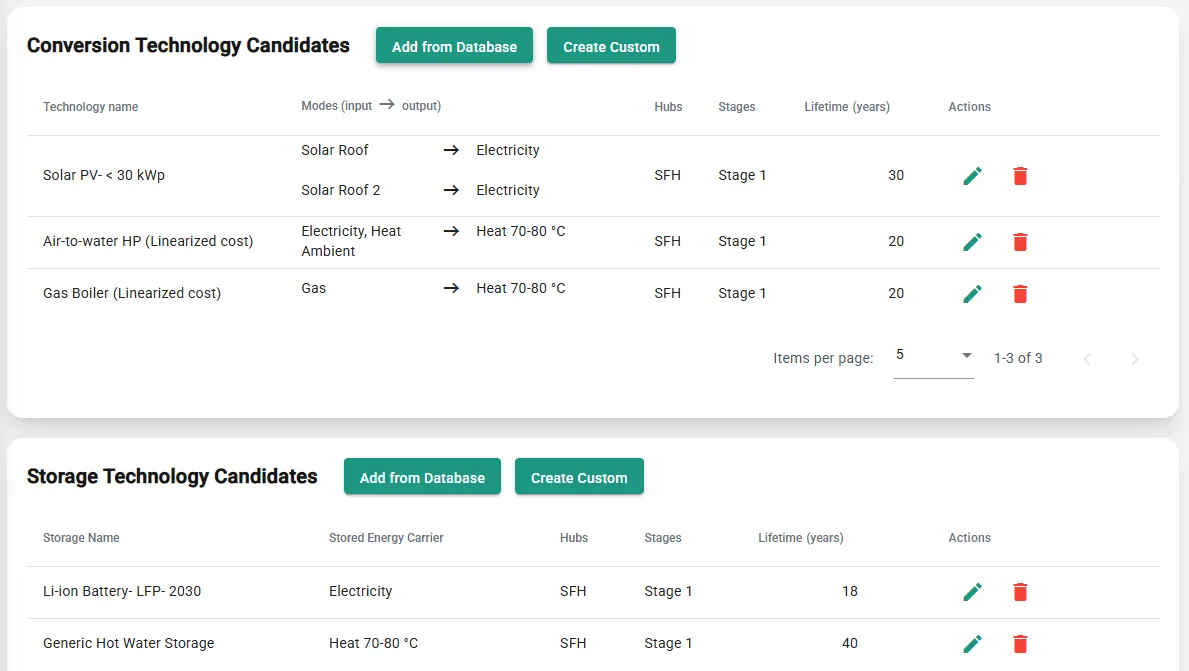
Size the central plant and the chilled-water network together.
Chillers, heat recovery, free cooling, the chilled-water loop and any conventional backup all enter the same optimization. Sympheny sizes the central cooling plant against the pooled load and routes the network, so a shared chilled-water system is compared like for like against leaving each building on its own chillers, inside one model.
- Central chilled-water plant sized against the pooled, diversified load
- Shared system compared like for like against decentralized unit cooling
- Recovered heat and free cooling brought into the same optimization
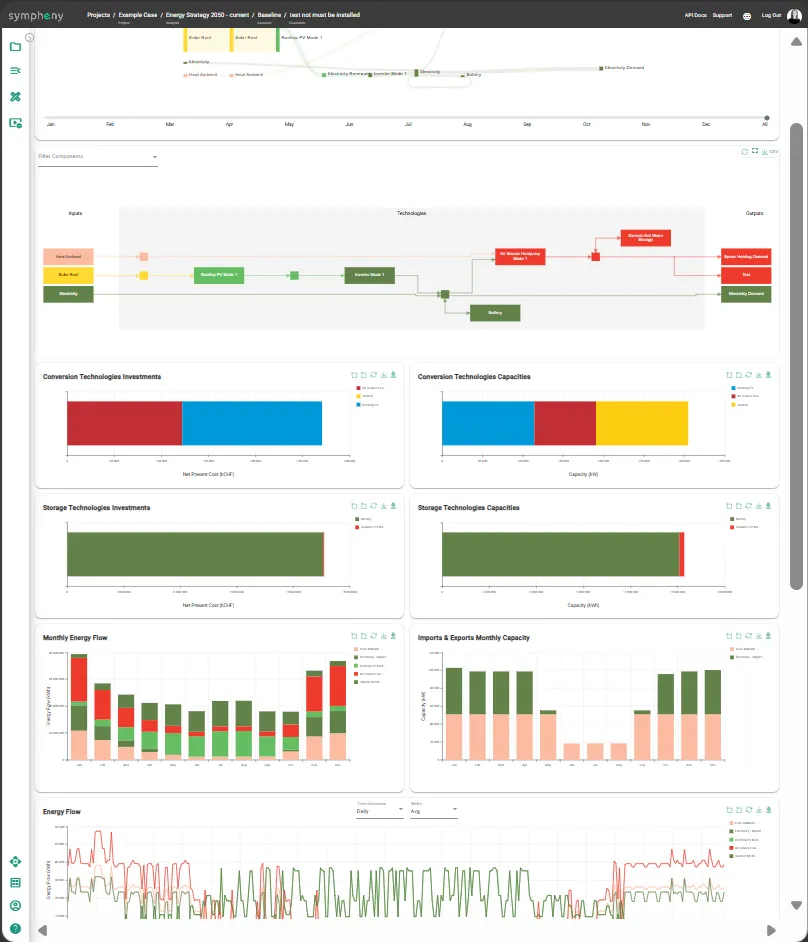
Place thermal storage to shave the peak.
Chilled-water and ice storage shift cooling out of the few hours that set the demand charges and the chiller sizing. Sympheny sizes that storage against the real hourly cooling profile and the tariff, so you can see how much it shrinks the plant and the capacity charge before you commit to it, rather than guessing.
- Chilled-water and ice storage sized against the real hourly profile
- Peak demand and chiller tonnage reduced, then costed against the tariff
- Cooling, cost and CO2 compared on one Pareto front
Stage the build and defend it in review.
Stage the plant and the network against the budget and the load growth, and compare staged scenarios on one Pareto front. Every result traces to its inputs and runs on a deterministic MILP engine, so the recommendation survives the review where a board, a campus committee or a lender asks why.
- Network and plant staged against budget and load growth
- Deterministic, auditable outputs a reviewer can interrogate
- Scenario comparison with automated sensitivity analysis
For the developer, university or utility, the output is a costed answer: what a central district cooling system costs against decentralized chillers, how much thermal storage shaves off the peak and the capacity charge, and the staging that fits the budget. The figures are directional, from the project model, not a guaranteed outcome for a specific site.
Sympheny does not replace your detailed hydraulic or mechanical design tools, and it is not a chiller-plant control system. It sits upstream of them, deciding whether a shared chilled-water system is worth building, how big the central plant and storage should be, and which configuration meets the cooling load at the lowest total cost. Once the concept is fixed, your detailed-design and delivery partners size pipes and plant and take it from there.
District cooling judged as a whole system, not one chiller at a time.
A shared chilled-water system only pays off when the plant, the network and the storage are sized together against the pooled load. Sympheny weighs all of them against decentralized cooling and the budget, which is what turns the central-versus-distributed question from a default into a costed decision.
Multi-energy, not cooling in isolation
Cooling, heating and electricity are modeled together, so heat recovery, free cooling and a shared loop can carry value that a standalone chiller plant cannot, and the cheapest mix shows up in the result.
The cooling side of a thermal energy network
District cooling is one half of a shared thermal energy network. Sympheny models heating and cooling on the same loop, so the cooling decision is made in the context of the whole network, not bolted on separately.
Upstream of detailed design and delivery
Sympheny settles whether to build a shared plant and how big. Hydraulic design, controls and detailed engineering sit with your design and delivery partners. It is the concept-stage layer, not a substitute for them.
District cooling feasibility, explained.
What is district cooling?
District cooling is a shared chilled-water system that produces cooling at a central plant and distributes it through an insulated pipe network to many buildings, instead of each building running its own chillers. It is common on campuses, in dense downtown and mixed-use districts, and around cooling-heavy loads like data centers. Because a central plant serves the pooled, diversified load of many buildings, it usually needs less installed chiller capacity than the sum of standalone systems, and it can add thermal storage to shave the peak. Sympheny sizes that system against the district's real cooling load and prices it against decentralized cooling.
How is district cooling different from decentralized unit cooling?
Decentralized cooling gives each building its own chillers, sized for that building's own peak. District cooling pools the load of many buildings onto one central plant and a shared chilled-water network. Because buildings rarely all peak at the same moment, the central plant can be smaller than the sum of the individual systems, and it can run more efficiently and host thermal storage. The trade-off is the cost and disruption of the network. Sympheny compares the two on the same life-cycle cost and carbon basis, on real hourly demand, so the central-versus-distributed decision is costed rather than assumed.
How does thermal storage shift the cooling peak?
Cooling is peaky: a few hot hours set the demand charges and the chiller sizing for the whole year. Chilled-water or ice storage makes and stores cooling in the off-peak hours and discharges it during the peak, so the central plant can be smaller and the demand charge lower. The value depends on the hourly cooling profile and the tariff, which is why it has to be sized against the real load. Sympheny sizes the storage inside the same optimization that sizes the plant, and shows how much it shaves off the peak and the capacity charge before you commit.
How does Sympheny model the cooling network and plant?
Sympheny builds a GIS model of the district — the buildings, their hourly cooling and heating demand, and the on-site resources — then sizes the central plant, routes the chilled-water network and places thermal storage as one mixed-integer optimization. Chillers, heat recovery, free cooling and storage all enter as candidate technologies, and the shared system is compared against decentralized cooling on life-cycle cost and CO2. The outputs are deterministic and traceable, so an engineer or a reviewer can interrogate every number.
How does district cooling relate to a thermal energy network?
District cooling is the cooling side of a thermal energy network. A thermal energy network is a shared loop that moves heating and cooling between buildings, often at low or ambient temperature, with heat pumps and recovered heat. District cooling is the case where the dominant load on that loop is cooling. Sympheny models heating and cooling on the same network, so a cooling-led project is planned in the context of the whole thermal energy network rather than as a separate system. You can read more on the thermal energy networks pillar.
What drives the district cooling feasibility decision?
Usually three things: the cooling load and how dense and diverse it is across the district, the cost and disruption of building a chilled-water network, and the value of pooling the load and adding thermal storage to shave the peak demand charge. Resilience matters too where the cooling cannot go down, as around data centers. Sympheny puts all of these on the same cost and carbon basis, so the developer, university or utility can see whether a shared plant pencils out against decentralized cooling before the layout is fixed.
Related US planning topics and proof.
Plan district cooling you can actually price.
Bring us a campus, downtown block or data-center site. We will size the central plant, the chilled-water network and the storage against the real cooling load, and show you what a shared system costs against decentralized chillers, before anyone specifies a chiller.