Energy resilience, sized and costed before you commit.
Data centers, military bases, hospitals and campuses all carry loads that cannot go dark. Sympheny sizes the on-site generation, storage and microgrid that carry the critical load through an outage, and puts the cost of each level of resilience on the table, so the decision is a trade-off you can defend instead of an assumption.
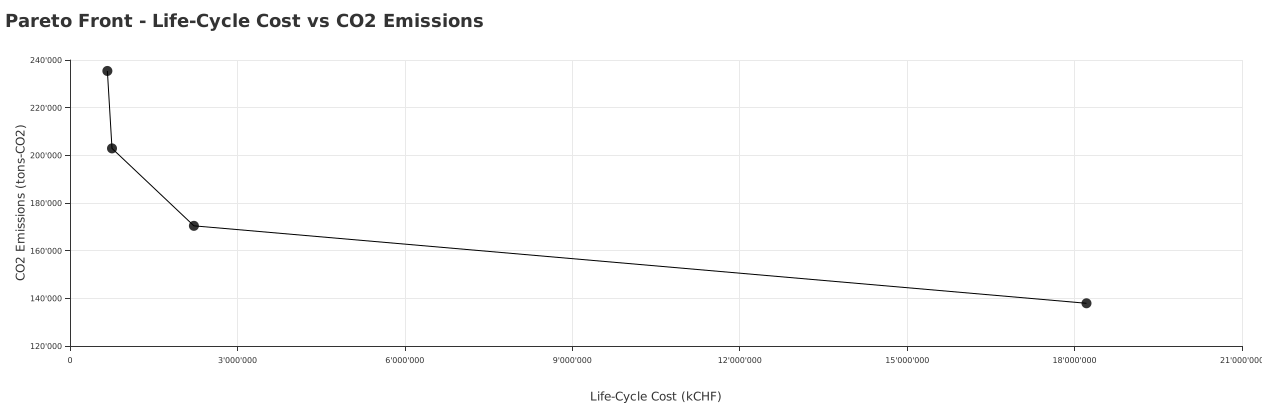
Every resilient-supply option on one chart: life-cycle cost against carbon, with the critical load held through an outage.
What teams planning for critical-load resilience are up against.
The grid is less of a sure thing
Outage exposure is rising with extreme weather and a strained grid, and for a data center, base or hospital an interruption is a mission and revenue event, not an inconvenience. The question is no longer whether to back up the critical load, but how much on-site capacity is worth building, and that is a cost question as much as an engineering one.
A diesel genset is not a plan anymore
Standby diesel covers an outage but earns nothing the rest of the year and carries its own emissions and fuel-logistics risk. On-site generation, storage and a microgrid can carry the critical load and also cut the energy bill and the carbon, but only if they are sized against the real load instead of a nameplate.
Resilience gets assumed instead of costed
Most projects bolt resilience on after the system is chosen, so nobody can say what an extra hour of ride-through or an extra nine of availability actually costs. A defensible plan compares resilience levels on the same cost and carbon basis, which is exactly the comparison a board, a program office or a lender asks to see.
Sizing on-site systems against a hard constraint is what we do.
An on-site system that gave a site a viable path to energy self-sufficiency, generation and storage sized against its own load, the same problem a critical site solves to ride through an outage.
Read case studySixteen on-site generation and energy-sharing scenarios compared in one project. Generating and sharing power locally was the lowest-risk strategy, the same on-site logic a microgrid relies on.
Read case studyA low-temperature network moving 90,000 MWh a year across six hubs and 30+ scenarios. The same multi-energy, multi-hub modeling a resilient campus or base relies on.
Read case studySize the resilient system, and price each level of resilience.
Sympheny models electricity, heat, cooling, on-site generation and storage as one multi-energy system and optimizes it with mixed-integer programming. It sizes the generation, storage and microgrid that carry the critical load through an outage of the length you set, and returns the cost and carbon of each resilience level, so resilience becomes a line in the trade-off rather than an afterthought.
Model the critical site and its loads as they are.
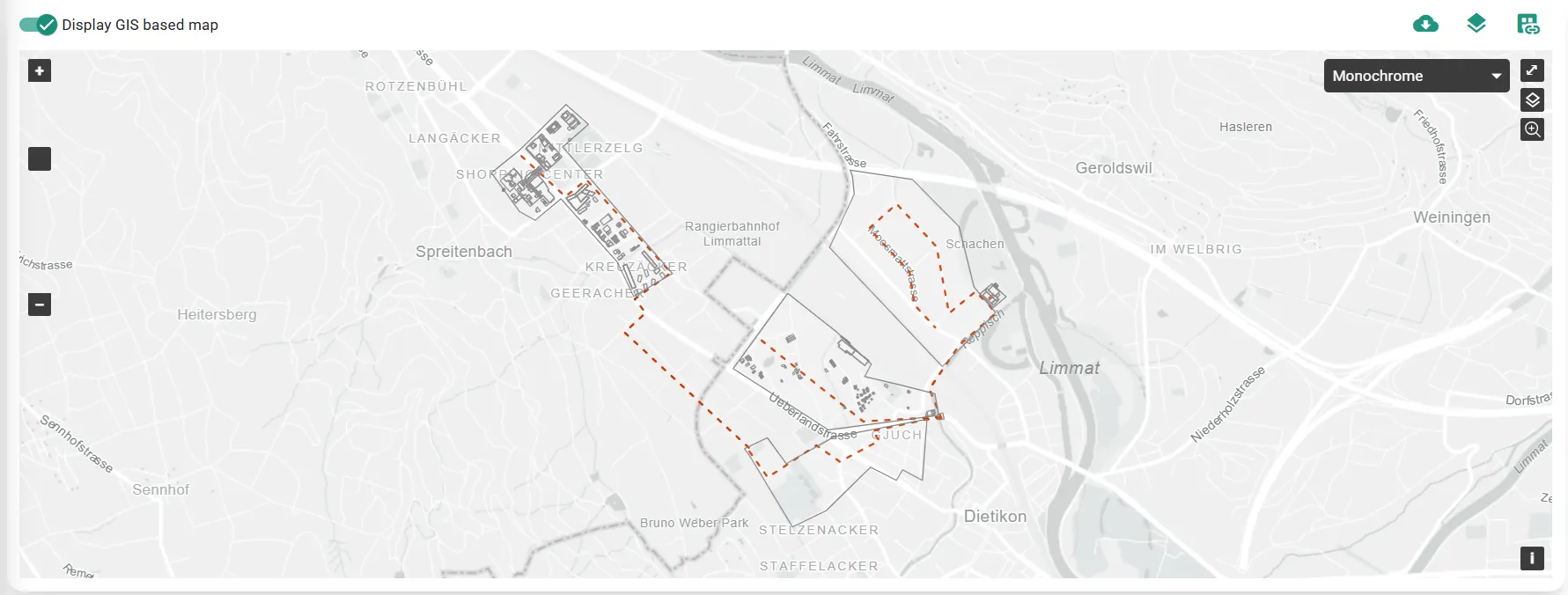
Start from the site, not a blank sheet. Sympheny's GIS-enabled view holds the buildings, their electricity, heating and cooling demand, and the on-site resources, so the resilient system reflects the real load and what the site can actually draw on. Critical and deferrable loads are distinguished, because not everything has to ride through an outage.
- GIS site view with buildings, hourly loads and on-site resources
- Critical, essential and deferrable loads separated
- From a single facility up to a base, campus or data-center district
Size the system that carries the critical load through an outage.
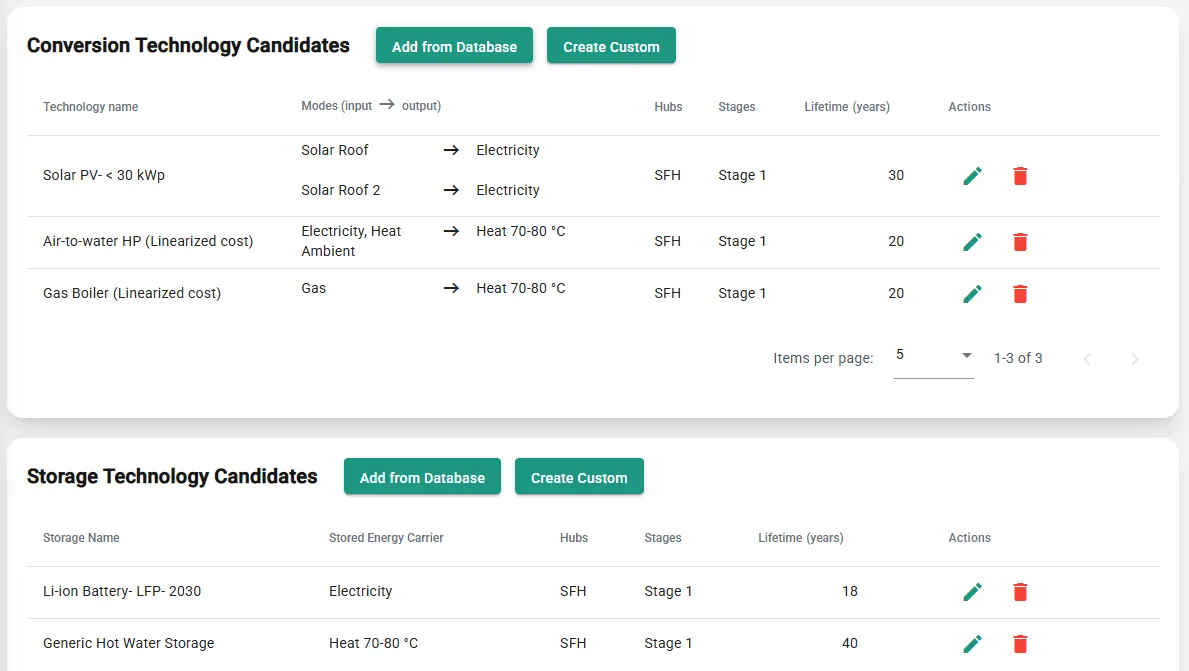
Model PV, storage, generators, fuel cells, heat and cooling together, and size the microgrid to hold the critical load through an outage of the duration you choose. The system is justified by the load it has to carry when the grid is gone, and by the bill and carbon it cuts the rest of the time.
- Islanded operation sized against a defined outage duration
- On-site generation and storage that also cut the everyday bill
- Critical load held while non-essential load is shed
Put a price on each level of resilience.
How long the site has to ride through, and how certainly, are inputs, not guesses. Sympheny compares resilience levels on the same cost and carbon axes, so you can see what another hour of ride-through or another increment of availability costs before you commit to it.
- Ride-through duration and availability set as targets, then costed
- Resilience, cost and CO2 compared on one Pareto front
- The marginal cost of more resilience made explicit
Stage the investment and defend it in review.
Stage the capital against the budget and the load, and compare staged scenarios on one Pareto front. Every result traces to its inputs and runs on a deterministic MILP engine, so the recommendation survives the review where a program office, board or lender asks why.
- Investment staged against budget and load growth
- Deterministic, auditable outputs a reviewer can interrogate
- Scenario comparison with automated sensitivity analysis
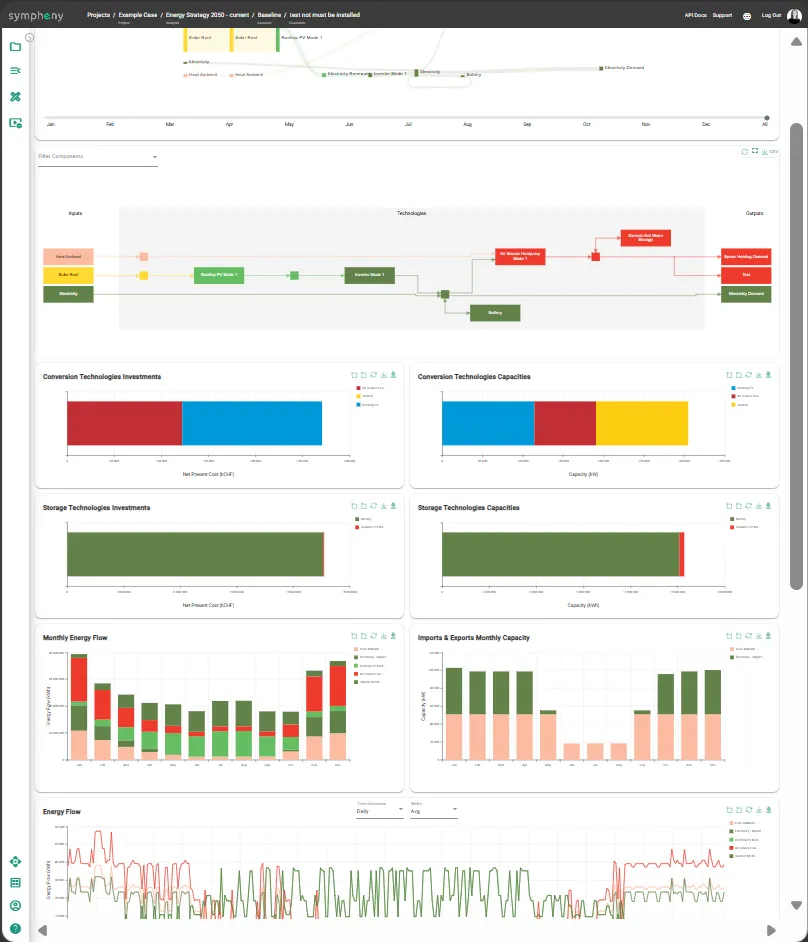
For the executive or program lead, the output is a costed answer: what each level of resilience costs, the lowest-cost system that holds the critical load through the outage, and the staging that fits the budget. The figures are directional, from the project model, not a guaranteed outcome for a specific site.
Sympheny does not replace your electrical or controls design tools, and it is not a microgrid controller or an EPMS. It sits upstream of them, deciding how much on-site generation, storage and microgrid is worth building and which configuration carries the critical load at the lowest total cost. Once the concept is fixed, your detailed-design, interconnection and delivery partners take it from there.
Resilience planning that judges the whole system, not one vector.
A resilient site is more than a battery on the electricity side. Sympheny weighs generation, storage, heat and cooling together against the critical load and the budget, which is what turns resilience from an assumption into a costed decision.
Multi-energy, not a single-vector microgrid
Electricity, heat and cooling are modeled together, so a CHP unit, thermal storage or a shared loop can carry resilience that a battery alone cannot, and the cheapest mix shows up in the result.
Upstream of detailed design and delivery
Sympheny settles how much resilience to build and which configuration. Microgrid controllers, switchgear and detailed engineering sit with your design and delivery partners. It is the concept-stage layer, not a substitute for them.
Applied in US federal energy work
Sympheny's optimization engine has been applied in US Department of Defense thermal energy network feasibility studies under the ESTCP program, as the design-optimization layer that compares system options on cost and energy.
Resilient energy planning, explained.
What is energy resilience?
Energy resilience is the ability of a site to keep its critical loads running through a grid outage or disruption, and to recover quickly afterward. For a data center, base, hospital or campus it usually means on-site generation, storage and a microgrid that can island from the grid and carry the critical load for a defined duration. Sympheny sizes that system against the site's real load and prices each level of resilience, so the decision is a costed trade-off rather than an assumption.
How do you size a microgrid for resilience?
You start from the critical load, the outage duration you have to ride through, and the availability you need, then size on-site generation and storage to hold that load when the grid is gone. Sympheny does this against the site's real hourly load, separates critical from deferrable load, and optimizes generation, storage and the microgrid together, so the system is sized for real operation and not a nameplate number. It also values the bill and carbon savings the same assets earn the rest of the year.
What does a resilient microgrid cost?
It depends on how much load has to ride through, for how long, and how certainly, which is exactly why resilience should be costed rather than assumed. Sympheny compares resilience levels on the same life-cycle cost and CO2 axes and shows the marginal cost of each additional increment, so you can see what another hour of ride-through or another nine of availability costs before you commit. The figures are directional, from the project model, for a specific site.
How is resilience planning different from a standby generator?
A standby generator covers an outage but earns nothing the rest of the year and adds emissions and fuel-logistics risk. A resilient microgrid sizes on-site generation, storage and flexibility so the same assets carry the critical load during an outage and cut the energy bill and carbon the rest of the time. Sympheny models both modes in one optimization, so the system is justified by year-round value, not just by the hours the grid is down.
Does Sympheny support federal and DoD resilience work?
Sympheny's optimization engine has been applied in US Department of Defense thermal energy network feasibility studies under the ESTCP program, as the upstream design-optimization layer that compares system options on cost, carbon and energy. It produces deterministic, traceable outputs a program office and funder can interrogate, and sits ahead of detailed mechanical and electrical design rather than replacing it.
How does Sympheny fit alongside a microgrid controller or EPMS?
It sits upstream of them. A microgrid controller and an energy power management system operate the system once it is built and chosen. Sympheny answers the earlier question: how much generation, storage and microgrid is worth building, and which configuration holds the critical load at the lowest total cost. Once that concept is fixed, the controls and detailed-design tools take over. The two are complementary.
Related US planning topics and proof.
Plan resilience you can actually price.
Bring us a critical site. We will size the generation, storage and microgrid that carry the load through an outage, and show you what each level of resilience costs, before anyone specifies a component.