Deliver more US energy concepts per engineer.
US energy concept work is now high-volume: microgrid feasibility, behind-the-meter sizing, thermal energy networks, interconnection-constrained sites. Sympheny lets your firm scale that output without scaling senior headcount. The optimization engine handles scenario preparation so your engineers spend their hours on judgment and defend the result in front of the client.
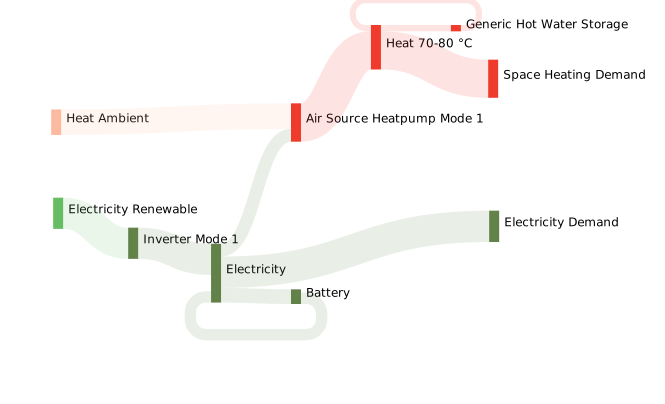
Detailed Sankey energy flow. Every carrier, technology and storage element traced from supply to demand.
Trusted by consulting engineering teams
Used by engineering consultancies across Europe on feasibility, district energy, microgrid and campus planning projects. The workflow carries directly to US microgrid, behind-the-meter and thermal-network work.




How Sympheny helps
From site brief to a defensible concept
Go from project inputs to a working multi-energy scenario without rebuilding a spreadsheet first. Power, heat, cooling, storage and on-site generation are modeled together, so sector-coupling shows up in the result instead of falling between two separate studies.
More scenarios, recommendations that hold up
The MILP engine evaluates tens of thousands of technology and capacity combinations per run, then puts every scenario on the same cost and CO2 axes. Sensitivity runs on tariffs, load growth and fuel prices are part of the workflow, which is what keeps a recommendation standing when the client pushes back.
Outputs the client's reviewer can read
Sankey flows, Pareto charts and dashboards come straight from the model, in the browser, ready for a review call. Your engineers spend their hours on judgment, and your firm bills for analysis instead of chart formatting.
What changes for A&E and consulting teams
| Process | Before Sympheny | With Sympheny |
|---|---|---|
| Project setup | Each assignment starts from a fresh spreadsheet rebuilt by a senior engineer | Structured inputs and reusable workflows. Every project starts from a working baseline |
| Scenario breadth | Two or three options per project, because each variant is manual rework | Pareto comparison across cost, CO2 and technical constraints, with sensitivity runs included |
| Client delivery | Results translated by hand into slides before every review | Client-ready Sankey, Pareto and dashboard outputs from the same model that ran the optimization |
| Team capacity | More projects means hiring more senior engineers, a 12-month problem | The same team takes on more concept work without dropping the standard clients expect |
The sensitivity analysis is what makes a recommendation stick when the client pushes back.
“Sympheny supports our strategic energy planning in an ideal way. The flexibility is extremely convincing and the sensitivity analysis provides security in finding solutions.”
— Andreas Wirz, Chief Digital Officer, Eicher+Pauli (Switzerland) Read the full WSP case study →
Engineering workflows, proven on live European projects.
See how engineering teams used Sympheny to take a feasibility study from a site brief to a defensible concept, and how the analysis held up once a client started pushing on the numbers. The method carries to US microgrid, behind-the-meter and thermal-network work.
Green hydrogen production and sector coupling
Technical proof: Green hydrogen and sector-coupling variants optimised
Business outcome: 60% CO2 reduction and up to 26% lower life-cycle costs identified.
Strategic energy concept for the Insel-Holligen district
Technical proof: 30+ price and demand scenarios tested
Business outcome: Infrastructure investment stress-tested before commitment.
Residential energy concept for a new housing quarter
Technical proof: 16 buildings, 3 supply variants on the same Pareto front
Business outcome: Groundwater heat pumps win once cost, CO2 and autarky are weighed together.