From a site the grid can't power yet to a concept you can build and finance.
Four steps take a US site from its real hourly load and its interconnection limit to an optimized energy concept, with the cost, carbon and resilience case to defend it. Behind-the-meter generation, storage, microgrids and thermal energy networks, sized together.
Scenario setup, optimization and reporting in one workflow.
Four steps from a connection constraint to a buildable system.
The hard part of a US energy project isn't the equipment. It's proving, to a utility, a funder and a tenant, that the system you want to build is the right size and the lowest total cost given a grid that can't yet carry the load. Here is how Sympheny gets you there.
Start from the real load and the connection limit
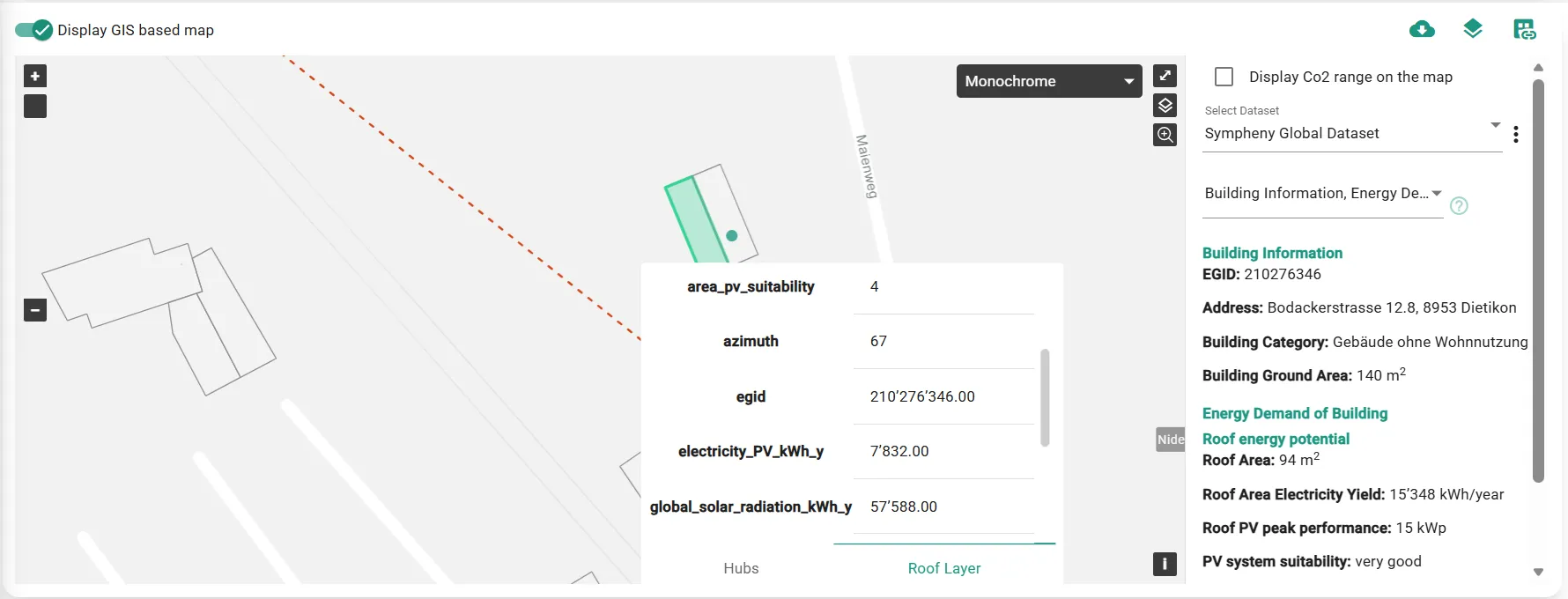
Most studies start from a nameplate number. We start from the load shape that actually shows up at the meter and the interconnection capacity you can realistically get. AI and HPC workloads swing hard hour to hour, and US tariffs, demand charges and capacity costs all turn on those peaks. You bring the hourly demand, the tariff structure and what the utility has told you the connection can carry. Sympheny models against that constraint, not against a flat average that nobody operates at.
Lay out the options as a digital twin
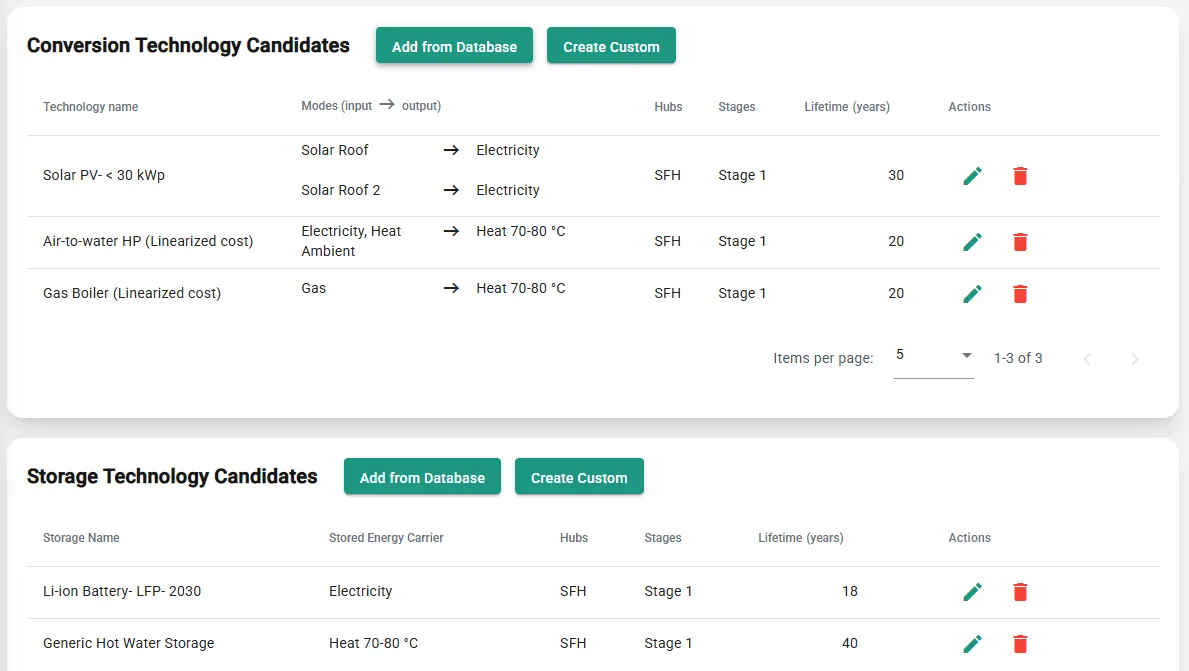
Behind-the-meter generation, battery and thermal storage, an on-site microgrid, cooling, a thermal energy network and the grid connection itself all go in as candidates that compete on cost and carbon. Nothing is decided up front. You can drop in your own asset catalog and assumptions, so the twin reflects the equipment and prices you'd actually procure, not generic library defaults.
Optimize for the system that gets the site powered
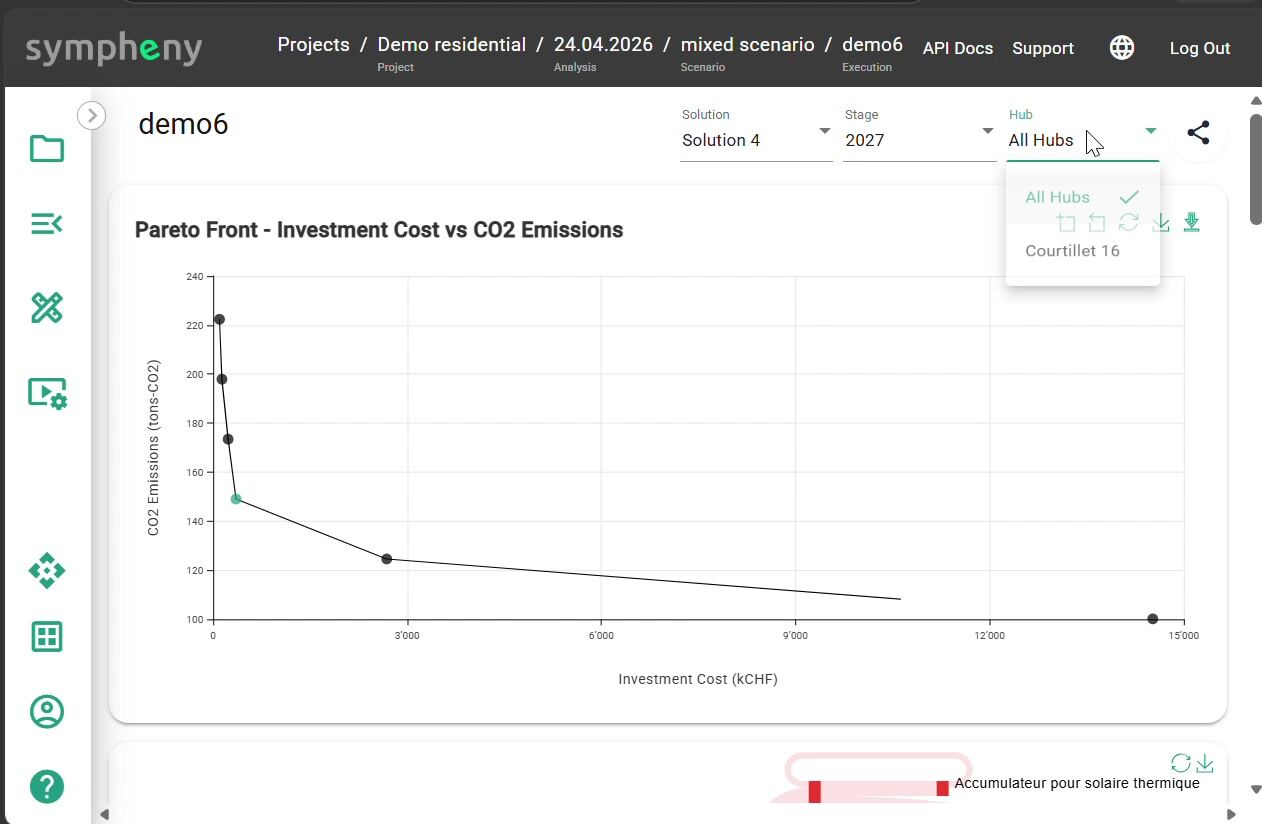
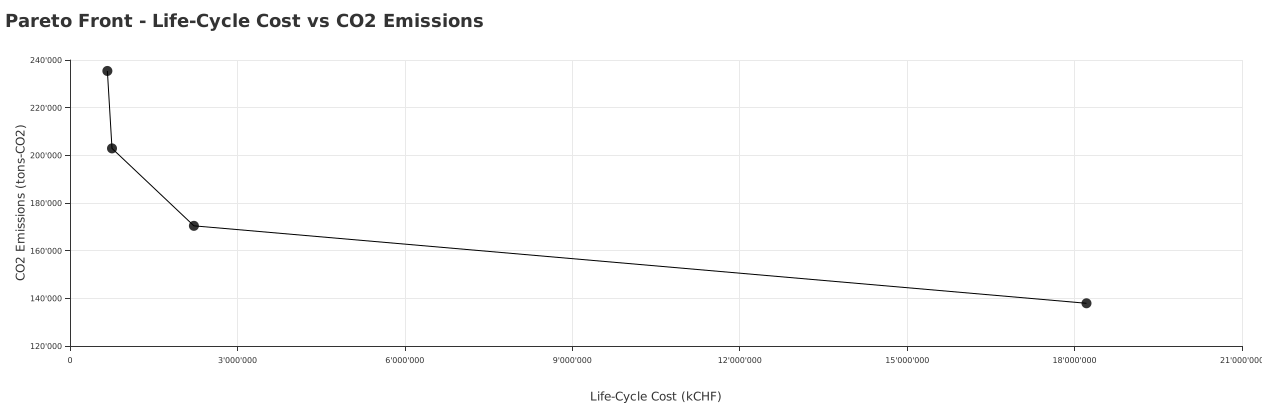
Sympheny sizes the system that powers the site at the lowest total cost while hitting your resilience and carbon targets, and while respecting the connection limit. It runs on a deterministic MILP engine, which is math, not AI, so two people running the same inputs get the same answer and can defend it. The output isn't one scenario, it's a Pareto front: every optimized option laid out so you can see what an extra increment of resilience or decarbonization actually costs.
Produce outputs that survive the review
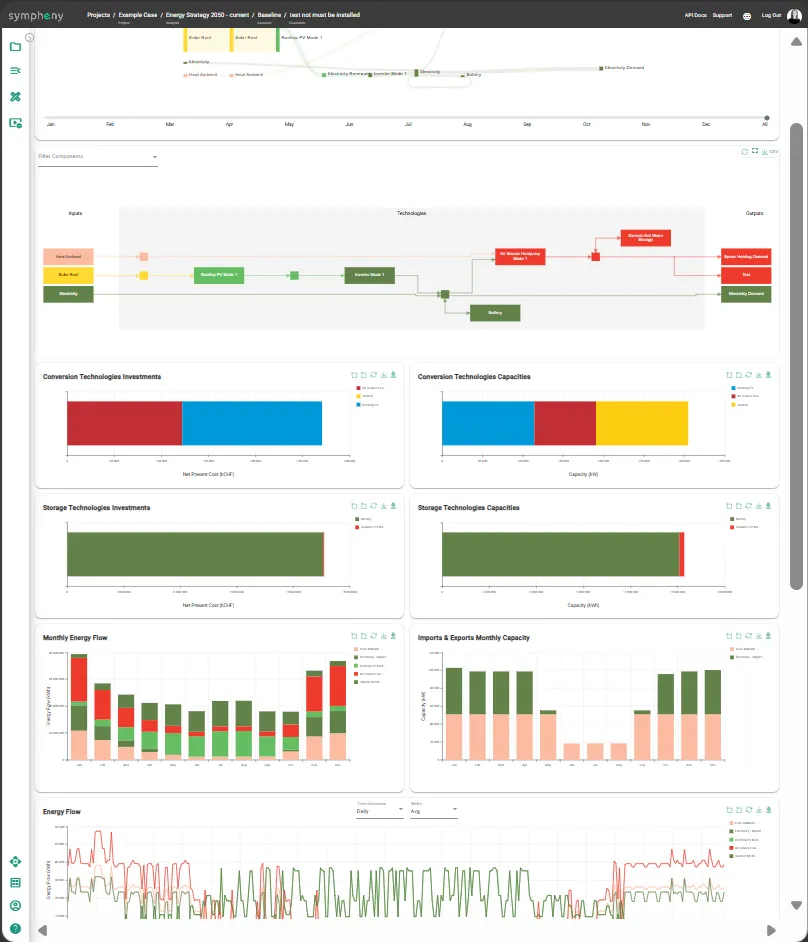
A concept is only worth as much as it stands up to scrutiny. Sympheny generates hourly profiles, load-duration curves, Sankey energy flows and the cost and carbon comparison from the same model, so the numbers reconcile. That feeds the four reviews a US site has to clear: the interconnection request, the CFO or board case, documentation for a federal energy program, and the due diligence a hyperscale tenant runs before it signs.
One model, so the numbers don't fall apart between reviews.
The load case you file with the utility, the cost case you take to the board and the carbon case in a program submission all come out of the same optimization. There's no separate spreadsheet drifting away from the model, so when a reviewer pushes on one number, the rest still holds.
“With Sympheny I compared far more energy-system variants in my project work than would ever have been possible by hand in Excel. And for each variant I could see straight away what it meant technically, in energy terms, and economically.”
The whole energy system, traced from source to end use.
Built for the teams powering critical US sites
The technical lead who has to size the system and the economic buyer who has to fund it both work from the same model, so the concept that gets built is the one everyone signed off on.
Data Center Developers & Operators
Get a site powered when the grid can't yet. Size behind-the-meter generation, storage and a microgrid against the real load, and carry an interconnection request and clean-power case the utility and your tenants will accept.
Learn moreA&E Firms & Consulting Engineers
Take a feasibility study from a site brief to a defensible, optimized concept, with multi-energy rigor and client-ready outputs you can stand behind in the room.
Learn moreFederal & DoD Energy Programs
Compare thermal energy network and microgrid options for a campus or base on cost, carbon and resilience, with documented outputs a program reviewer and funder can interrogate.
Learn moreUtilities & Energy Providers
Plan across sites, networks, tariffs and investment horizons that run decades out, with scenarios solid enough to back a real infrastructure call.
Learn moreThe method a US site relies on, demonstrated on real projects.
These are European commissions. They show the engine and the method working end to end on the exact problem a US data center, campus or base now faces: needing less from the grid by generating, storing and sharing on site.
A two-site system sharing a thermal network and a microgrid, optimized with life-cycle cost up to 26% below the baseline. The same generate-store-share approach a US campus relies on to need less from the grid.
Read case studyA municipal utility sizing an anergy network across multiple buildings. The ambient-loop and supply-mix problem a federal or data-center-district thermal energy network poses, worked end to end.
Read case studyMulti-energy optimization on a live research campus, the modeling rigor behind the engine, demonstrated on a real site rather than a slide.
Read case studyWatch the workflow run.
A short overview of the platform, plus a look at the results a finished project produces.
Sympheny in two minutes
A short walk through scenario setup, optimization and reporting in one workflow.
Results walkthrough
The outputs a finished project produces: Pareto comparison, hourly profiles and energy flows.
How Sympheny fits a US project.
How does Sympheny fit into the interconnection process?
Sympheny sits upstream of the utility study. Before you file, it sizes behind-the-meter generation and storage against your real hourly load, so you can request a smaller, better-evidenced grid connection and show the utility how the site behaves at its peaks. It does not replace the utility's own interconnection study, and it is not an electrical design tool. It produces the load and system case that the request is built on.
Can it size behind-the-meter generation and storage for a data center?
Yes. On-site generation, battery and thermal storage, a microgrid and the grid connection all go in as competing candidates, and the optimization sizes them together against the actual hourly load and your resilience and carbon targets. Sizing on the real load shape rather than a nameplate number is what makes the result bankable, and it's where a flat-average study tends to be wrong.
How does it handle AI and HPC load variability?
You model on hourly demand across a full reference year, so the swings in an AI or HPC profile are in the optimization rather than averaged out. Storage sizing, peak-shaving and the demand-charge exposure all fall out of that hourly resolution. If you only have a partial profile, the platform can cluster and fill it, and you can compare scenarios as the load assumption changes.
Can it produce documentation for a federal energy program?
Sympheny generates the cost, carbon and resilience comparison, hourly profiles and energy-flow diagrams from one model, so the figures reconcile in a program submission. Its optimization engine has been applied in US Department of Defense thermal energy network feasibility studies under the ESTCP program. We can't speak to any specific program's acceptance criteria, but the outputs are built to be interrogated rather than taken on trust.
How does it fit alongside our electrical and DCIM tools?
It sits upstream of them. Sympheny decides what system to build and how to size it, the question of which generation, storage and network configuration powers the site at lowest total cost. Your electrical design, controls and DCIM tools take that concept and engineer and operate it. The two don't overlap; Sympheny hands off a sized, costed concept for them to detail.
Bring us a site the grid can't power yet.
We'll model the on-site generation, the storage, the network and the grid cost together, and show you the system worth building before anyone specifies a component.