Plan for load growth, interconnection and DER in one model.
Load growth, interconnection limits and a rising tide of distributed energy resources are all landing in the same planning cycle. Sympheny gives utility planning teams one model to compare those pathways side by side, with cost, CO2 and supply-security trade-offs visible from day one, so the roadmap holds up under board, regulator and customer scrutiny.
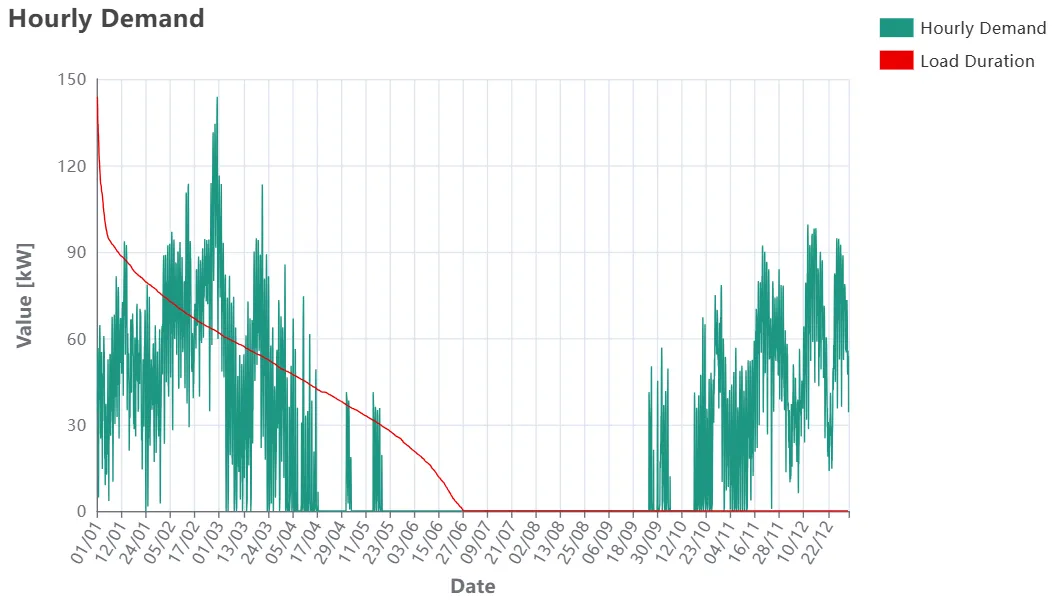
Hourly demand with load-duration curve. Full-year resolution behind every supply and grid scenario.
Trusted by utility and grid planning teams
Used by European utilities to plan district energy, generation strategy and city-wide supply pathways. The same workflow carries to US load growth, interconnection and DER planning.




How Sympheny helps
One model for every supply and grid pathway
Compare generation mix, distributed energy resources, storage and grid reinforcement on the same baseline, not as separate studies stitched together at the end. Load growth and interconnection limits are constraints in the model, not afterthoughts.
CAPEX and CO2 trade-offs visible early
Quantify the investment implications of each pathway before committing, so the board, the regulator and the customer base see the same evidence. Distributed energy resources are weighed against reinforcement on cost, not on policy alone.
A planning asset, not a one-off study
When load forecasts, tariffs or policy assumptions move, re-run scenarios in the same workflow instead of restarting from a blank sheet. The roadmap evolves with the system instead of going stale on delivery.
What changes for utilities and grid planners
| Process | Before Sympheny | With Sympheny |
|---|---|---|
| Supply and grid planning | Each supply, DER and reinforcement option lives in its own study, hard to compare | One structured model compares supply, DER and grid pathways side by side on the same baseline |
| Investment case | CAPEX, OPEX and CO2 trade-offs hard to quantify before the board commits | Scenario outputs make the life-cycle cost and emissions of each pathway visible early |
| Load growth and interconnection | New large loads and queue limits handled outside the planning model | Load growth and interconnection limits modeled as constraints, with DER weighed against reinforcement |
| Roadmap upkeep | A static study outdated by the next planning cycle | A living roadmap the team owns, re-runs, and uses to brief the regulator and customers |
How IBC Chur built a defensible net-zero pathway for the city.
“Digitalization with Sympheny helps us to develop decentralized energy concepts and creates security for investments in new infrastructures.”
— Martin Derungs, CEO, IBC Chur (Switzerland) Read the full IBC Chur case study →
Utility planning, proven in the field.
See how utilities used Sympheny when the board wanted one investment roadmap, not a folder of studies, and the regulator wanted to see the cost and emissions behind it. The same workflow carries to US load growth, interconnection and DER planning.
City-wide energy supply strategy toward 2050
Technical proof: 3.2 M m2 energy reference area, three time horizons modelled
Business outcome: CO2-free 2035 supply confirmed at similar life-cycle cost.
Solar development strategy for the Port of Switzerland
Technical proof: 16 variants across four strategies optimised
Business outcome: Up to 20-25% cost reduction identified; lowest-risk path confirmed.
Optimal expansion strategy for a district heating network
Technical proof: Five network segments included in the optimal design
Business outcome: Three of four expansion scenarios confirmed profitable.