Power a data center the grid can't connect yet.
Interconnection queues run for years and large new loads are increasingly told there is no capacity. Sympheny sizes behind-the-meter generation, storage and a microgrid against your site's real hourly load, not a nameplate number, so you can move forward with a smaller, better-evidenced grid request and a case your investment committee can sign.
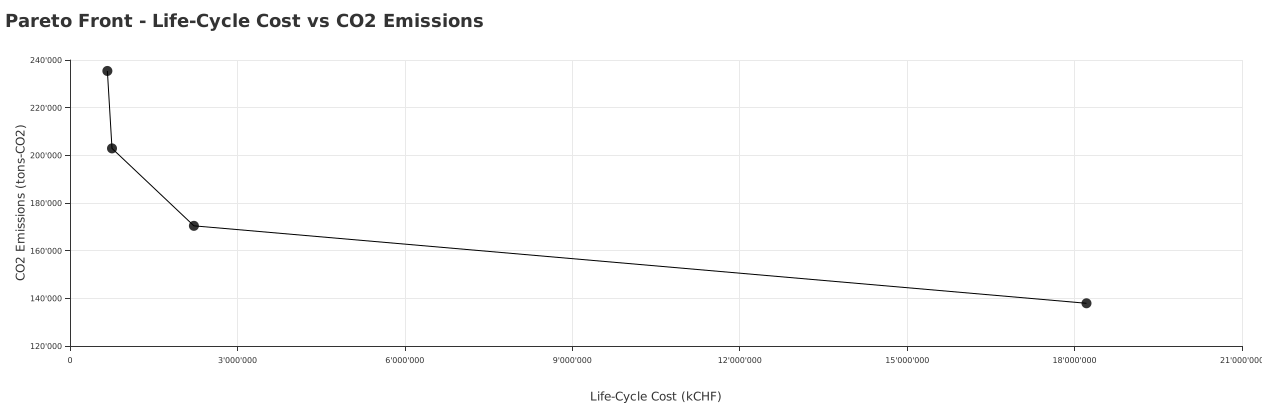
Every on-site energy option on one chart: life-cycle cost against carbon, with the connection constraint held.
Trusted by energy planners, utilities and engineering firms
Used across Europe on feasibility, district energy and microgrid planning, where the goal was the same one a US data center has: needing less from the grid by generating, storing and sharing power on site. No US deployments are claimed.





When data-center power planning gets hard
Multi-year interconnection queues and capacity that may never clear
AI and HPC load that swings sharply and drives the capacity charge
Behind-the-meter generation moving from optional to essential
Clean-power commitments and Scope 1, 2 and 3 scrutiny from tenants and lenders
Phasing on-site capacity against a grid connection that arrives late
Waste-heat offtake where a thermal energy network is next door
For developers and operators
- Behind-the-meter and microgrid feasibility before site commitment
- A smaller, defensible interconnection request
- Clean-power and PPA pathway compared on cost and CO2
- An investment case the board and lenders can interrogate
For the engineering partner
- An optimized upstream concept ready for detailed design
- Generation, storage, cooling and grid connection sized together
- Staged investment against the load ramp and interconnection
- Documented outputs that survive technical due diligence
How Sympheny helps
Size the microgrid against the real load, not a nameplate
Model PV, storage, gas, fuel cells and the cooling plant as one system against the site's real, variable load, including AI and HPC swings. The behind-the-meter system is justified by the load it serves and the grid capacity it avoids, which is what makes it bankable.
Shrink the interconnection request
Optimize generation, storage and load flexibility against capacity charges and connection limits, so the request to the grid is smaller and easier to approve. A smaller, well-evidenced connection is what actually moves through a multi-year queue.
A cost, carbon and resilience case in one model
The same model that sizes the system produces the Scope 1, 2 and 3 pathway and the resilience case, ready for the review where a lender, regulator or hyperscale tenant picks it apart. Directional estimates, traceable to the inputs.
What changes for data-center energy teams
| Process | Before Sympheny | With Sympheny |
|---|---|---|
| Grid request | A single large connection request sized on nameplate, then a multi-year wait with no plan B | A smaller request evidenced by an optimized behind-the-meter system that carries the gap |
| Load assumptions | System sized on a flat average, wrong for real AI and HPC operation | Generation, storage and cooling sized against the real hourly load shape |
| Clean-power case | Scope emissions assembled separately from the energy plan, by a different team | One model produces the power mix and the Scope 1, 2 and 3 pathway behind it |
| Investment sign-off | The energy lead defends vendor numbers they didn't produce | Scenario outputs the CFO and lenders can interrogate, with sensitivities on price and load |
Proven on the same problem a data center faces: needing less from the grid.
These are European commissions, not US deployments, and we won't pretend otherwise. They show the method a US data center relies on: sizing on-site generation, storage and a network against a real, variable load so the site needs less of a grid connection it can't get quickly.
Strategic energy concept for the Insel-Holligen district
Technical proof: 30+ price and demand scenarios tested
Business outcome: Infrastructure investment stress-tested before commitment.
Solar development strategy for the Port of Switzerland
Technical proof: 16 variants across four strategies optimised
Business outcome: Up to 20-25% cost reduction identified; lowest-risk path confirmed.
Eco-quartier energy concepts and decarbonisation roadmap
Technical proof: Three scenarios mapped for an eco-quartier and city roadmap
Business outcome: 83% CO2 reduction pathway identified by 2040.