Plan resilient energy for a federal site, and document why it holds.
Federal sites carry an energy-security mandate that most projects only assume. Sympheny models the site as a multi-energy system, compares network, microgrid and on-site generation options on the same baseline, and stress-tests each against energy prices, electrification load and interconnection limits, so the recommendation holds when the assumptions move and when a reviewer asks why.
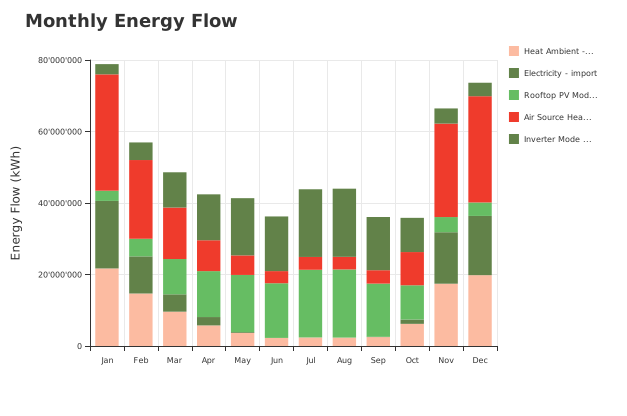
Monthly energy flow across the planning horizon. The kind of documented output a program review can interrogate.
Network, microgrid and resilience analysis
These are European commissions used as capability proof of the method, not US deployments. Sympheny's optimization engine has been applied in US Department of Defense thermal energy network feasibility studies under the ESTCP program, as the design-optimization layer ahead of detailed engineering.




How Sympheny helps
Resilience as a sized, costed decision
Model on-site generation, storage, a microgrid and a thermal energy network together, and see what each level of resilience costs against the load it has to carry through an outage. Resilience stops being an assumption and becomes a line in the trade-off.
Network and microgrid options on one baseline
Compare a thermal energy network, a microgrid, and on-site generation on the same cost, carbon and resilience axes, at hourly resolution, instead of as separate studies that never line up. The cost of each decarbonization level is explicit.
Documented outputs a reviewer can interrogate
Every result traces to its inputs and equations. Sympheny runs on a deterministic MILP engine, so two people running the same inputs get the same answer, which is what a program office, an auditor and a funder need to see.
What changes for federal energy programs
| Process | Before Sympheny | With Sympheny |
|---|---|---|
| Resilience planning | Resilience assumed and bolted on after the system is chosen | On-site generation, storage and network sized against the load they carry through an outage |
| Option comparison | Network, microgrid and generation studied separately and reconciled by hand | Every option on the same cost, carbon and resilience baseline, at hourly resolution |
| Documentation | A static study that's hard to audit and outdated by the next review | Traceable, deterministic outputs the program office and funder can interrogate |
| Concept to design | Detailed mechanical design starts before the right system is settled | The optimized concept is fixed first, then handed to detailed engineering and delivery |
Network, microgrid and resilience analysis, proven on European ground.
These European commissions show the same analysis a federal site relies on: comparing network, microgrid and on-site generation options on cost, carbon and resilience, with documented outputs. Sympheny's optimization engine has also been applied in US Department of Defense thermal energy network feasibility studies under the ESTCP program.
Strategic energy concept for the Insel-Holligen district
Technical proof: 30+ price and demand scenarios tested
Business outcome: Infrastructure investment stress-tested before commitment.
Solar development strategy for the Port of Switzerland
Technical proof: 16 variants across four strategies optimised
Business outcome: Up to 20-25% cost reduction identified; lowest-risk path confirmed.
City-wide energy supply strategy toward 2050
Technical proof: 3.2 M m2 energy reference area, three time horizons modelled
Business outcome: CO2-free 2035 supply confirmed at similar life-cycle cost.