Behind-the-meter power that carries the load while the grid catches up.
Interconnection queues in the US now run for years, and a data center cannot wait for the full grid request to clear before it energizes. Sympheny sizes the behind-the-meter generation and storage that carry the load on day one, and works out how small the grid request can be, so the on-site system and the interconnection ask are decided together instead of one after the other.
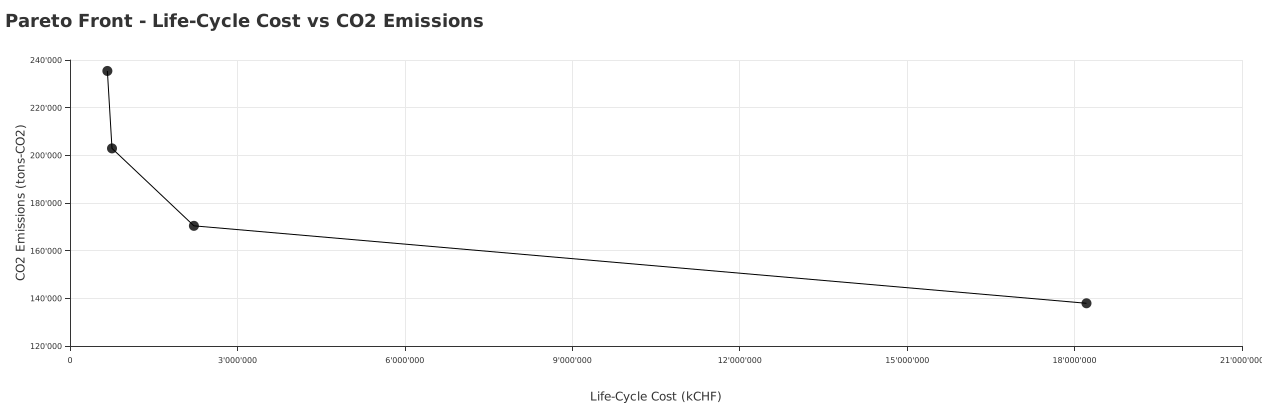
Every behind-the-meter option on one chart: life-cycle cost against carbon, with the grid request sized down to what the load really needs.
What teams sizing on-site power for a data center are up against.
The interconnection queue is the real bottleneck
A large grid connection in the US can sit in the interconnection queue for years before a study clears and an upgrade is built. For a data center on a delivery timeline, that gap between needing power and getting a full grid connection is the binding constraint, not the cost of the megawatts themselves. The smaller and better-evidenced the grid request, the faster and cheaper it tends to move.
Behind-the-meter went from optional to load-bearing
On-site generation and storage behind the meter used to be a hedge. Now it is what energizes the site while the larger interconnection works through the queue, and what holds the load when the grid request lands smaller than the nameplate. The question for the engineer is no longer whether to build behind the meter, but how much, of what, and sized against which load.
Capacity charges punish a nameplate-sized request
Asking the utility for a connection sized to the nameplate peak is expensive twice over: it adds years and cost to the interconnection study, and it locks in capacity and demand charges against a peak the site rarely hits. Sizing the grid request to the load that behind-the-meter generation does not cover, rather than to the plate, is where the economic case usually turns.
Sizing on-site generation against a real load is what we do.
Sixteen on-site generation and energy-sharing scenarios compared in one project. Generating and sharing power locally was the lowest-risk strategy, the same behind-the-meter logic a data center uses to shrink its grid request.
Read case studyOn-site generation and storage sized against a site's own load to give it a viable path to energy self-sufficiency, the same sizing problem behind a behind-the-meter data-center build.
Read case studyA multi-hub system moving 90,000 MWh a year across six hubs and 30+ scenarios. The same multi-energy, multi-source modeling a data-center campus relies on to balance on-site supply against grid import.
Read case studySize the behind-the-meter system, then size the grid request to match.
Sympheny models the data-center load, on-site generation, storage and the grid connection as one system and optimizes it with mixed-integer programming. It sizes the behind-the-meter generation and storage against the real hourly load, then works out the smallest grid import the site can run on once that on-site capacity is in place, so the interconnection request is the residual after BTM, not the whole nameplate.
Model the data center and its load as it actually runs.
Start from the site and its hourly load shape, not a nameplate number. Sympheny's GIS-enabled view holds the building, its electricity and cooling demand and the on-site resources, so behind-the-meter generation is sized against the load the site really draws rather than the peak it was rated for.
- GIS site view with the building, its hourly load and on-site resources
- Real load shape separated from nameplate peak
- From a single hall up to a multi-building data-center campus
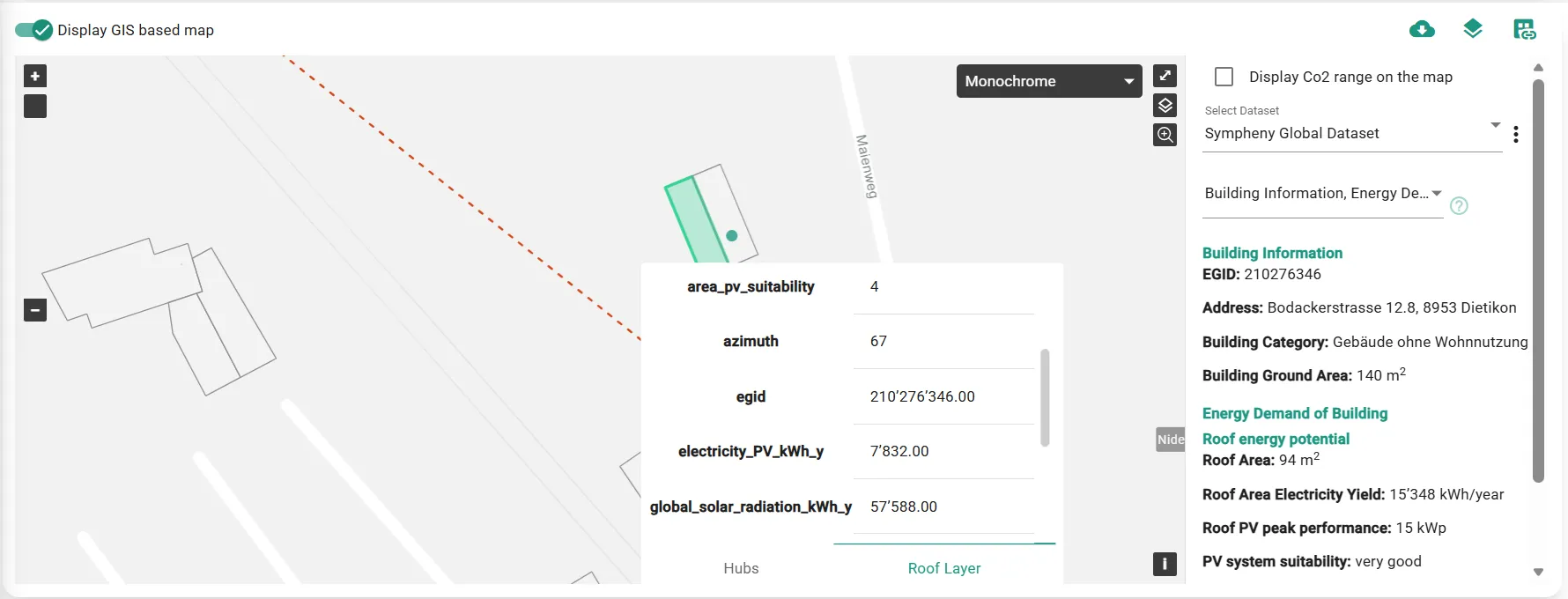
Size the on-site generation and storage that carry the load.
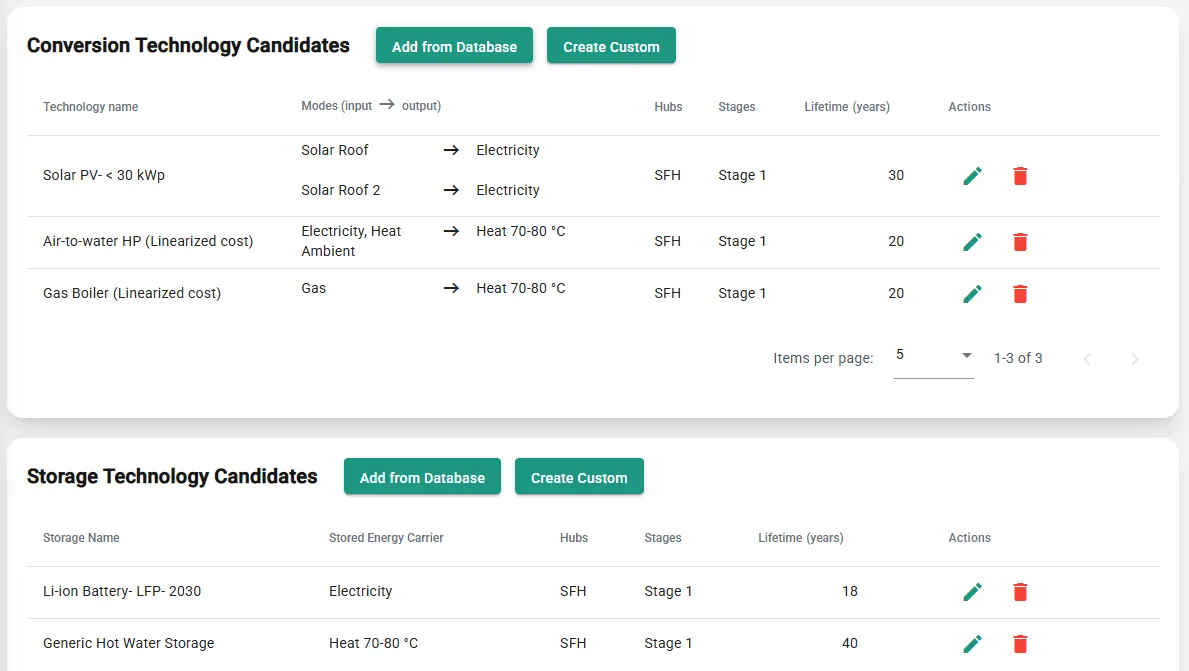
PV, batteries, fuel cells, on-site generators and cooling all enter the same optimization. Sympheny sizes the behind-the-meter mix that energizes the site and carries the load while the interconnection clears, and it values the bill that mix cuts the rest of the time, so the on-site build is justified by more than the wait for the grid.
- On-site generation and storage sized against the real load
- Behind-the-meter mix that energizes the site before the grid request clears
- Same assets cut the everyday bill, not just bridge the queue
Find how small the grid request can be.
The interconnection ask is not fixed at the nameplate. Sympheny treats the grid import as a variable and finds the smallest connection the site can run on once behind-the-meter capacity is in place, then shows what each size of request costs in capacity and demand charges. That is the number that moves through the queue.
- Grid import sized as the residual after behind-the-meter generation
- Smaller, evidenced grid request that moves faster in the queue
- Capacity and demand charges costed against each connection size
Stage the build against the interconnection timeline.
The behind-the-meter system can come on first and the grid connection later, as the queue allows. Sympheny stages the build against that timeline and compares staged scenarios on one Pareto front, with every result tracing to its inputs on a deterministic MILP engine, so the plan survives the review where a lender or board asks why.
- Build staged against the interconnection timeline, BTM first
- Deterministic, auditable outputs a reviewer can interrogate
- Scenario comparison with automated sensitivity analysis
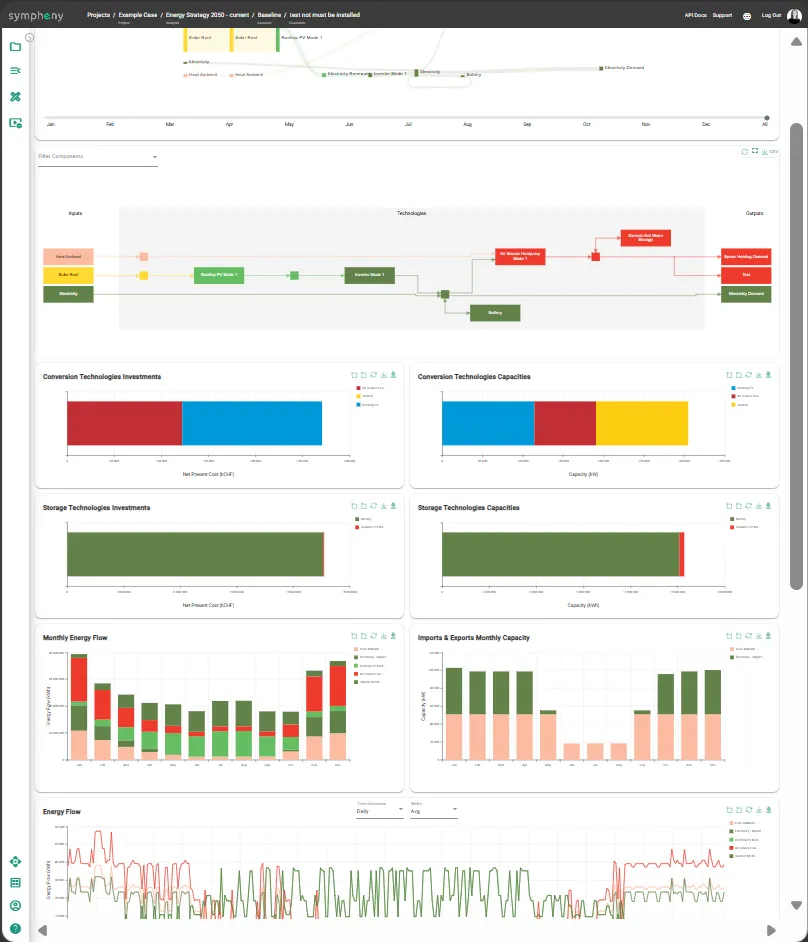
For the developer or operator running the numbers, the output is the trade-off that matters: what behind-the-meter capacity costs, how much it shrinks the grid request, and what that does to the capacity and demand charges over the life of the site. The figures are directional, from the project model, not a guaranteed outcome for a specific site.
Sympheny sits upstream of detailed electrical design and upstream of the utility process. It decides how much behind-the-meter generation and storage is worth building and how small the grid request can be, then hands that concept to your electrical engineers and to the utility. It is not a substitute for the formal interconnection request to the utility, not a power-system or relay-coordination study, and not a microgrid controller. It settles the sizing question those steps then act on.
Behind-the-meter sizing that sizes the grid request with it.
Most on-site studies size the generation and treat the grid connection as a given. Sympheny optimizes both together, which is what turns a nameplate-sized interconnection request into a smaller, evidenced one that moves through the queue.
Grid request sized as the residual, not the nameplate
Behind-the-meter generation and the grid import are solved in one model, so the interconnection ask comes out as what the load needs after on-site capacity, not the plate the site was rated for. That smaller, evidenced request is the one that tends to clear the queue faster.
Upstream of detailed design and the utility
Sympheny settles how much to build behind the meter and how small the grid request can be. Detailed electrical design, protection studies and the formal interconnection application sit with your engineers and the utility. It is the concept-stage layer, not a substitute for either.
Applied in US federal energy work
Sympheny's optimization engine has been applied in US Department of Defense thermal energy network feasibility studies under the ESTCP program, as the design-optimization layer that compares system options on cost and energy ahead of detailed design.
Beyond single-site microgrid sizing.
Most US teams sizing on-site power know HOMER, and it is strong at what it was built for: sizing the generation and storage behind one meter. The difference shows when the question is no longer one site's microgrid but a whole campus across power, cooling and heat, and how small the grid request can be.
HOMER is a capable tool and many US teams use it well: HOMER Pro can model thermal loads through its CHP module, and HOMER Front handles utility-scale storage and electricity-market dispatch. The difference is not whether heat can be represented, but whether multiple energy carriers and the networks between them are optimized together across a site against a cost-and-carbon trade-off. Where the job is sizing one site's microgrid, HOMER may well be the right tool.
Behind-the-meter power for data centers, explained.
What is behind-the-meter power?
Behind-the-meter (BTM) power is generation and storage on the customer's side of the utility meter, serving the site's own load directly rather than exporting to the grid. For a data center that usually means on-site PV, batteries, fuel cells or generators that energize the site and carry the load. Because it sits behind the meter, it reduces what the site has to draw from the grid, which both shrinks the energy bill and shrinks the size of the grid connection the site has to ask the utility for.
How does behind-the-meter power cut the interconnection request?
If on-site generation and storage carry part of the load, the site only needs the grid to cover the residual, so the interconnection request can be sized to that residual rather than to the nameplate peak. A smaller, well-evidenced request typically clears the queue faster and costs less in grid upgrades and in capacity and demand charges. Sympheny sizes the behind-the-meter system against the real hourly load and then finds the smallest grid import the site can run on, so the connection ask is the residual after BTM, not the whole plate.
What is the difference between behind-the-meter and in-front-of-meter?
Behind-the-meter assets sit on the customer's side of the meter and serve the site's own load, so they offset purchases and reduce the connection the site needs. In-front-of-meter (or front-of-meter) assets sit on the grid side and sell energy or services into the wholesale market through their own interconnection. For a data center trying to energize quickly and shrink its grid request, behind-the-meter is usually the relevant side, because it carries the load directly without waiting on a separate market interconnection.
Why are interconnection queues so long in the US?
Demand for new large connections, much of it from data centers and electrification, has grown far faster than the studies and grid upgrades needed to approve them, so the interconnection queue in many US regions now runs for years. Each large request can trigger system studies and network upgrades that take time to plan and build. This is external market context, not a Sympheny figure. The practical response is to ask for a smaller, better-evidenced connection, which is the part Sympheny helps size.
What on-site generation options fit a data center?
It depends on the site, but the usual candidates are on-site PV where there is room, battery storage for ride-through and peak shaving, fuel cells, and on-site generators for firm capacity, often alongside efficient cooling that lowers the load itself. Sympheny puts all of these in one optimization as candidate technologies and sizes the mix against the site's real hourly load and its cost and carbon targets, rather than picking a technology up front.
How does Sympheny size behind-the-meter power against a real load?
Sympheny models the data center's hourly electricity and cooling load, the candidate on-site technologies and the grid connection as one system, then optimizes them together with a deterministic mixed-integer program. It sizes the behind-the-meter generation and storage against the real load shape, works out the smallest grid import the site needs once that capacity is in place, and returns the cost and carbon of each option on a Pareto front. The result is sized for how the site actually runs, not for its nameplate.
How is Sympheny different from HOMER?
HOMER is built to size the generation and storage behind one meter, and it does that job well; HOMER Pro can also model a thermal load through its CHP module. The difference is scope. HOMER's optimization stays anchored to a single site with electricity as the lead carrier and lowest cost as the objective. Sympheny optimizes electricity, cooling, heat, hydrogen and storage together across one or many hubs on a campus, sizes the networks between them in the same run, treats the grid request as a variable, and returns the full cost-versus-carbon trade-off as a Pareto front instead of a single least-cost answer. For sizing one site's microgrid, HOMER may be the right tool; for deciding what to build across a whole multi-energy campus before detailed design, that is where Sympheny fits.
Related US planning topics and proof.
Size the on-site build and the grid request together.
Bring us a data-center load. We will size the behind-the-meter generation and storage that carry it, and show you how small the grid request can be, before anyone files the interconnection application.