Turn a multi-occupier estate into a shared energy system.
The value in a business park comes from sharing: rooftop solar, battery storage, EV charging and a private wire network optimised across occupiers rather than fenced off building by building. Sympheny models the whole estate together, so the case for shared on-site energy is made on cost and resilience, not just intent.
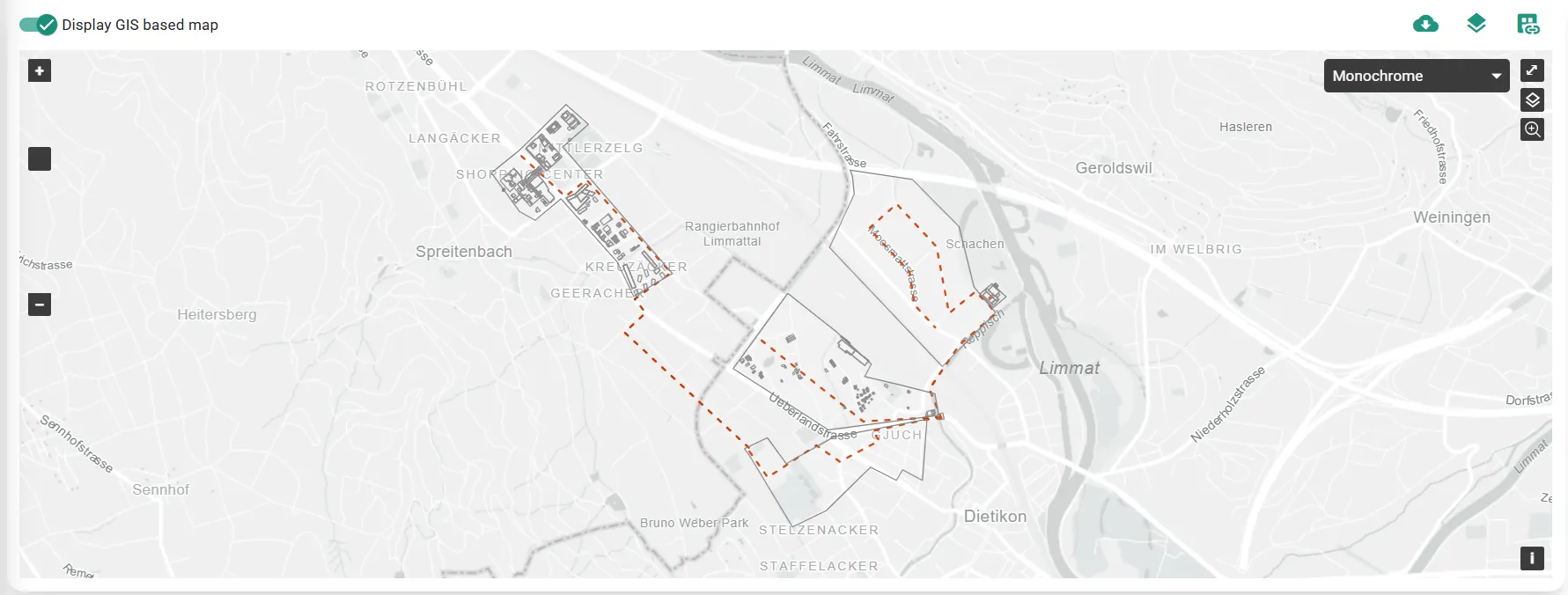
A multi-owner site modelled as one shared system, with the connections that create the savings drawn on the map.
Why energy-sharing is hard to plan.
The benefit only appears when you model the whole estate
Shared on-site energy pays off because one occupier's surplus meets another's demand across a private wire. That benefit is invisible if each building is studied alone. It only shows up when the buildings, the generation and the loads are optimised together as one estate.
Many occupiers, different loads, one decision
Who installs what, who shares with whom, how the battery is sized and split, and how the EV charging fits: the option space across several occupiers with different loads and commercial arrangements runs well beyond what a few hand-built variants can cover. Most teams test a handful when the real decision space runs into the dozens.
Grid connection limits and energy costs move the answer
Connection constraints and queue delays cap what the estate can import or export, commercial energy costs are high and volatile, and occupiers carry their own net zero requirements. Where the estate falls in a heat network zone, that shapes it too. A concept has to be stress-tested against that risk, not built at today's prices and left.
Proven on real multi-owner sites.
A net-zero commercial-park concept at roughly 75% lower CO₂ and about 20% lower life-cycle cost than the conventional reference design: decarbonisation without a cost premium when the whole site is optimised together.
Read case studyFour strategies across 16 scenario variants. Interlinking the buildings into a shared community cut costs 20–25% and proved the most resilient strategy against an adverse tariff change.
Read case studyThe whole estate, every occupier, in one optimisation.
Buildings, rooftop solar, battery storage, EV charging and the private wire connections between them sit in the same mixed-integer optimisation at hourly resolution. The engine decides which buildings to link, how to size the shared assets and how the estate operates across a full reference year, within the grid connection it can actually get.
Which buildings to link is a decision, not an assumption.
Draw the candidate connections between buildings on a real GIS map. The optimiser decides which links to build from measured length and cost, so the energy community that comes out is the one that actually pays, not a layout sketched by hand.
- Candidate connections between buildings drawn on a GIS basemap
- Shared electricity and thermal loops modelled explicitly
- Which buildings to interlink returned by the optimiser, with staging
PV, storage and a thermal loop, sized for the whole community.
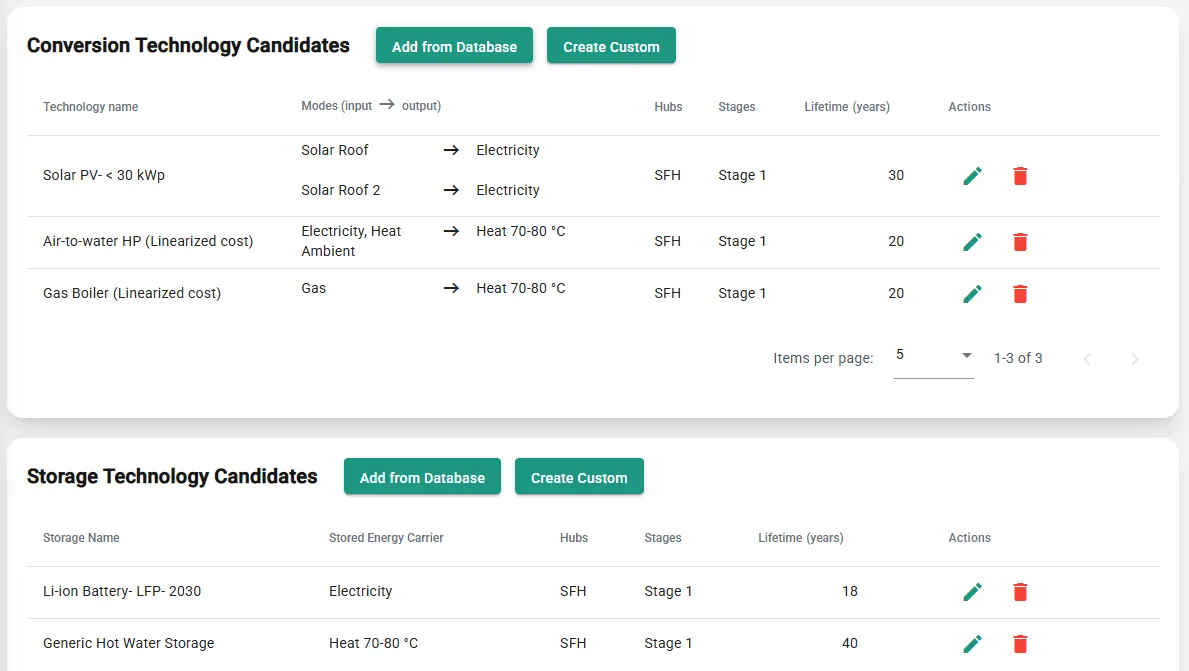
On-site PV, batteries, heat pumps and a shared thermal network enter as candidates, sized against the combined load of every connected building. Self-consumption across the community is optimised, so generation serves demand on site before it is exported.
- PV, batteries, heat pumps and a shared loop sized against the combined load
- Self-consumption across the community maximised before export
- Seasonal performance and hourly resource limits respected
Compare sharing strategies, stress-tested against tariffs.
Define competing strategies: status quo, maximum on-site production, interlinking, maximum self-consumption. Let the optimiser cost each against several market futures. The strategy that wins on cost and survives a tariff change comes out of one model.
- Multiple sharing strategies compared in one project
- Each strategy tested against price, export and demand scenarios
- Regulatory and tariff risk surfaced explicitly, not assumed away
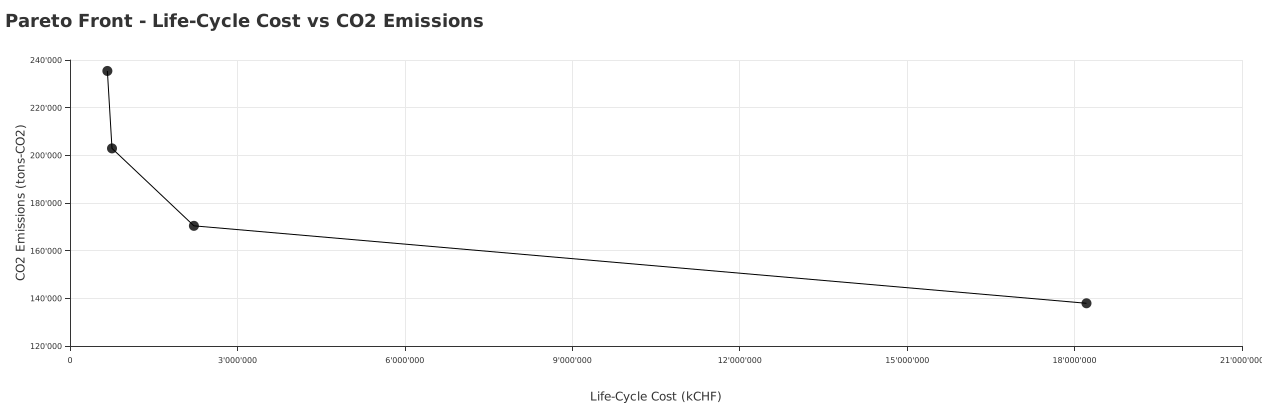
For the economic buyer, that means a defensible answer on the shared investment: what shared on-site energy costs against the status quo, what each strategy saves, and which one holds up if the connection limit binds or energy prices move.
Sympheny covers feasibility and concept design: settling the sharing strategy, the shared assets and the business case. Detailed electrical and hydraulic design, the grid connection application and the legal structuring between occupiers are separate steps. Most of what decides whether shared on-site energy gets built is settled at the concept stage.
Built for the multi-owner sharing decision.
Plenty of tools size a single PV array or battery. Sympheny is built for the harder question an energy community has to answer: who shares what with whom, and is it worth it.
Not a single-building or single-asset sizer
Yield and battery-sizing tools answer one asset well. Sympheny optimises the connections and shared assets across the whole site, so the community-level benefit surfaces.
Not a static spreadsheet model
A spreadsheet cannot resolve self-consumption across many buildings at hourly resolution. Sympheny co-optimises the sharing topology and supply, then stress-tests it against tariffs.
Built around the optimisation, run in the browser
A MILP engine sits at the core, run in a cloud platform an engineer uses directly, with client-ready outputs the partners can read.
Questions business-park teams ask.
What is a private wire network on a business park?
A private wire network is on-site electrical infrastructure that lets buildings on a commercial estate share generation and storage directly, behind the meter, rather than each importing and exporting through the public grid in isolation. On a business park that usually means shared rooftop solar, battery storage and EV charging, with surplus from one occupier meeting demand in another. Sympheny models the whole estate as one system to find which connections and shared assets actually pay.
How do you plan shared energy across a business park?
Planning runs from the combined demand of every occupier, through candidate shared generation, storage, EV charging and private wire connections, to a costed strategy. Because the buildings interact, deciding asset by asset tends to leave value on the table. Sympheny co-optimises the sharing topology, the shared supply and the operation in one model at hourly resolution, then compares competing strategies on cost and CO₂.
Does shared on-site energy still make sense with grid connection limits?
It depends on the strategy. Connection constraints and queue delays cap what an estate can import or export, and rising, volatile commercial energy costs change which approach wins. Sympheny tests each strategy against several market and connection scenarios, so the chosen concept is the one that holds up. Maximising self-consumption on site is often the strategy least exposed when the connection limit binds.
How does Sympheny help plan a business park?
Sympheny models a business park as connected buildings with shared generation, storage and EV charging, decides which buildings to interlink over a private wire, sizes the shared assets and compares strategies on cost against CO₂. It returns a Pareto front with the underlying data exportable for the deliverable, so a multi-occupier estate can move from idea to a fundable concept quickly.
Related pages and proof.
See your estate modelled as one shared system.
Bring the business park to a demo and watch the sharing strategies compared on cost and resilience, or start a free trial and build the first concept yourself.