The story
Example Town is a synthetic example: the town, its data and the results are illustrative. A waste plant already feeds a heat network to the North and Centre districts. South and the Retail park still heat with gas boilers, and the Retail park also needs a lot of cooling.
The utility wants to grow the network step by step until 2038. Two questions: which expansion steps pay off, and in which order? And when does the waste heat run out?
This is an advanced tutorial. The model is already built, so instead of setting it up from scratch you walk through what is new compared with the basic tutorials: stages, limited heat sources and a second kind of network link. Then you run it, read the results stage by stage and test one what-if.
Step by step
Follow along in Sympheny. Each step has a screenshot from the video; click the time under it to watch that moment.
- 1
Open the scenario and look at the stages
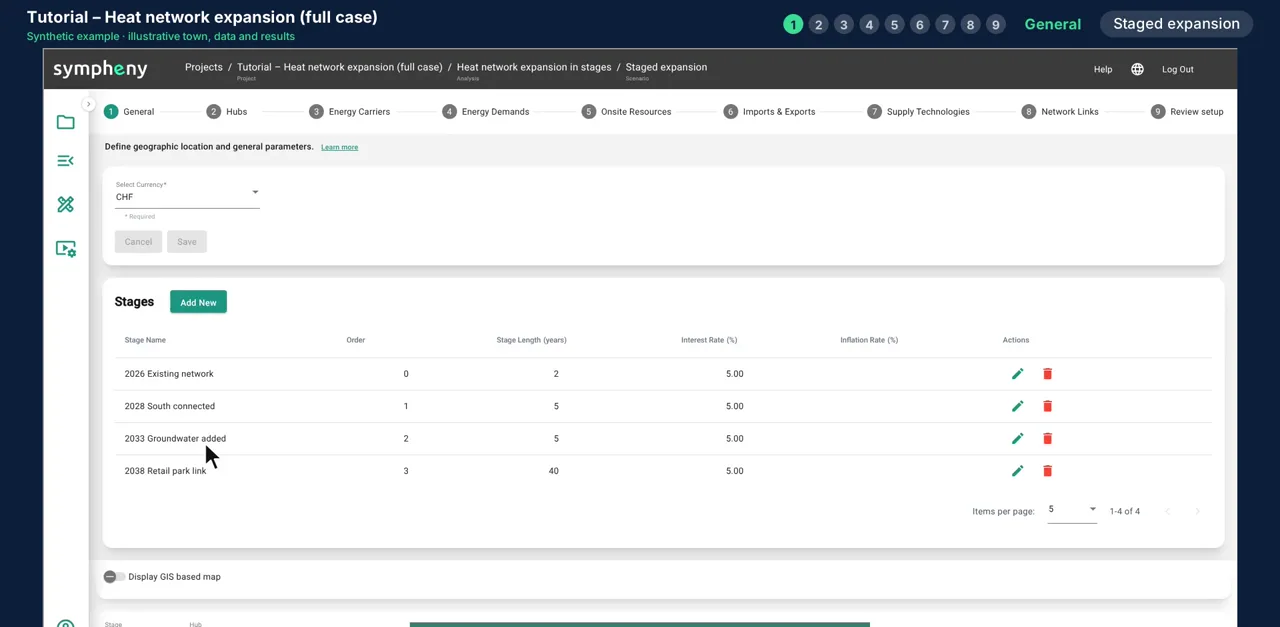
Open the scenario Staged expansion and go to General. The model has four stages: 2026, the existing network; 2028, South connected; 2033, groundwater added; and 2038, the Retail park link.
In the documentation: Stages ↗
- 2
Check each stage's length and interest rate
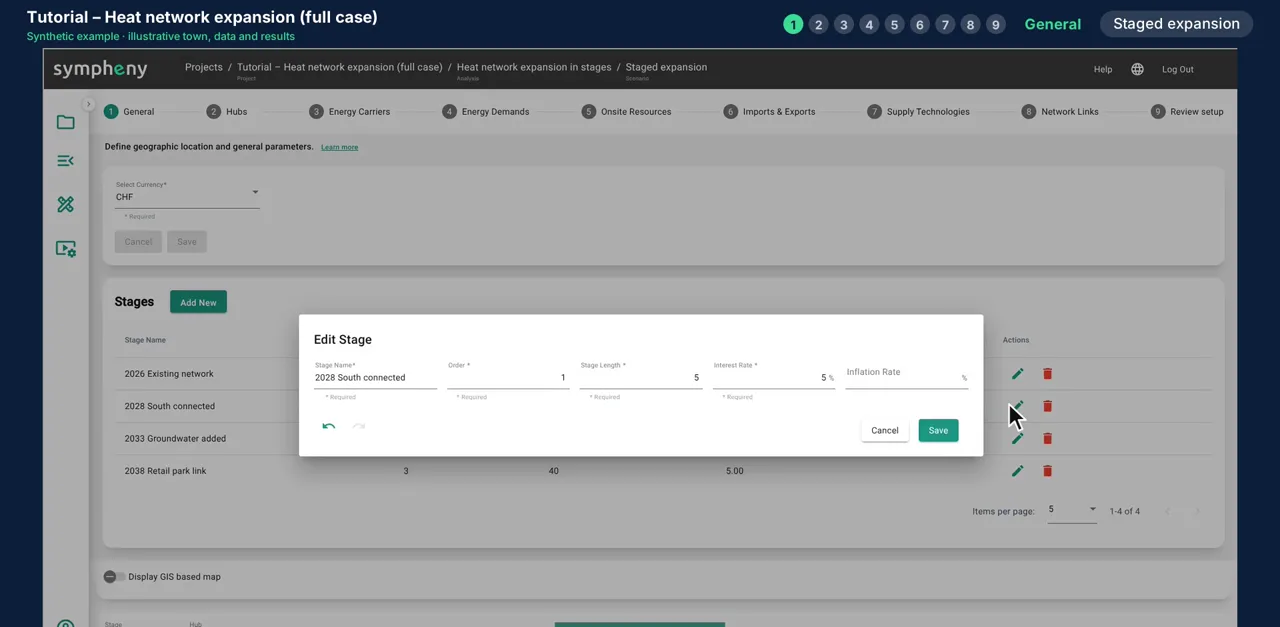
Click the edit icon on a stage to see its settings. Each stage has a length and an interest rate. 2028 runs for five years; the last stage, 2038, runs for forty years, so long-lived pipes are judged over their whole life.
Anything built in one stage stays in the later stages. That is how Sympheny tells you not only what to build, but also when.
In the documentation: Stages ↗
- 3
Hubs, energy carriers and demands
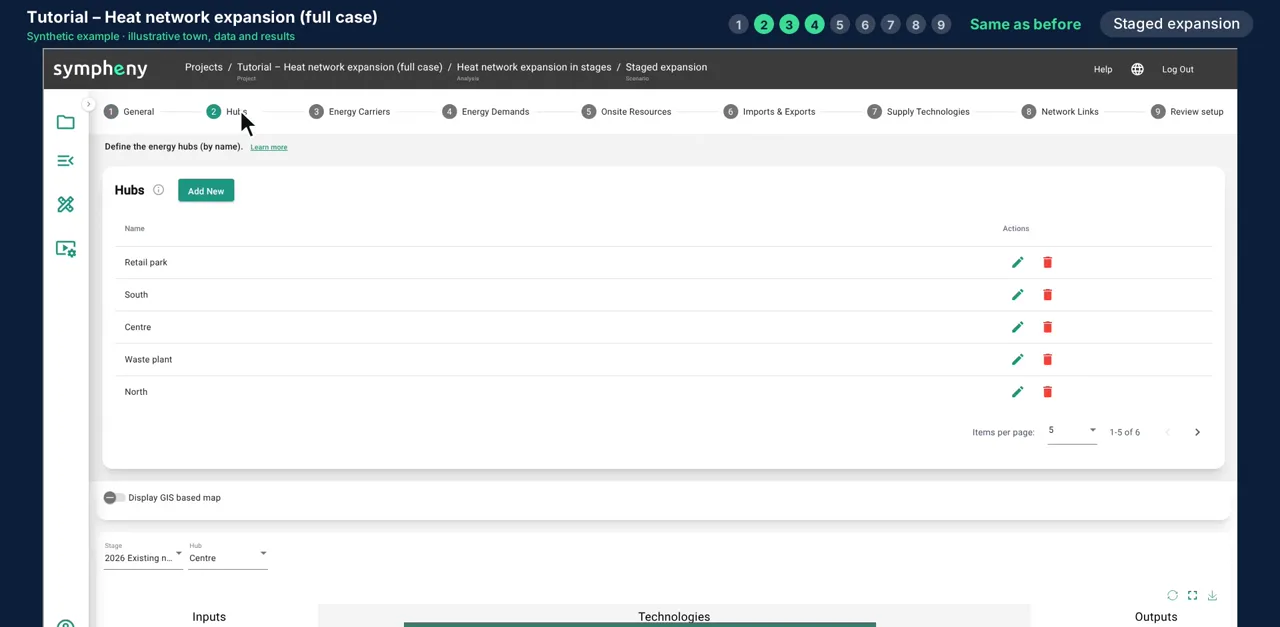
These steps work as in the basic tutorials. There are six hubs, including the waste plant and a junction, and each district has its own heating and cooling demand.
In the documentation: Hubs step ↗ Energy carriers step ↗ Energy demands step ↗
- 4
Cap the waste-plant heat
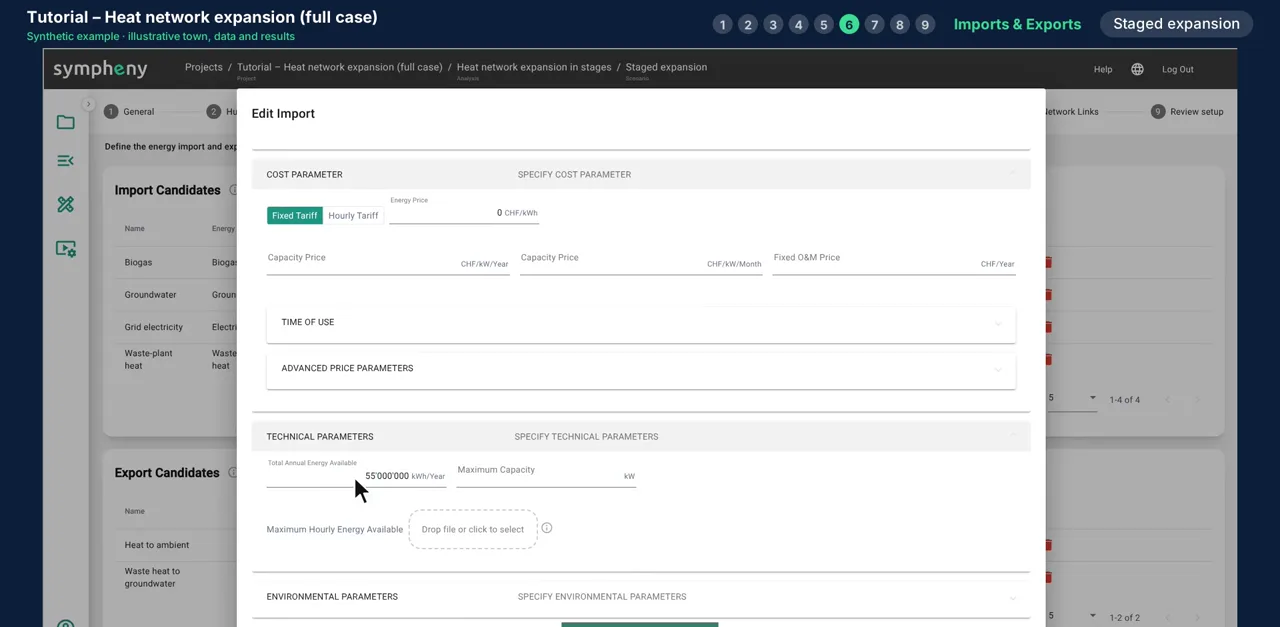
New here: limited sources. Under Imports & Exports, open the waste-plant heat. Its total annual energy is capped at 55,000 MWh. That is all the plant can deliver in a year.
In the documentation: Imports & exports step ↗
- 5
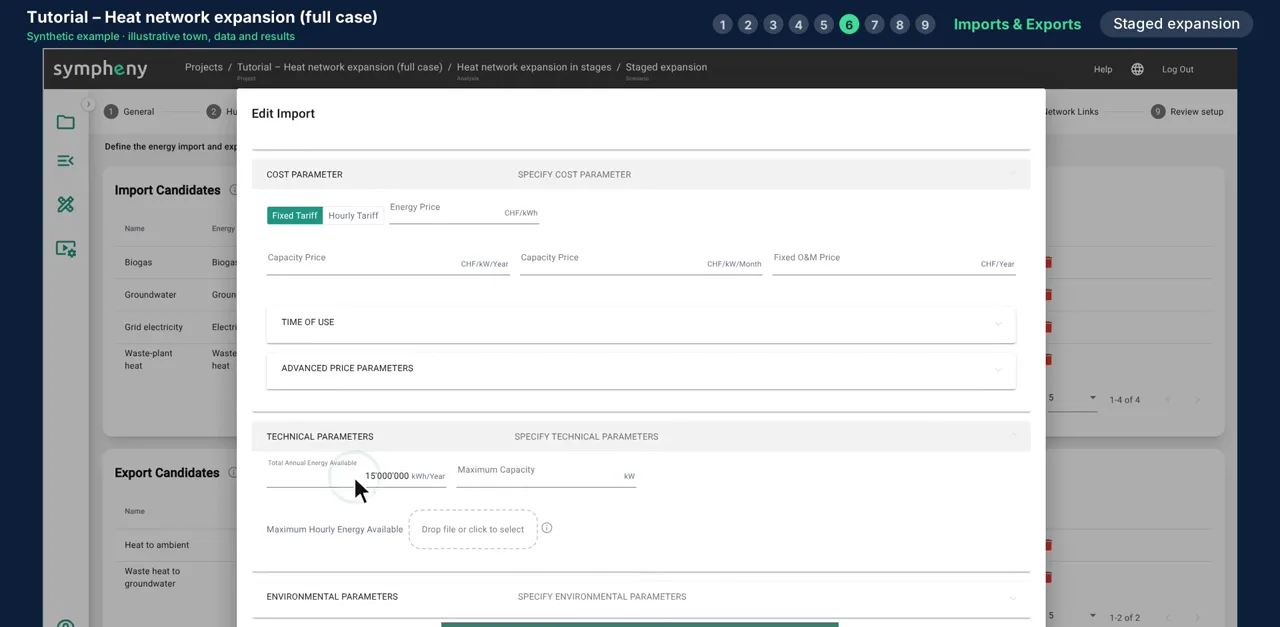
Add groundwater as a second source
Groundwater is a second source, at South. It is only available in the stages from 2033, and it is capped too, at 15,000 MWh a year.
These caps are what make the order matter: once a source is used up, the next district has to be heated some other way.
In the documentation: Imports & exports step ↗
- 6
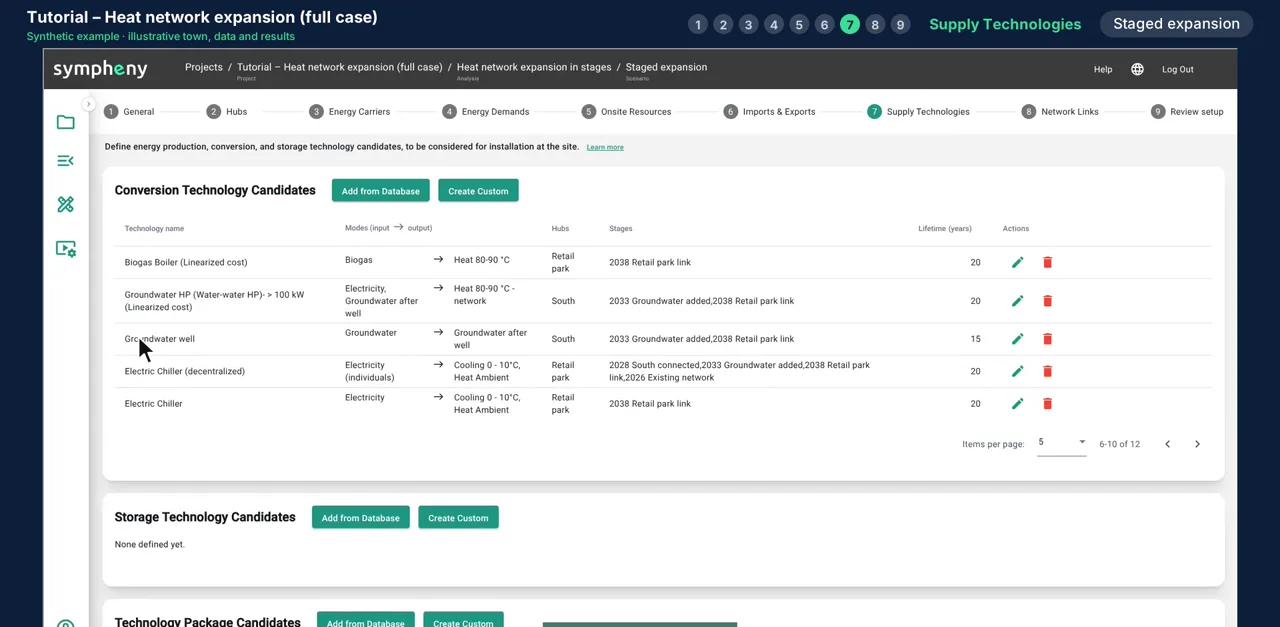
Make supply technologies available from a stage
Under Supply Technologies, the groundwater well and the heat pump at South are also limited to 2033 and later. Open the well to see its stages. This is how you tell Sympheny when an option becomes possible.
In the documentation: Stages ↗ Supply technologies step ↗
- 7
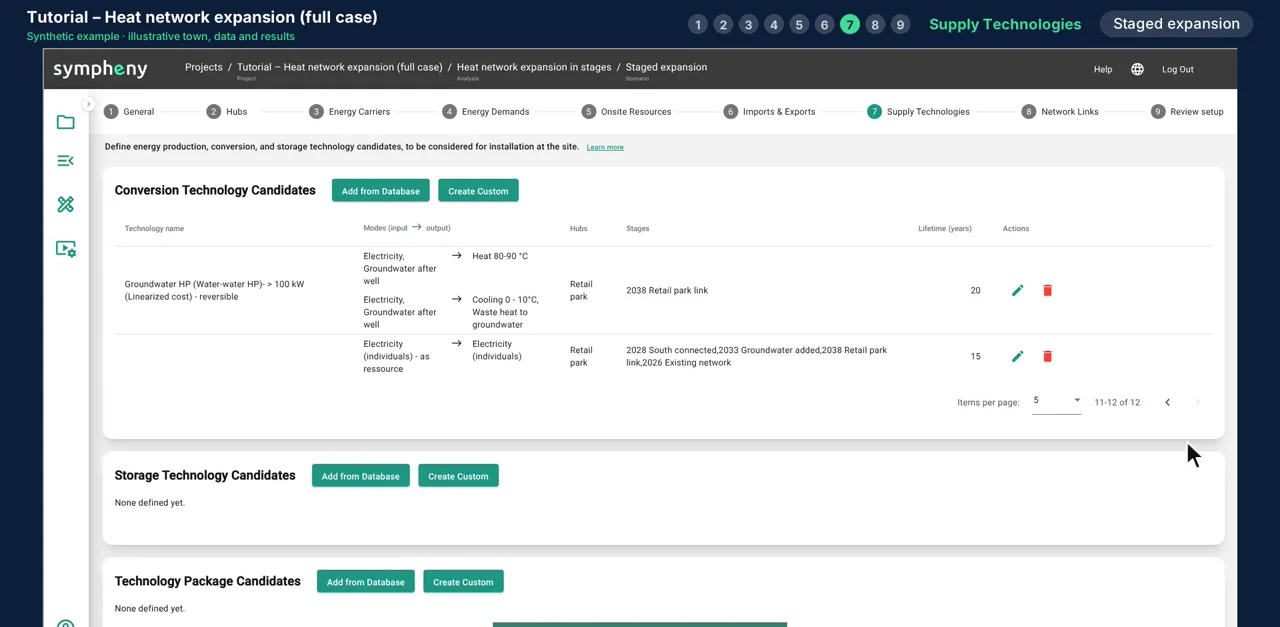
Options for the Retail park
For the Retail park, from 2038, there are three options: a reversible groundwater heat pump that heats in winter and cools in summer, a central chiller and a biogas boiler.
In cooling mode, the reversible heat pump sends the Retail park's heat back into the groundwater.
In the documentation: Supply technologies step ↗
- 8
Give network links stages and costs
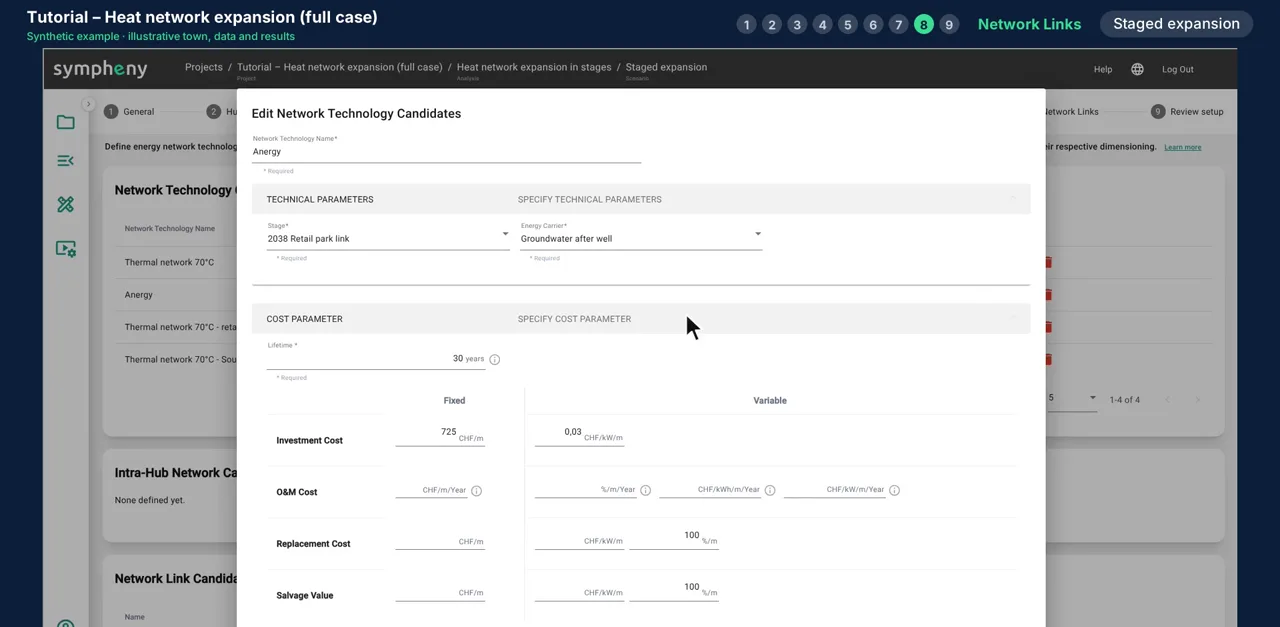
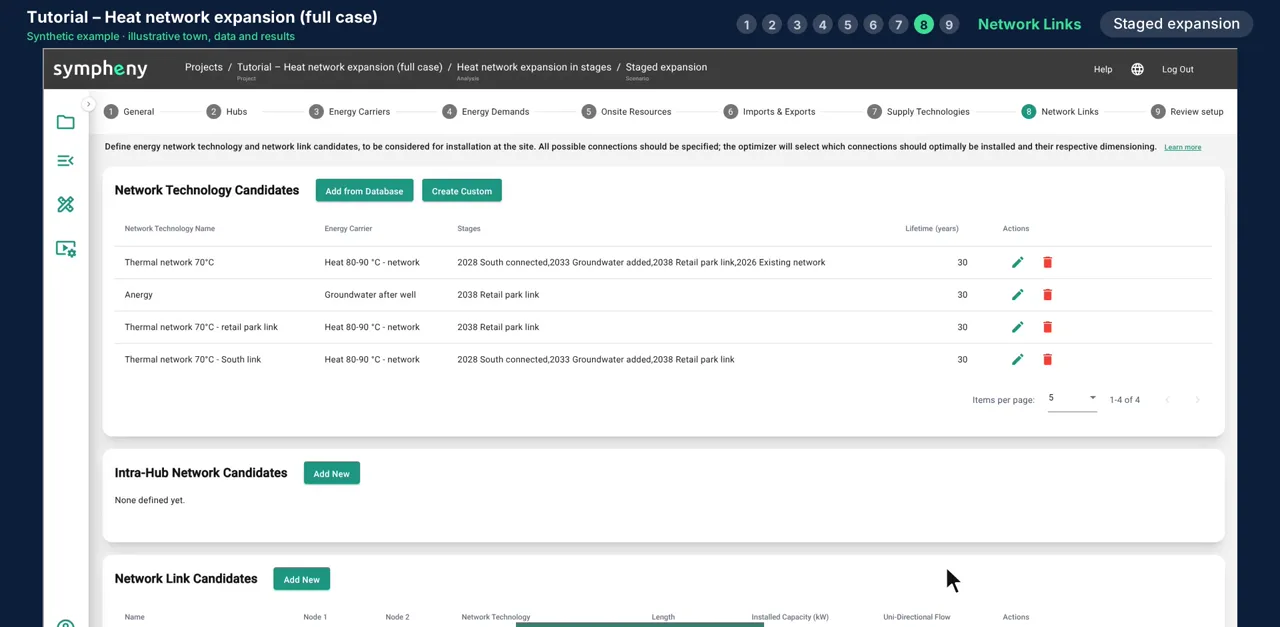
Under Network Links, network technologies have stages too. The South link can be built from 2028.
For the Retail park there are two candidate links. The first is a low-temperature link, also called anergy, which carries groundwater. It costs 725 francs per metre.
Each pipe has a cost per metre plus a cost per kilowatt and metre, so the results show the right size of each pipe, not just whether to build it.
In the documentation: Stages ↗ Network links step ↗
- 9
Offer a hot-water link as the alternative
The other candidate is a classic hot-water link. Both links are offered from 2038, and Sympheny decides which one, if either, is worth building.
In the documentation: Network links step ↗
- 10
Run the optimisation
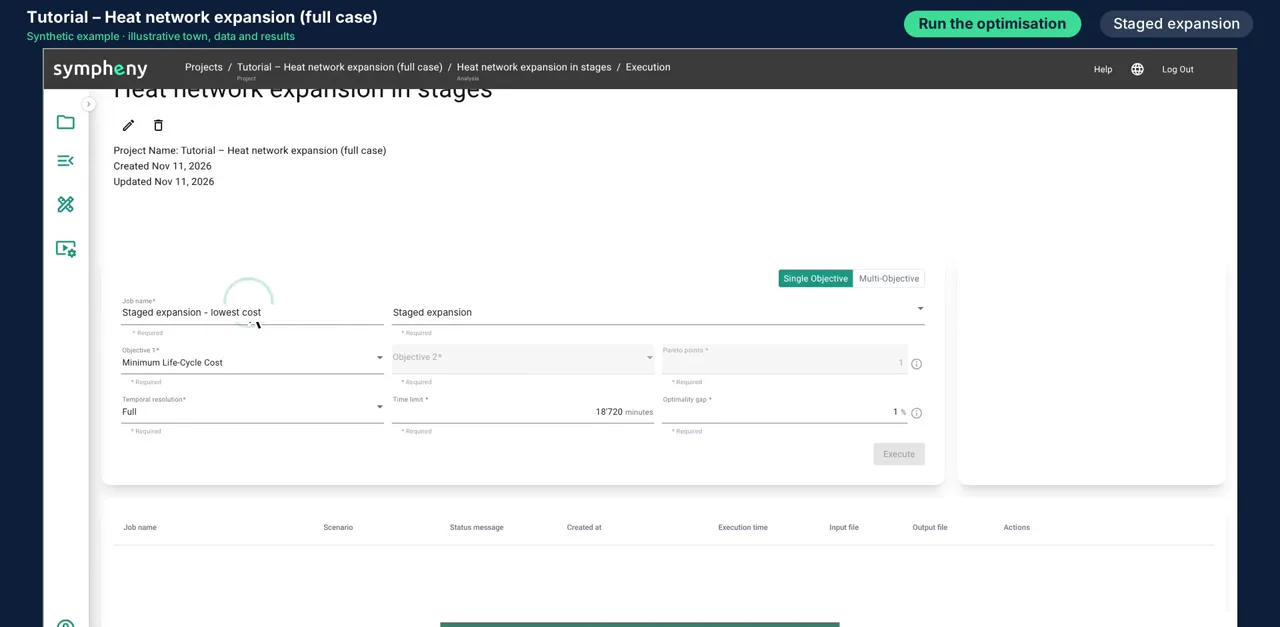
Run the optimisation for the lowest life-cycle cost, at full time resolution. For this model it takes about thirteen minutes, and you can keep working in the meantime.
In the documentation: Execution ↗
- 11
Results for 2026: the existing network
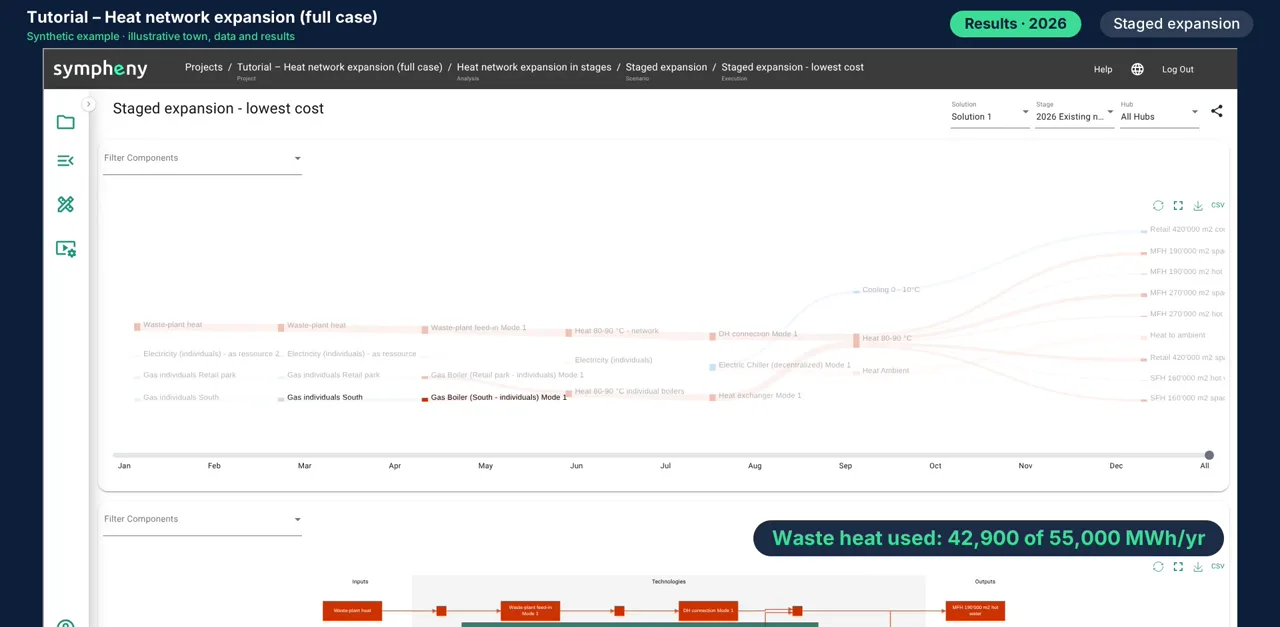
Open the results and pick a stage at the top. The energy flow shows what happens in that stage. Read it from left to right: sources, then technologies, then the district demands.
In 2026, the network uses about 42,900 of the 55,000 MWh of waste heat. South and the Retail park still burn about 37,800 MWh of gas a year.
In the documentation: Results dashboard ↗
- 12
2028: South is connected
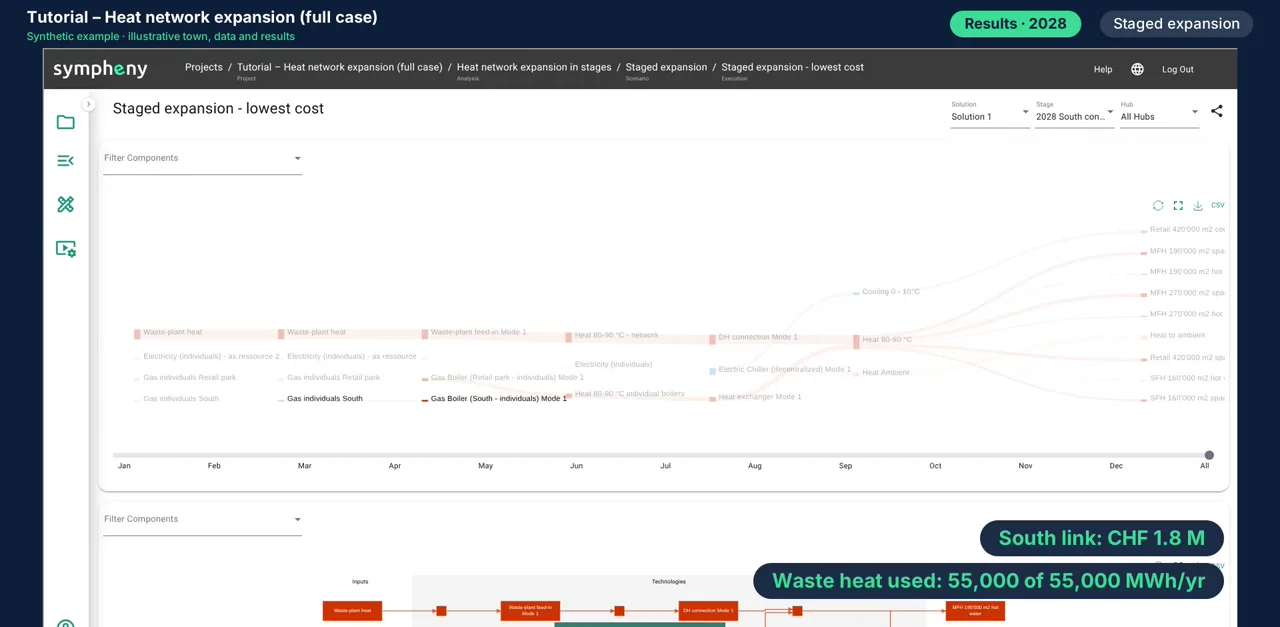
In 2028, the South link is built for about CHF 1.8 million. Now all 55,000 MWh of waste heat are used, and South still needs some gas.
Because the waste heat is capped, on cold days the network cannot cover all of South.
In the documentation: Results dashboard ↗
- 13
2033: groundwater comes in
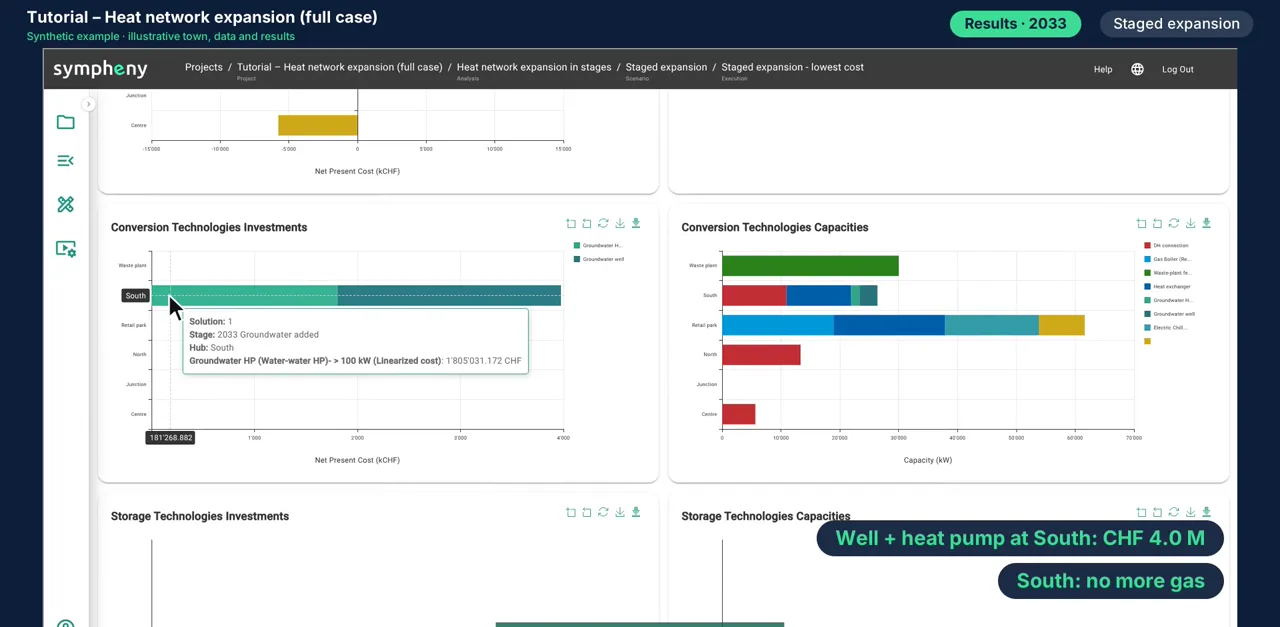
So groundwater is the next source. In 2033, the well and the heat pump at South cost about CHF 4 million, and South no longer needs gas.
In the documentation: Results dashboard ↗
- 14
2038: the Retail park gets a low-temperature link
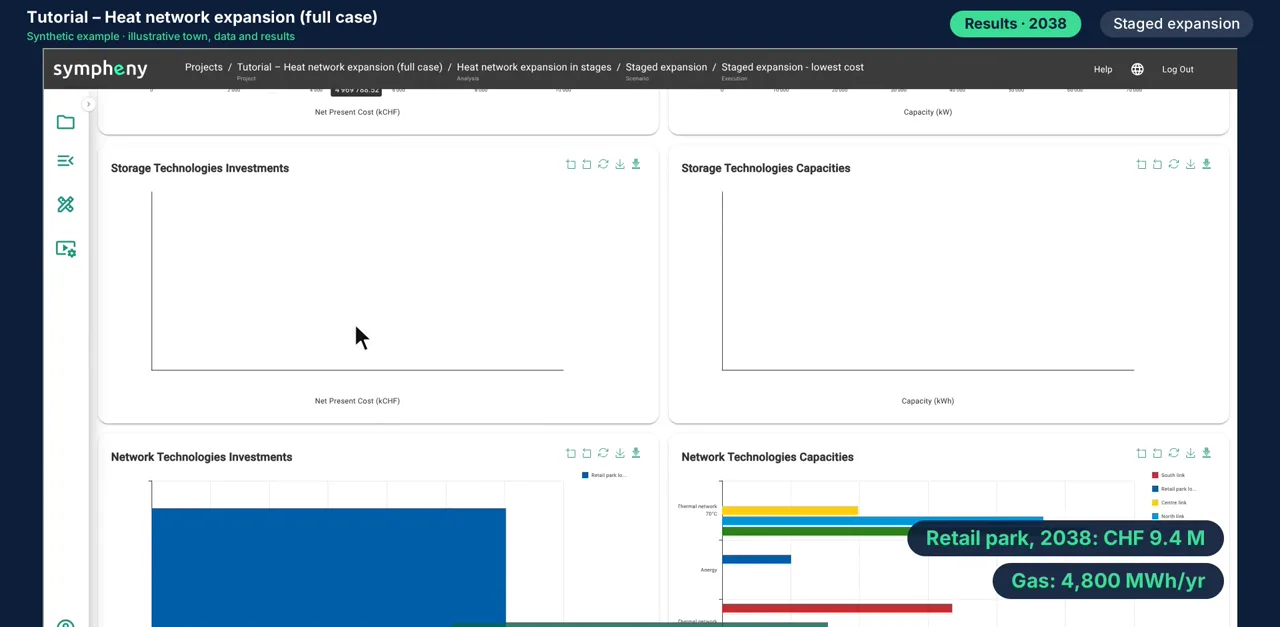
In 2038, the Retail park gets the low-temperature link, together with the reversible heat pump, the chiller and the biogas boiler: about CHF 9.4 million in total. Gas drops to about 4,800 MWh a year.
Why a low-temperature link? It carries groundwater instead of hot water, so the pipe costs less, and the same link serves both heating and cooling.
In the documentation: Results dashboard ↗
- 15
All four stages side by side
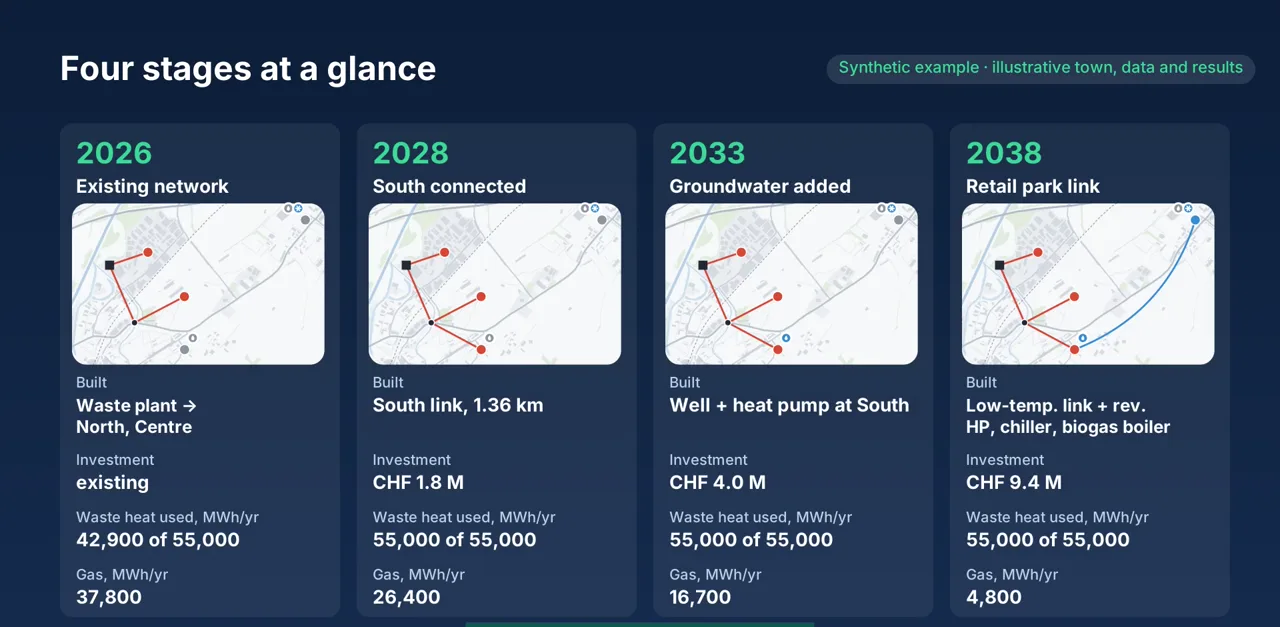
Put together, the four stages show what is built, what it costs, how much waste heat is used and how much gas is left. The hot-water link was offered, but it is not in the lowest-cost design.
In the documentation: Results dashboard ↗
- 16
What-if: copy the scenario
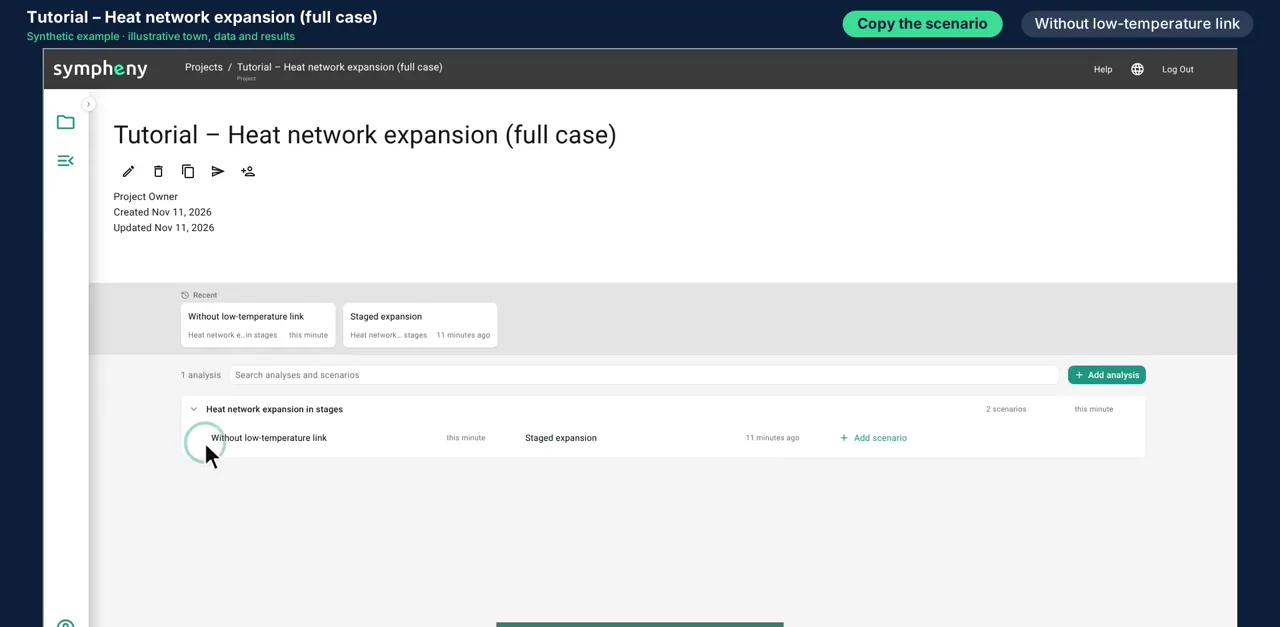
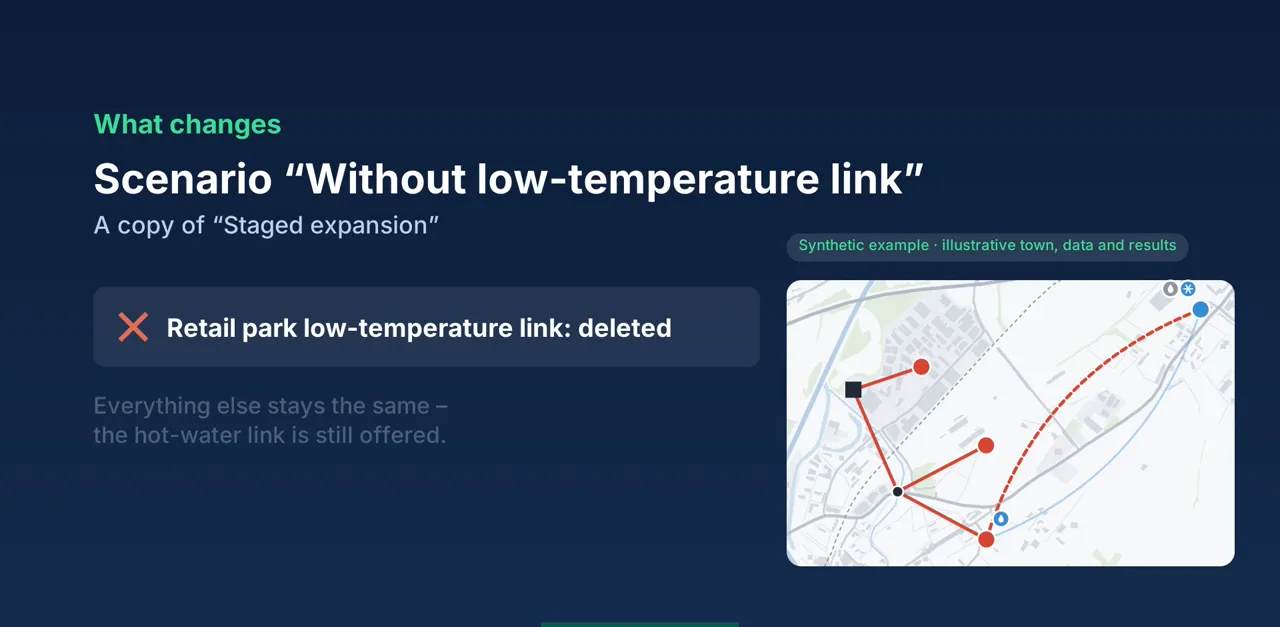
Is the low-temperature link really the better choice? Test it. Copy the scenario, call it Without low-temperature link, and under Network Links delete the low-temperature link. Confirm the delete.
In the documentation: Analyses and scenarios ↗
- 17
Only one thing changes
In the copy, only one thing is different: the low-temperature link is gone. The hot-water link is still offered. Then run the optimisation again.
- 18
Read the what-if results
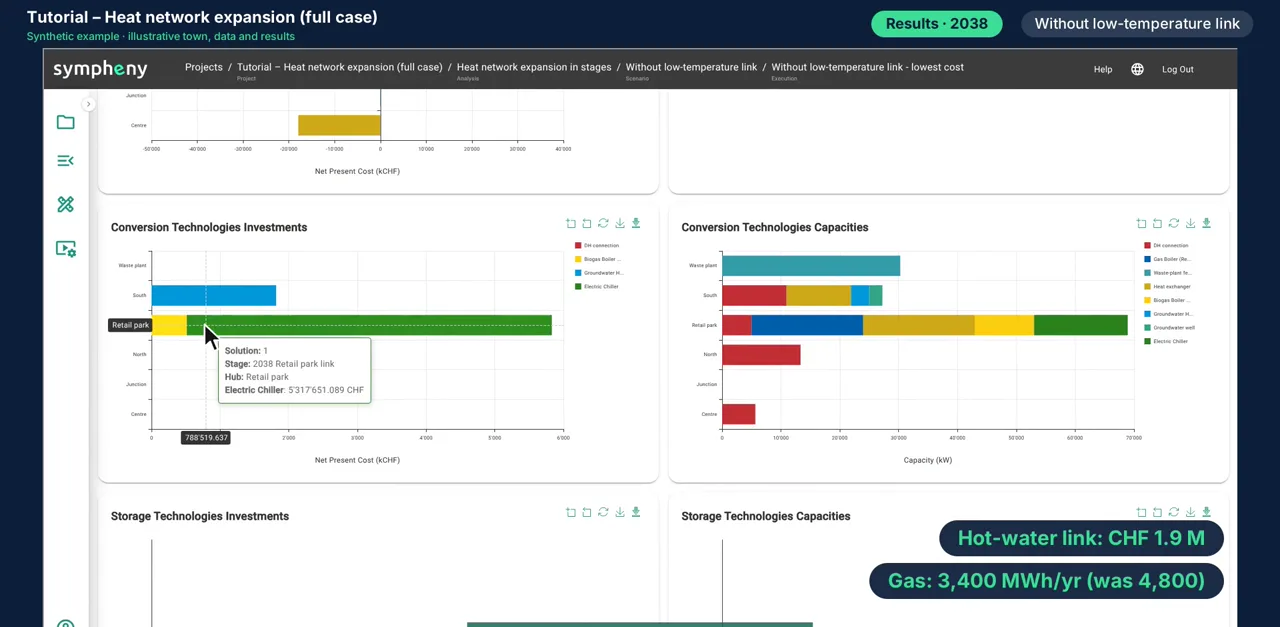
Now the lowest-cost design uses the hot-water link instead, for about CHF 1.9 million, with a bigger chiller. Gas is lower, about 3,400 instead of 4,800 MWh a year, but the whole system has a higher life-cycle cost. The low-temperature link remains the lower-cost option, and you can now see the trade-off.
In the documentation: Results dashboard ↗
- 19
The answers, and your turn
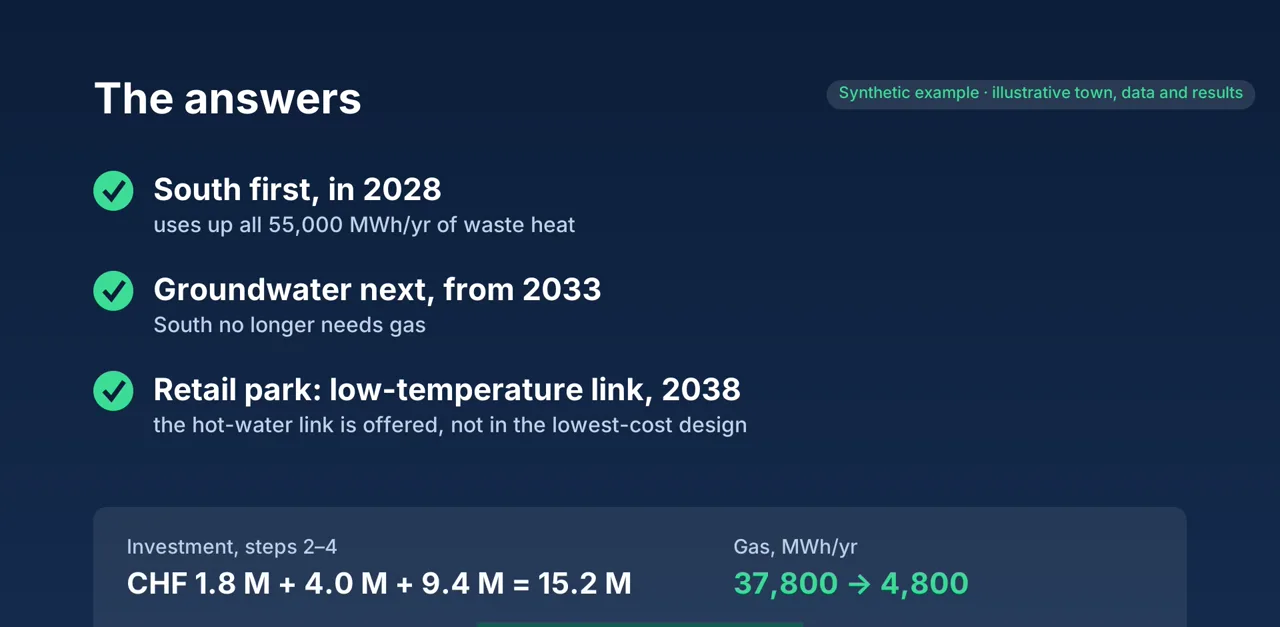
Connecting South in 2028 pays first, and it uses up all the waste heat. Groundwater is the next source, from 2033. The Retail park gets a low-temperature link in 2038; the hot-water link is offered but is not in the lowest-cost design.
Your turn: change a stage, a cap or a price, run it again and compare.
Results
Lowest life-cycle cost, full time resolution. Investment per stage as read from the results; gas is the remaining gas use in each stage.
| Stage | What is built | Investment | Waste heat used, MWh/yr | Gas, MWh/yr |
|---|---|---|---|---|
| 2026 | Existing network: waste plant to North and Centre | existing | 42,900 of 55,000 | 37,800 |
| 2028 | South link | CHF 1.8 M | 55,000 of 55,000 | 26,400 |
| 2033 | Groundwater well and heat pump at South | CHF 4.0 M | 55,000 of 55,000 | 16,700 (Retail park, not yet connected) |
| 2038 | Low-temperature link, reversible heat pump, chiller and biogas boiler for the Retail park | CHF 9.4 M | 55,000 of 55,000 | 4,800 |
- The three expansion stages (2028, 2033 and 2038) add up to about CHF 15.2 million, and gas falls from about 37,800 to 4,800 MWh a year.
- The waste heat is fully used from 2028 on, which is why groundwater is the next source.
- Without the low-temperature link, the model picks the hot-water link (about CHF 1.9 million) and a bigger chiller. Gas drops to about 3,400 MWh a year, but the life-cycle cost is higher.
Try it yourself
Build the model alongside the video in your own Sympheny account, then change one assumption and run it again.
Stuck on a step? Ask our support team. Tell us which tutorial and step, and we'll help you get unstuck. Contact support ↗
Video transcript
This is Example Town, a synthetic example. A waste plant already feeds a heat network to the North and Centre districts.
South and the Retail park still heat with gas boilers. The Retail park also needs a lot of cooling.
The utility wants to grow the network step by step until 2038. Which expansion steps pay off, and in which order? And when does the waste heat run out?
Let's find out.
This is an advanced tutorial. The model is already built, so we'll focus on what's new: stages, limited heat sources, and a second kind of network.
Open the scenario. Under General, the model has four stages: 2026, the existing network; 2028, South connected; 2033, groundwater added; and 2038, the Retail park link.
Each stage has a length and an interest rate. 2028 runs for five years; the last stage, 2038, runs for forty, so long-lived pipes are judged over their whole life.
Anything built in one stage stays in the later stages. So Sympheny shows not just what to build, but also when.
Hubs, energy carriers and demands work the same as in the basic tutorials: six hubs, including the waste plant and a junction, and the heating and cooling demands of each district.
New here: limited sources. Under Imports, open the waste-plant heat. Its total annual energy is capped at 55,000 megawatt hours. That's all the plant can deliver.
Groundwater is a second source, at South. It's only available in the stages from 2033, and it's capped too, at 15,000 megawatt hours a year.
These caps are what make the order matter. Once a source is used up, the next district has to be heated some other way.
Under Supply Technologies, the groundwater well and the heat pump at South are also limited to 2033 and later. Open the well to see its stages. That's how you tell Sympheny when an option becomes possible.
For the Retail park, from 2038: a reversible groundwater heat pump that heats in winter and cools in summer, a central chiller, and a biogas boiler.
In cooling mode, the reversible heat pump sends the Retail park's heat back into the groundwater.
Under Network Links, network technologies have stages too. The South link can be built from 2028.
For the Retail park there are two candidate links. A low-temperature link, also called anergy, carries groundwater. It costs 725 francs per metre.
Each pipe has a cost per metre plus a cost per kilowatt and metre, so the results show the right size of each pipe, not just whether to build it.
The other is a classic hot-water link. Both are offered from 2038. Sympheny shows which one, if any, is worth building.
Run the optimisation for the lowest life-cycle cost, at full time resolution. For this model it takes about thirteen minutes.
You can keep working in the meantime.
Open the results, and pick a stage at the top. The energy flow shows what happens in that stage.
Read the energy flow from left to right: sources, then technologies, then the district demands.
In 2026, the network uses about 42,900 of the 55,000 megawatt hours of waste heat. South and the Retail park still burn about 37,800 megawatt hours of gas.
In 2028, the South link is built, for about 1.8 million francs. Now all 55,000 megawatt hours of waste heat are used, and South still needs some gas.
The waste heat is capped, so on cold days the network can't cover all of South.
So groundwater is the next source. In 2033, the well and the heat pump at South cost about 4 million francs, and South no longer needs gas.
In 2038, the Retail park gets the low-temperature link, with the reversible heat pump, the chiller and the biogas boiler: about 9.4 million francs. Gas drops to about 4,800 megawatt hours a year.
Why a low-temperature link? It carries groundwater instead of hot water, so the pipe costs less, and the same link serves both heating and cooling.
Here are the four stages side by side: what's built, what it costs, how much waste heat is used, and how much gas is left.
And the hot-water link? It was offered, but it isn't in the lowest-cost design.
Is the low-temperature link really the better choice? Let's test it. Copy the scenario, call it Without low-temperature link, and delete that link under Network Links. Confirm the delete.
In the copy, only one thing changes: the low-temperature link is gone. The hot-water link is still offered.
Then run it again.
Now the lowest-cost design uses the hot-water link instead, about 1.9 million francs, with a bigger chiller. Gas is lower, 3,400 instead of 4,800 megawatt hours a year, but the whole system costs about 2.1 million francs more over its life.
Here are the two runs side by side. The low-temperature link is the lower-cost option, and now you can see the trade-off.
So, the answers. Connecting South in 2028 pays first, and it uses up all the waste heat. Groundwater is the next source, from 2033. The Retail park gets a low-temperature link in 2038; the hot-water link is offered but not in the lowest-cost design.
Steps two to four add up to about 15.2 million francs, and gas falls from 37,800 to 4,800 megawatt hours a year.
Your turn: change a stage, a cap or a price, run it again, and compare. To turn results like these into dashboards, watch our heat network webinar.