The optimization engine US sites use when the grid can't keep up.
Interconnection queues run for years and AI load is climbing. Sympheny optimizes behind-the-meter generation, storage, microgrids and thermal energy networks together, so a site has a defensible cost, carbon and resilience case before anyone commits capital.
One model for power, heat, cooling and storage, optimized together.
The constraint isn't efficiency anymore. It's getting power.
New loads wait years for a grid connection while demand climbs. The way through is generating, storing and sharing power on site, and that only holds up if the whole system is optimized against the real load instead of a nameplate number.
The grid request decides the timeline
A site that asks the utility for more than it can justify lands at the back of an interconnection queue that runs for years. Sizing behind-the-meter generation and storage against the real hourly load is how you ask for less and get connected sooner.
Options get studied one at a time
Solar, storage, a gas backup, a heat pump loop, a microgrid: each gets a separate study, on separate assumptions, that never line up. Nobody can say which combination is actually best, only which one somebody already modeled.
AI load breaks a flat-average plan
AI workloads swing hard hour to hour. A system sized on an annual average is wrong for real operation and wrong for the connection request. You need the full hourly picture before you commit capital.
Optimization rigor, multi-energy scope, and outputs that survive review.
Optimization, not a calculator
Sympheny runs a deterministic MILP optimization that searches across thousands of technology and sizing combinations for the best cost, carbon and resilience outcome. It is math, not a spreadsheet that re-tots a configuration you already chose.
Multi-energy in one model
Electricity, heat, cooling, gas, hydrogen, storage and on-site generation are modeled together, so a behind-the-meter or sector-coupling choice is judged as part of the same system instead of in its own silo.
Sized on real hourly load
Every scenario is solved across a full reference year at hourly resolution. Peak-shaving, storage sizing and the grid request fall out of the real demand shape, not a nameplate number that won't survive review.
Compare scenarios on the same footing
A Pareto front lays every optimized scenario out on cost against CO2, so the trade-off is explicit. You bring a decision to the table, not a single option somebody has to take on faith.
Outputs a reviewer can interrogate
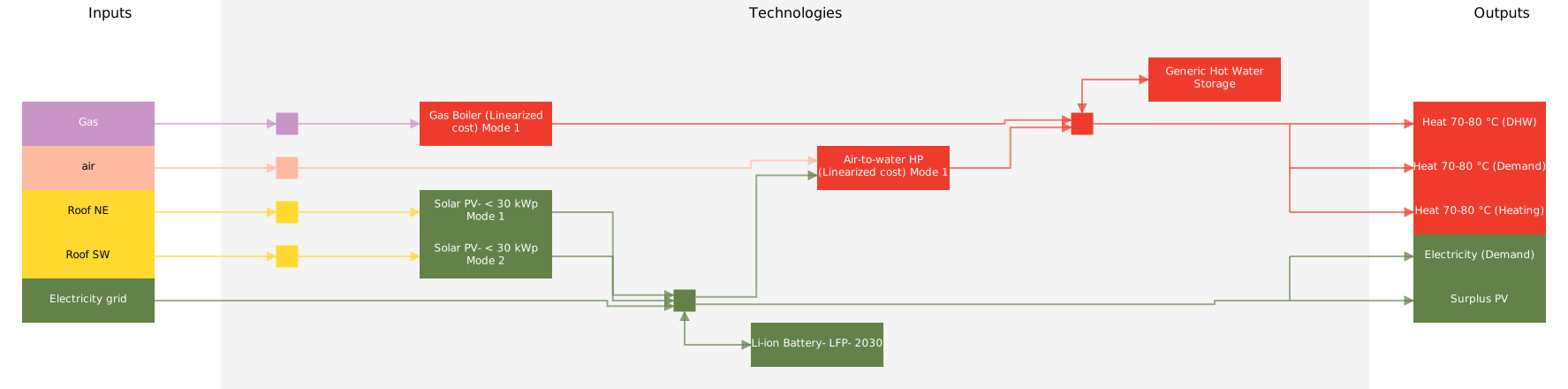
Load-duration curves, Sankey energy flows and life-cycle cost breakdowns come out of the same model, ready for the review where a funder, tenant or program office picks the case apart.
Swiss pedigree, applied in the US
Sympheny is an Empa spin-off out of the ETH Domain, with more than ten years of R&D behind the optimization engine. In the US, that engine has been applied in US Department of Defense thermal energy network feasibility studies under the ESTCP program, as the design-optimization layer ahead of detailed engineering.
“In the Uster city centre I compared three networking options: no network, an anergy network, and one with additional electricity trading. The result was clear — maximum thermal and electrical networking is the best solution, economically and ecologically. I couldn't have run a variant comparison at this depth without Sympheny.”
Where Sympheny earns its place over the usual approach.
A spreadsheet can tally a system. It can't search for the best one.
Hand-built models scale to a handful of options before they get unmaintainable, and they can't size storage or behind-the-meter generation against an hourly load. You end up defending the configuration you had time to build, not the one that's actually best.
A consulting team compared six fully optimized scenarios in under ten minutes, with life-cycle cost up to 26% below the baseline. A spreadsheet would have managed one or two by hand.
Read the WSP case studyOpen-source solvers need a modeler. This needs an engineer.
Tools like a raw MILP framework give you the math but none of the workflow: no data foundation, no GIS, no demand profiles, no shared outputs. They turn every feasibility study into a coding project. Sympheny wraps the same rigor in a planning platform an engineer can actually use.
Simulation tells you how one design performs. It won't find a better one.
Detailed building or grid simulation answers a narrow question well, but it starts from a design you already picked. It won't explore the option space, and it won't compare cost against carbon across scenarios. That's optimization, and it's a different job.
An internal model is one person's job security, not your method.
In-house tools work until the person who built them moves on, and they rarely survive a reviewer who wants to see the assumptions. A maintained platform with documented outputs is what a funder, tenant or program office can actually sign off on.
We'd rather you know up front.
Not for a single fixed design
If the system is already decided and you just want it drawn or simulated, an optimization engine is overkill. Sympheny earns its place when there are real options still on the table.
Not a back-of-envelope screen
Sympheny needs a real data foundation: hourly demand, tariffs, site context. If you want a one-number gut-check in five minutes, it's more tool than the question deserves.
Not a substitute for delivery
Sympheny gets you to a defensible, optimized concept. Interconnection hardware, the legal framework and on-the-ground delivery are where your engineering and delivery partners come in.
The US power problem isn't going to wait for you to model it twice.
The sites that get powered are the ones that come to the utility with a smaller, better-evidenced request and an on-site system that holds up. That case has to be built before the queue, not after.
Optimizing the whole system together, against the real hourly load, is how you get there in days instead of a series of disconnected studies.
Large new loads are waiting years for a grid connection, and many are told there's no capacity at all.
Data-center power demand is projected to grow several-fold this decade, and AI workloads swing sharply hour to hour.
Behind-the-meter generation, storage and microgrids are how sites move forward while the grid catches up.
Campuses, bases and data-center districts are shifting heating and cooling onto shared ambient loops and heat pumps.
Every one of those decisions has to survive a review on cost, carbon and resilience, with the numbers shown.
The payback shows up in the grid request and the review.
The value isn't a faster spreadsheet. It's a smaller connection ask, a bankable on-site system, and a case a reviewer can't pull apart. You can put rough numbers on the planning time it saves.
A smaller, better-evidenced grid request that can move through interconnection faster.
Behind-the-meter and storage sized against the real load, so the system is bankable rather than guessed.
Cost and carbon compared across scenarios, so capital goes to the option that actually wins.
Decision-ready outputs that hold up in front of a funder, tenant or program office.
Weeks of feasibility work compressed into days, so more concepts get a serious look.
Figures from the savings estimator are indicative and depend on your own rates, scope and assumptions.
European commissions, on the same problems US sites face.
These are European projects. They demonstrate the method a US data center, campus or base depends on: needing less from the grid by generating, storing and sharing on site, with the cost and carbon case to back it.
A two-site system sharing a thermal network and a microgrid, life-cycle cost up to 26% below baseline, six Pareto variants in under ten minutes.
Read case studySixteen on-site generation and energy-sharing scenarios compared in one project. Generating and sharing power locally was the lowest-risk path.
Read case studyA low-temperature thermal network moving 90,000 MWh a year of heating and cooling across six hubs and 30+ scenarios, the ambient-loop problem a campus TEN poses.
Read case studyEmpa / ETH Domain engineering
Your data stays yours
Bring us a site the grid can't power yet.
We'll model the on-site generation, the storage, the network and the grid cost together, and show you the system worth building before anyone specifies a component.