Why energy teams choose Sympheny
Sympheny helps engineering firms, utilities, municipalities, and developers leave slow manual planning behind. You reach investment-grade energy concepts faster, and you can rerun the whole analysis as the project changes instead of starting over.
One model. Every carrier. Every technology you decide is in scope.
Energy planning is still too slow for the decisions it needs to support
Most energy planning still runs on manual data preparation, spreadsheet handoffs, and consultants who become the bottleneck. Every scenario takes time to set up, so teams end up evaluating a handful of options instead of the full range. And it's hard to build the kind of evidence an infrastructure investment decision actually needs.
Manual data prep consumes planning time
Every hour spent cleaning GIS data, aligning tariffs, and building demand profiles by hand is an hour your engineers aren't spending on the actual engineering. That work adds up, and it pushes timelines out.
Too few scenarios get evaluated
When each scenario is slow and expensive to run, teams compare two or three options instead of ten. The option that would have worked best never gets looked at.
Justifying decisions is harder than finding them
Regulators, clients, and finance teams expect rigorous documentation. Outputs assembled from spreadsheets are harder to audit, explain, and update when assumptions change.
Purpose-built for multi-energy planning, not adapted from something else
Data to start from, flexibility to go further
Most tools force a choice: bundled data with a fixed model you can't change, or full flexibility with no data to start from. Sympheny ships with technology, performance, and building energy data ready to run today, and still lets you override any assumption or add your own technologies. Your project data is never used to train our models.
Built for multi-energy system planning
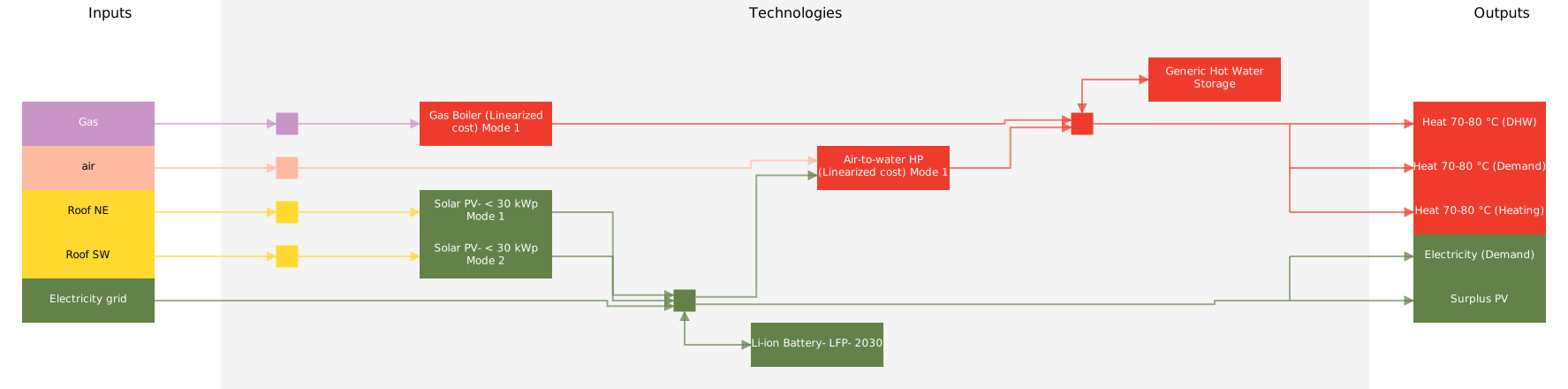
Sympheny optimises heat, electricity, cooling, hydrogen, and storage as a single connected system. Most tools only handle one carrier at a time; Sympheny solves for all of them at once.
Optimisation engine, not a spreadsheet
A physics-based MILP solver searches 50,000+ technology and capacity combinations per run. Choose from nine objectives, from life-cycle cost and CO₂ to investment cost and energy imports, optimise one or two at once, and see the trade-off on a Pareto front. What comes out is an optimum proven to within a tolerance you set, not a number someone tuned by hand.
Scenario comparison built in
Run multiple scenarios in parallel. Compare on cost, CO₂, self-sufficiency, and risk across the same baseline model, without rebuilding anything.
One tool covers the full project lifecycle
One place for acquisition, strategic planning, detailed design, scenario comparison, and the outputs you hand to stakeholders. GIS site view, Swiss and EU benchmark data, tariffs, and in-app reporting (printable from the browser) all come built in. No stitching three packages together to cover one project.
Research-backed and production-proven
Developed from Empa / ETH Domain research in multi-energy optimisation and network-aware planning. Used in 70+ projects across Europe, the USA, and China: the Nanoverbund thermal micro-grid in Basel (operational since 2023, with IWB), the 78-district energy roadmap for the City of Bern, and a multi-year city-wide strategy for IBC Chur. This is not a prototype.
“In the Uster city centre I compared three networking options: no network, an anergy network, and one with additional electricity trading. The result was clear — maximum thermal and electrical networking is the best solution, economically and ecologically. I couldn't have run a variant comparison at this depth without Sympheny.”
Sympheny vs. the alternatives
Spreadsheets don't scale to multi-energy complexity
Spreadsheets are flexible but hard to audit, slow to re-run, and nearly impossible to compare across scenarios. Put six energy carriers, 30 technology options and three demand assumptions in one and it becomes a liability. Sympheny runs the same analysis faster and keeps every scenario documented and directly comparable, so you rerun the model as inputs change instead of rebuilding it each time.
WSP ran six Pareto-optimal hydrogen variants in under 10 minutes, a multi-site sector-coupling analysis that would have taken weeks in spreadsheets.
Read case studyOpen-source rigour, with people behind it
Open-source tools can be rigorous and transparent, but most need programming skills and ship with no support, onboarding, or maintained roadmap. When a key contributor moves on, there's no one to call. Sympheny gives you the same peer-reviewed MILP rigour and exportable models, plus onboarding, fast support response times, agreed in your contract, API documentation, and a roadmap shaped by paying customers. Built by a Swiss team with PhDs from ETH Zürich and TU Delft.
Built for multi-energy sites, not a single meter
Desktop tools like HOMER set the standard for sizing on-site power, and most Indian energy teams know them well. They can bring in a thermal load, but the model stays anchored to one site behind one meter, with power as the lead carrier and lowest cost as the goal. The ceiling shows when the brief goes properly multi-energy: cooling, heat, hydrogen and storage optimised together with power, several hubs linked across a site, a client who wants cost weighed against carbon on the same chart. Sympheny optimises every carrier and the networks between them in one MILP run across 50,000+ combinations, in the browser with GIS site context, and returns the cost-versus-carbon trade-off as a client-ready output. Teams keep their HOMER experience; the modelling just stops ending at a single meter.
Internal tools are expensive to build and fragile to maintain
Building a multi-energy optimisation tool from scratch takes energy modellers, software engineers, and data specialists, plus years of validation. Most teams that try it find the ongoing maintenance costs more than the original build. Sympheny is a maintained, continuously improved platform backed by Empa research and a full engineering team, with a roadmap, onboarding, and a solver already validated on real projects, off your maintenance budget.
What Sympheny is not
Not a real-time energy management system
Sympheny is a planning tool, not an operations platform. It does not monitor live energy flows, control building systems, or replace BMS/EMS software like Siemens Desigo or Schneider EcoStruxure. It is used before infrastructure is built, to decide what to install and why.
Not a wholesale market modelling tool
Sympheny does not model national grid capacity, long-run electricity price curves, or policy scenarios at a regional or country level. Tools like Aurora, PLEXOS, or EnergyPLAN cover that space. Sympheny works at the district, campus, city, and site scale, where infrastructure decisions are made.
Overkill for single-technology feasibility
Sympheny can model a solar-only or EV-charging scenario, but if that's all you need, it's more than the job requires. The platform is built for projects where multiple energy carriers interact (heat, electricity, storage, gas, hydrogen) and where the right answer depends on how the system fits together.
Energy planning is getting harder, not easier
Electrification, heat networks, distributed storage, dynamic tariffs, carbon targets, and tightening regulation are all hitting planning teams at once. The number of technology combinations that need to be evaluated is growing. The timeframes for decisions are compressing. And the quality of evidence that regulators, clients, and finance teams expect is rising.
The teams that can run more scenarios quickly, and show their reasoning clearly, are the ones winning work and putting money behind the right infrastructure. Sympheny exists to make that kind of work the default, not the exception.
More energy carriers to model: electricity, heat, H₂, storage, mobility
More stakeholders requiring documented, auditable reasoning
Shorter project timelines with higher quality expectations
Carbon targets that require long-range scenario analysis, not point estimates
Tariff structures changing faster than static models can track
What Sympheny gives back to your team
We don't publish a single ROI figure, because every team's workflow and billing structure is different. What we do see in practice is that the time saved on data preparation and scenario modelling tends to cover the cost of the platform within the first two projects.
Less time on manual data preparation, more time on engineering judgement
More scenarios evaluated and compared in the same project duration
Client-ready outputs explored in an interactive dashboard, not assembled by hand
Models that can be re-run as assumptions change, without rebuilding
Stronger confidence before infrastructure investment decisions
Time savings are directional estimates based on reported project experiences. Actual impact varies by team size, project type, and existing workflow.
A short ramp-up to powerful, flexible energy modelling.
Sympheny gives expert users the full flexibility of energy-system optimisation, and that flexibility takes some learning. Users with a background in optimisation or energy-system modelling are usually productive within a day. Once workflows are established, many studies can be set up in around 30 minutes.
See why most teams recover the license cost after 1-2 projectsTime savings vary by project complexity, input data quality, and team experience. Examples reflect common workflows after the relevant setup is in place.
Results from real projects
Green hydrogen produced on-site at a cost comparable to diesel. Life-cycle costs cut 26% versus the fossil baseline.
Read case studyThree city-wide scenarios confirmed a CO₂-free supply is achievable at similar life cycle costs to today.
Read case studyMapped by 2040 across three scenarios for a new eco-quartier and a city-wide decarbonisation roadmap.
Read case studyWe hold our security practices to ISO 27001 standards (not currently certified)
Nanoverbund project · IWB, ETH, Empa, HSLU, Sympheny
“Thanks to Sympheny, we can now develop more precise energy concepts for our customers and create added value for them.”

“Sympheny supports our strategic energy planning in an ideal way. The flexibility is extremely convincing and the sensitivity analysis provides security in finding solutions.”

“Digitalization with Sympheny helps us to develop decentralized energy concepts and creates security for investments in new infrastructures.”

See whether Sympheny fits your planning workflow
In 30 minutes, we'll run a scenario based on your project type, live in the tool, no slides.