Get the township energy concept right before the capital is committed.
Energy infrastructure decisions made at the concept stage lock in cost and carbon for thirty years, and in India the biggest of them is cooling. Sympheny lets development teams compare district cooling, rooftop solar, storage and grid options side by side, fast enough to inform the business plan and rigorous enough for the investment committee.
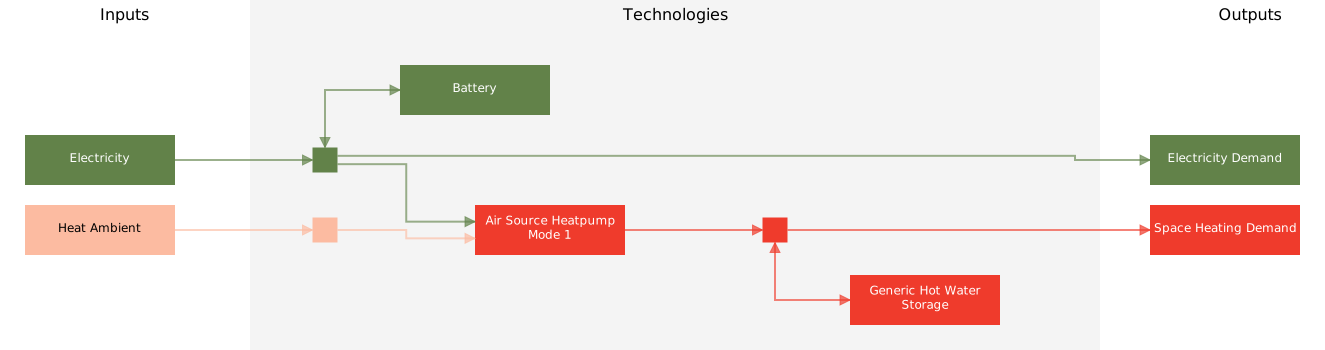
Site energy system. Inputs, technologies and outputs laid out in one connected model.
Trusted by developers and site owners
Used by developers, campus operators and site owners in Europe to test whole-site energy concepts before capital commitment. Delivered in India with ORMAE, Bengaluru.




When site energy planning gets complex
Cooling demand dominating the load profile and the budget
Grid sanction limits or long connection timelines
Phased build-out across a decade of construction
Rooftop solar, storage and district cooling competing for capital
Multiple stakeholders: owner, investors, tenants, DISCOM, consultants
Green-building certification targets with energy performance criteria
For townships and real estate
- Mixed-use townships and gated developments
- District cooling versus decentralised cooling comparisons
- Feasibility for IGBC / GRIHA performance targets
- Investor and board presentations from the same model
For campuses and smart-city projects
- IT parks, institutional campuses and industrial estates
- Smart-city energy infrastructure concepts
- Solar, storage and grid-capacity trade-offs
- Site-wide decarbonisation and resilience scenarios
How Sympheny helps
Cooling decided with everything else
District cooling, chillers with thermal storage, and unit-level options sit in the same optimisation as solar, batteries and the grid connection. The cooling strategy stops being a separate consultant study that arrives after the master plan is fixed.
Phasing modelled, not assumed
Townships build out over a decade. Sympheny models build stages explicitly, so you see which infrastructure earns its keep in phase one and what can wait, with the economics of each stage visible.
Numbers that hold up in the investment committee
CAPEX, OPEX, CO₂ and resilience trade-offs on one page, traceable to assumptions. Useful for IGBC and GRIHA submissions, more useful when an investor asks why this concept and not a cheaper one.
What changes for development teams
| Process | Before Sympheny | With Sympheny |
|---|---|---|
| Concept stage | Energy is a line item assumed from thumb rules while the master plan is drawn | Whole-site scenarios compared while the design is still cheap to change |
| Cooling strategy | District cooling assessed in isolation, usually too late to alter the plan | Cooling, solar, storage and grid modelled together from the first concept |
| Investor reviews | Energy CAPEX defended with consultant PDFs and assumptions nobody in the room can check | Scenario outputs with visible trade-offs, traceable to inputs the committee can interrogate |
| Certification | Green-building energy criteria handled as paperwork after design decisions are made | Performance targets fed into the optimisation as constraints from day one |
District and campus concepts, proven on European ground.
See how developers and site owners pressure-tested the energy concept while it was still cheap to change. The same workflow now runs on Indian campus and township projects, supported by ORMAE.
A self-sufficient campus energy concept
Technical proof: Agri-PV, storage, and biodigester options compared
Business outcome: A viable path to 100% energy self-sufficiency without giving up agricultural land use.
Residential energy concept for a new housing quarter
Technical proof: 16 buildings, 3 supply variants on the same Pareto front
Business outcome: Groundwater heat pumps win once cost, CO2 and autarky are weighed together.
Solar development strategy for the Port of Switzerland
Technical proof: 16 variants across four strategies optimised
Business outcome: Up to 20-25% cost reduction identified; lowest-risk path confirmed.
Daniel Büchi, General Manager, Neuhof (Switzerland)“With the help of Sympheny, we have found a concept that gives us a viable path to energy self-sufficiency.”