Research-grade optimisation, without building the model stack.
Sympheny was built inside a research institution before it was a product, and it shows: deterministic MILP on the Gurobi solver, methods published in Applied Energy, every result traceable to its equations. For groups working on Indian campus energy, district cooling or green hydrogen systems, it removes the model-plumbing phase so the work stays research, not setup.
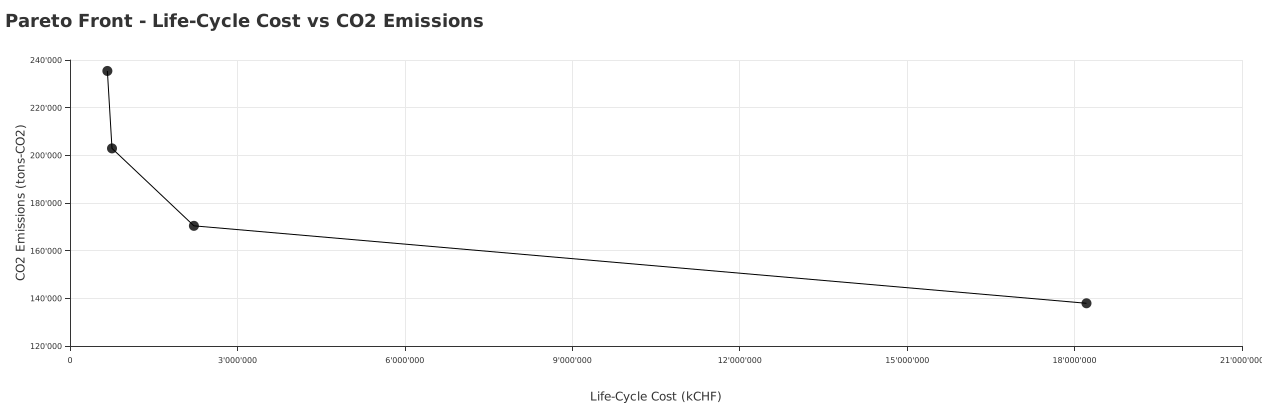
Pareto front of optimised scenarios. Every point a provably optimal solution, traceable to its inputs.
Built in the ETH Domain, used by research institutions
Spun out of Empa in the ETH Domain, with peer-reviewed methods and live research collaborations. The Empa campus itself runs on concepts modelled in Sympheny.




How Sympheny helps
Published methods, not a black box
The optimisation engine implements multi-scale MILP methods published in peer-reviewed journals, including Marquant et al. in Applied Energy. Results are deterministic and auditable, which is what a reviewer, or an examiner, expects.
Multi-energy where familiar tools stop
Many groups teach with desktop microgrid tools that handle electricity well and everything else awkwardly. Sympheny models power, cooling, heat, hydrogen and storage in one hub formulation, at hourly resolution, from a single building to a city.
From coursework to campus living lab
Students model real systems through a browser instead of debugging solver bindings. Institutes can model their own campus as a living lab, the way Empa modelled its 26-building, 12-hub campus toward its climate target.
What changes for research and teaching
| Process | Before Sympheny | With Sympheny |
|---|---|---|
| Starting a project | Months of model-building in Python or GAMS before the research question is touched | A running multi-energy MILP model in days, with the methods documented and citable |
| Teaching | Single-carrier microgrid exercises bounded by what desktop tools can hold | Sector-coupled systems with real GIS context, run by students in a browser |
| Collaboration with industry | Academic models that practitioners can't open, and vice versa | One platform both sides can use, which makes joint projects with consultants and utilities practical |
| Campus decarbonisation | The institute's own energy strategy outsourced or left as a report on a shelf | The campus as a living lab, modelled and re-run by your own researchers |
Born in a research lab. Used on real city systems.
Sympheny is the commercial form of ten years of Empa / ETH Domain research. These projects show the same methods applied beyond the paper, from a 26-building campus to whole-city studies.
Climate-neutral research campus by 2030
Technical proof: 26 buildings across 12 energy hubs modelled
Business outcome: A living campus model that can be updated as the site evolves.
City-wide energy supply strategy toward 2050
Technical proof: 3.2 M m2 energy reference area, three time horizons modelled
Business outcome: CO2-free 2035 supply confirmed at similar life-cycle cost.
Eco-quartier energy concepts and decarbonisation roadmap
Technical proof: Three scenarios mapped for an eco-quartier and city roadmap
Business outcome: 83% CO2 reduction pathway identified by 2040.