Put defensible numbers behind every guaranteed-savings contract.
ESCOs carry the performance risk that other players just write into assumptions. Sympheny models the client's site as a multi-energy system, compares intervention scenarios on the same baseline, and stress-tests the savings estimate across tariff, demand and weather assumptions. The result is a bid you can price with open eyes, and outputs that help your client's management sign.
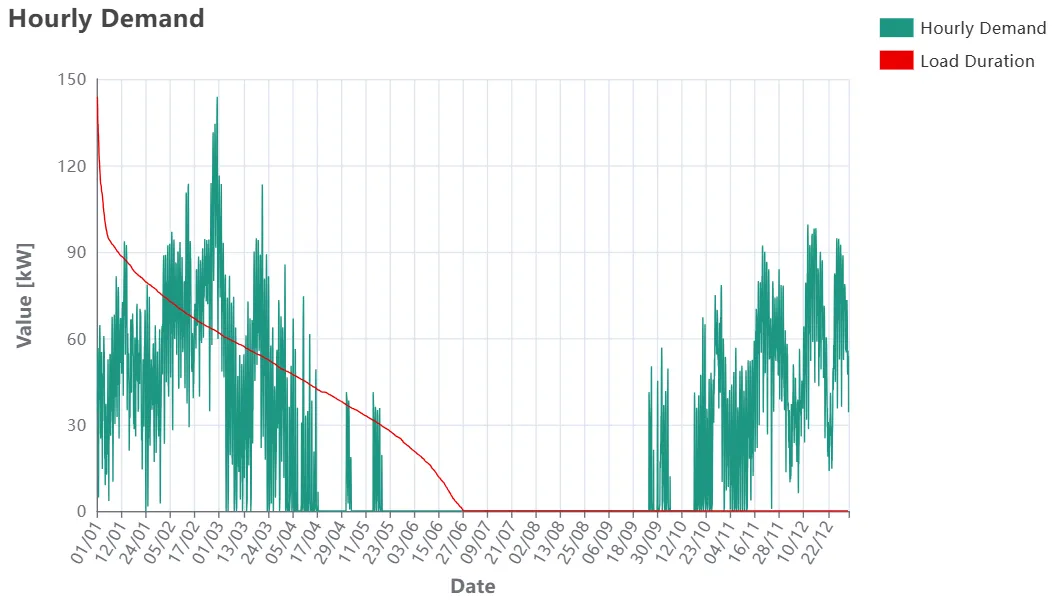
Hourly demand with load-duration curve. The baseline a savings guarantee stands on.
Trusted by energy service and engineering teams
Used by energy service providers and engineering teams in Europe to put scenario-backed numbers behind offers and investment decisions. Delivered in India with ORMAE.


How Sympheny helps
Baselines you can defend in an M&V dispute
Hourly demand modelling across a full reference year, with assumptions documented in the model rather than in one engineer's head. When the measurement and verification conversation gets difficult, you can show your work.
Sensitivity analysis as risk management
Savings guarantees fail at the edges: a tariff revision, a demand shift, an unusual summer. Sympheny runs those sensitivities as part of the workflow, so you see the range before you commit to the guarantee, and price accordingly.
Help the client's champion sell it upward
Your contact at the client rarely owns the budget. Scenario outputs with visible cost and CO₂ trade-offs give them something concrete to take to their management, which shortens the path from audit to signed contract.
What changes for ESCOs
| Process | Before Sympheny | With Sympheny |
|---|---|---|
| Bid preparation | Savings estimates from spreadsheet models that only their author trusts | Structured scenario comparison on a documented baseline, reusable across bids |
| Risk pricing | The guarantee priced on a point estimate plus a safety margin guessed from experience | Sensitivity ranges across tariffs, demand and operating assumptions, visible before signing |
| Client sign-off | Your contact struggles to justify the contract to a sceptical CFO | Outputs the client's management can interrogate, which moves deals out of the maybe pile |
| Portfolio learning | Each project's model dies with the bid | Models persist and improve. The next similar site starts from a working baseline |
The sensitivity analysis that protects a guaranteed-savings margin.
See how European teams used scenario and sensitivity runs to put ranges, not point estimates, behind investment decisions. The same discipline travels well into performance contracting.
Optimal expansion strategy for a district heating network
Technical proof: Five network segments included in the optimal design
Business outcome: Three of four expansion scenarios confirmed profitable.
A self-sufficient campus energy concept
Technical proof: Agri-PV, storage, and biodigester options compared
Business outcome: A viable path to 100% energy self-sufficiency without giving up agricultural land use.
Green hydrogen production and sector coupling
Technical proof: Green hydrogen and sector-coupling variants optimised
Business outcome: 60% CO2 reduction and up to 26% lower life-cycle costs identified.
Oliver Meyer, Energy Engineer, Elimes AG (Switzerland)“Thanks to Sympheny, we can now develop more precise energy concepts for our customers and create added value for them.”