Find the right power mix before you sign the PPA.
A captive or open access decision binds your plant to a supply structure for a decade or more. Sympheny puts every route on the same footing, with hourly modelling of your actual load, so the recommendation you take to the board is yours, not a vendor's. And the same model produces the decarbonisation pathway your BRSR disclosures keep asking for.
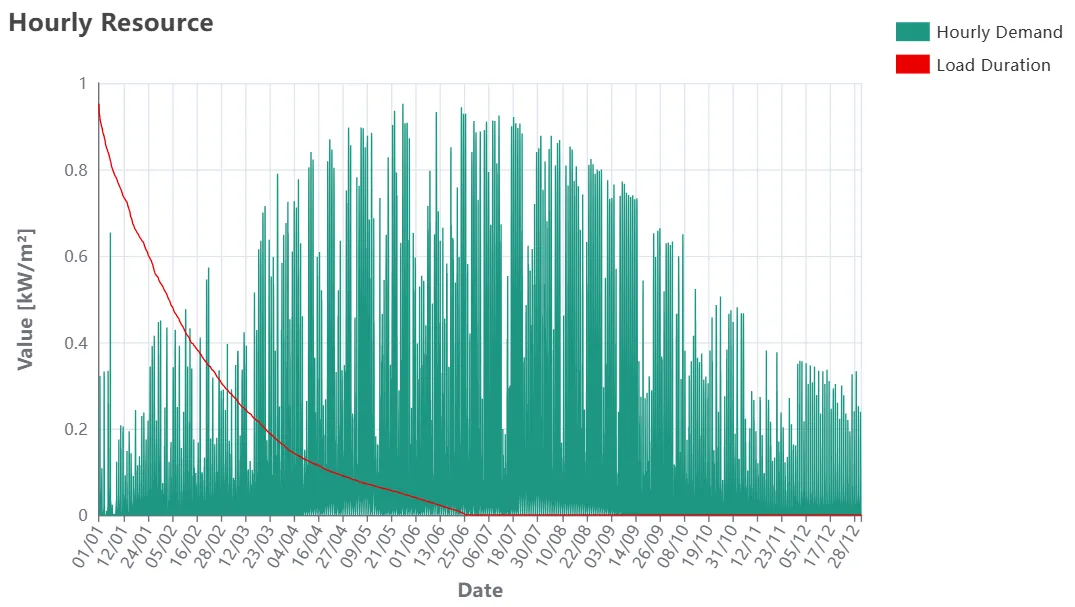
Hourly solar resource profile. Site-specific data behind every captive and storage scenario.
Trusted by industrial and site energy teams
Used by industrial sites, ports and commercial estates in Europe to weigh on-site generation, storage and grid supply before committing capital. Delivered in India with ORMAE.





How Sympheny helps
Every procurement route on one baseline
Captive, group captive, third-party PPA, rooftop plus storage, grid plus backup. One model, hourly resolution, your real load profile. The trade-offs are visible before the negotiation starts, not after the contract is signed.
Diesel displacement as an investment case
Outages cost Indian industry hundreds of millions of consumer-hours a year by CEA count. Sympheny sizes solar, storage and grid supply together so backup power becomes a costed energy-security decision instead of a standing diesel bill.
A decarbonisation pathway the board can sign
BRSR has put scope emissions on the agenda of every large listed company. The same model that picks your power mix produces the cost-per-tonne pathway, so sustainability reporting and capital planning stop being two separate documents.
What changes for C&I energy teams
| Process | Before Sympheny | With Sympheny |
|---|---|---|
| Procurement decisions | Each option arrives as a vendor proposal with its own assumptions, impossible to compare honestly | All routes modelled on the same baseline with your load data. You negotiate from your own numbers |
| Outage and backup strategy | Diesel gensets as a permanent operating cost, accepted as the price of reliability | Solar, storage and grid combinations sized against your actual outage exposure, with payback visible |
| BRSR and board reporting | Emissions reporting assembled separately from energy procurement, by different teams | One model feeds both: the procurement case and the decarbonisation pathway behind the disclosure |
| Internal sign-off | The energy manager defends vendor numbers they didn't produce | Scenario outputs your CFO can interrogate, with sensitivities on tariffs, fuel and demand growth |
Industrial sites in Europe have already run these numbers.
The procurement questions differ, the physics doesn't. See how site teams used Sympheny to compare on-site generation, storage and grid supply before committing capital.
A self-sufficient campus energy concept
Technical proof: Agri-PV, storage, and biodigester options compared
Business outcome: A viable path to 100% energy self-sufficiency without giving up agricultural land use.
Solar development strategy for the Port of Switzerland
Technical proof: 16 variants across four strategies optimised
Business outcome: Up to 20-25% cost reduction identified; lowest-risk path confirmed.
Net-zero commercial park: 75% CO₂ reduction
Technical proof: 75% CO2 reduction vs. reference scenario
Business outcome: 20% lower lifecycle cost vs. reference design.
Daniel Büchi, General Manager, Neuhof (Switzerland)“With the help of Sympheny, we have found a concept that gives us a viable path to energy self-sufficiency.”