BG Engineers
Green hydrogen production and sector coupling
60% CO₂ reduction with green hydrogen — at production cost comparable to today's diesel.
A coupled industrial-and-residential green-hydrogen feasibility study — six Pareto-optimal variants in under 10 minutes.
- Customer
- BG Engineers
- Sector
- Industry
- Location
- Western Switzerland
- Project type
- Hydrogen feasibility
- CO₂
- −60% vs fossil baseline
- Cost
- −26% life-cycle cost vs reference
- Tools
- Sympheny · MILP optimisation · Sector-coupled digital twin · Pareto comparison
Assess whether green hydrogen from on-site PV could work economically for an industrial and residential two-site system.
Modelled PV, electrolysers, hydrogen storage, batteries, heat recovery, and fossil baselines in one sector-coupled model.
Identified a 60% CO2 reduction and up to 26% lower life cycle cost, with green hydrogen production comparable to diesel cost.
The challenge
BG Group is an international engineering consulting firm with operations in Switzerland and France, advising clients on infrastructure and energy projects since 1954. For a feasibility study in Western Switzerland, their engineers needed to determine whether on-site green hydrogen production was commercially viable across two coupled sites: an industrial site with 20,000 m² available for PV and hydrogen facilities, and a residential neighbourhood of 14 multi-family houses with 3,200 m² of available rooftop.
The two sites would share a thermal network — waste heat from electrolysers and fuel cells on the industrial site could heat the residential buildings — but the design depended on dozens of interacting variables: PV sizing, H₂ storage capacity, fuel-cell economics, mobility-fuel demand from logistics trucks, and seasonal swings in renewable supply. Traditional variant-comparison methods couldn’t capture these interactions at the resolution the study required.
How Sympheny was used
BG Group’s engineers built a digital twin of the integrated industrial–residential system in Sympheny, layering in their internal economic and performance data from previous hydrogen, storage, multi-energy and mobility projects. They configured a fossil benchmark — diesel trucks, oil boilers, grid electricity — to anchor the comparison. Sympheny’s algorithm then evaluated the two-site system holistically and returned several Pareto-optimal design variants in under ten minutes.
- Sector-coupled digital twin — Modelled industrial logistics, residential heat, electricity and hydrogen as one connected system, with the thermal network linking the two sites.
- Six optimal variants — Surfaced six Pareto-optimal design configurations spanning the cost–emissions trade-off, plus the fossil reference for benchmarking.
- Roadmap to near-zero — Quantified the additional renewable resources and incremental costs needed to push beyond the 60% reduction toward near-zero emissions.
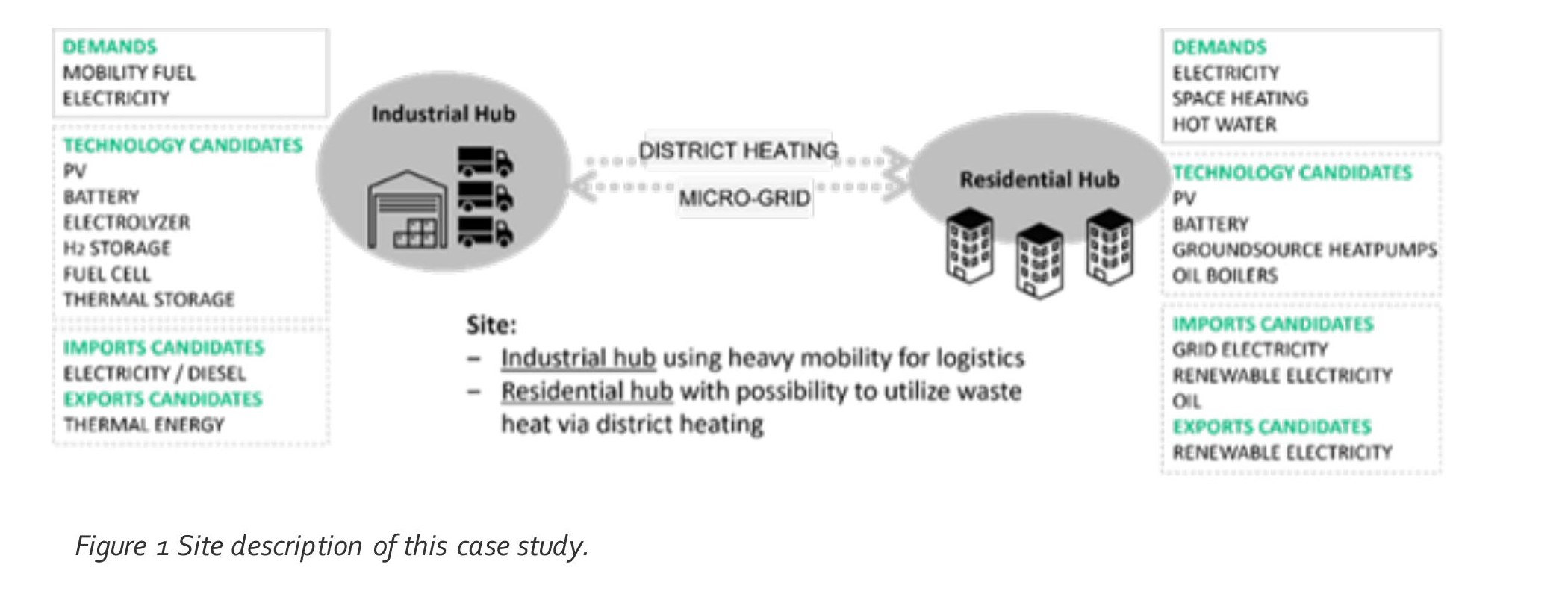
The two coupled sites modelled in Sympheny: an industrial hub for hydrogen production and heavy-mobility fuel, and a residential hub for buildings, linked by a thermal network and micro-grid.
Result
The optimal design cuts CO₂-equivalent emissions by 60% versus the fossil baseline while remaining cost-competitive: life-cycle costs land up to 26% below the reference system. Replacing 60–70% of diesel with green hydrogen produced from on-site PV is the configuration that makes the most economic sense for these two sites, and the production cost of that hydrogen — including electrolyser, compressor and storage capital — is comparable to today’s diesel price.
The seasonal logic the model surfaced is concrete: in summer, surplus PV electricity from the residential site flows to the industrial site to produce hydrogen, while waste heat from H₂ production supplies hot water back to the multi-family houses; in winter, residential PV serves direct electricity and heat-pump demand, while the industrial site draws on stored H₂ for fuel. The integrated system delivers full self-sufficiency for at least 15% of the year. BG also has a directional roadmap toward near-zero emissions, with the additional renewable build-out and cost increment quantified.
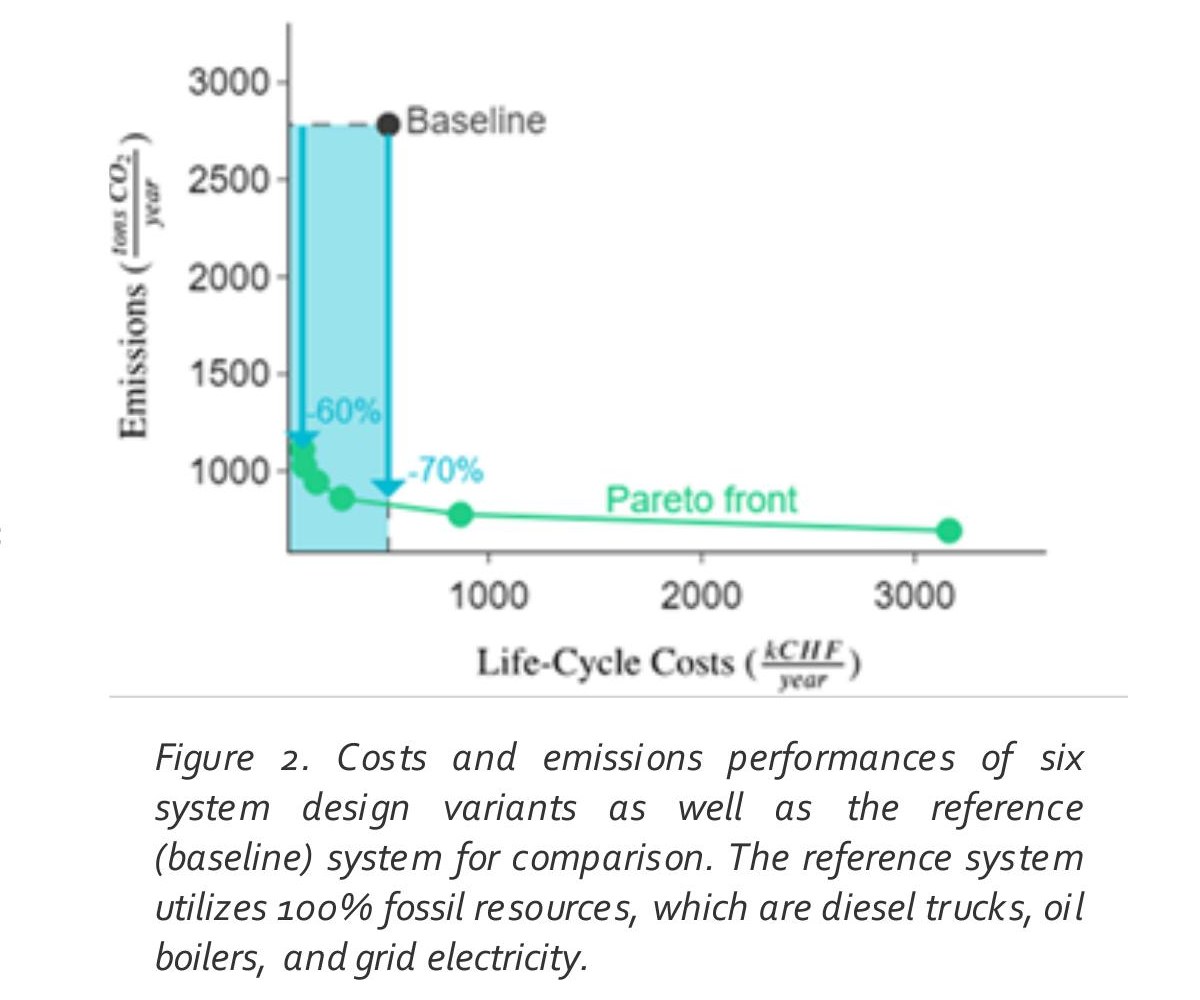
Six optimal design variants compared with the fossil reference. The most economically attractive configurations cut emissions by 60–70% relative to the baseline.
60% CO₂ reduction with life-cycle costs up to 26% below the reference system. Replacing 60–70% of diesel with green hydrogen produced from on-site PV is the most economically attractive configuration, and the production cost of that hydrogen is comparable to today's diesel.